Sogou Input Method Malware Delivers DarkVigil Spyware
A ubiquitous Chinese character utility recently became an unwitting vector for covert cyber espionage. Specifically, advanced threat actors hijacked network traffic to deploy the pervasive DarkVigil spyware framework. The malicious intrusion exploited unencrypted update mechanisms within the widely deployed desktop software. Consequently, thousands of unsuspecting enterprise users faced immediate surveillance across key Asian commercial hubs. Security analysts at ESET first detected active intrusions targeting Windows workstations in July 2026.
Hijacking Brand Promotion Mechanisms via DNS
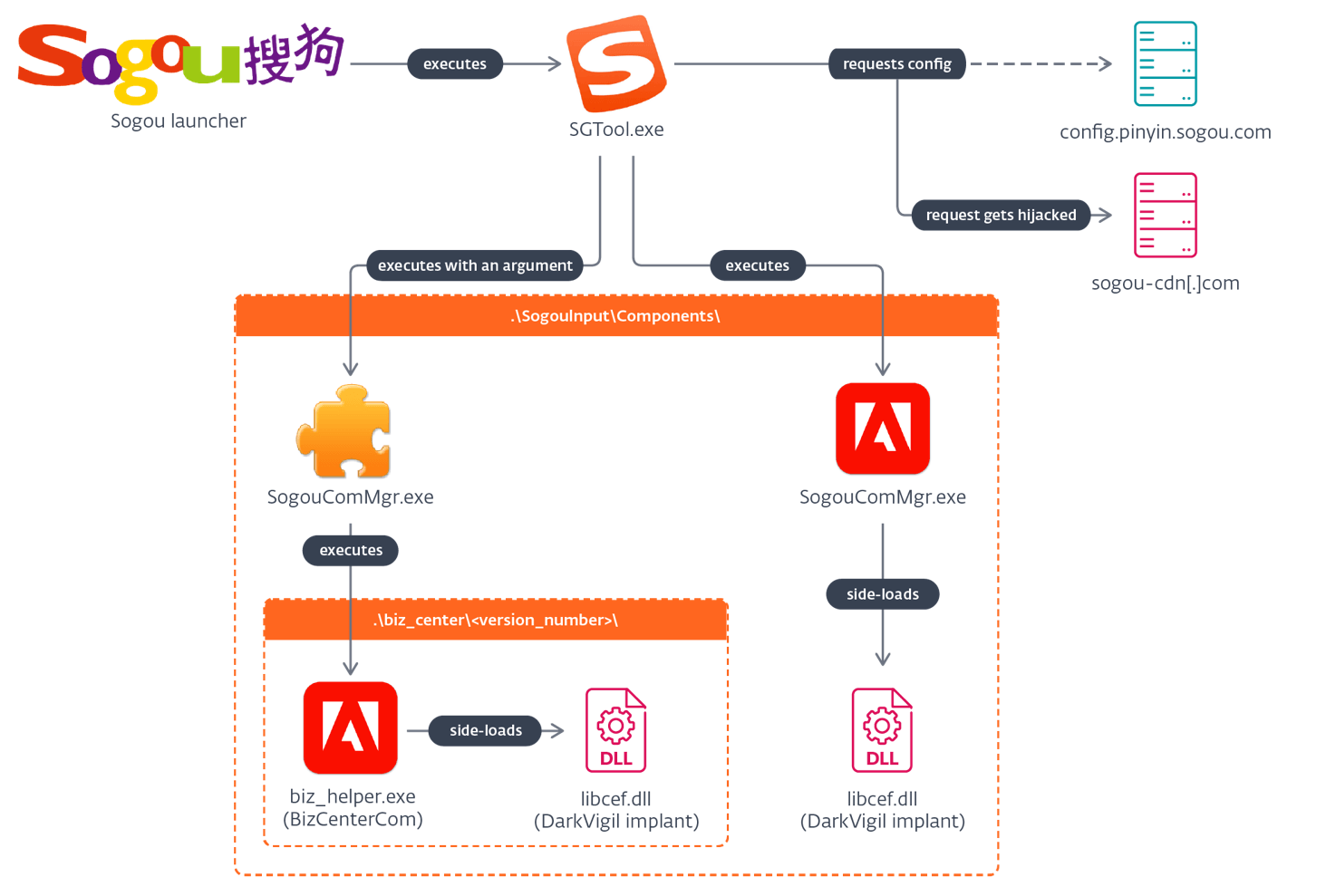
The adversary known as SlippyNunchucks compromised the application through sophisticated network redirection tactics. Specifically, the perpetrators spoofed DNS responses for the official domain config.pinyin.sogou.com. Because the auxiliary SGTool.exe component transmitted requests over unencrypted HTTP, forged servers answered inquiries directly. As detailed in the ESET research on the SlippyNunchucks Sogou hijack, attackers manipulated internal dictionary settings effortlessly.
Originally, the targeted routine retrieved benign promotional icons displayed beside predictive text recommendations. However, the forged configuration files instructed the desktop client to download remote executable archives. Although configuration records possessed internal encryption, developers hardcoded the cryptographic keys within application binaries. Therefore, adversaries decrypted and forged configuration manifests without encountering defensive obstacles.
Weaponizing DLL Side-Loading with DarkVigil
The corrupted configuration compelled Sogou to download a legitimate, cryptographically signed Adobe executable alongside a weaponized library. Specifically, attackers delivered a compromised libcef.dll file into local administrative directories. When the authentic executable initialized, it loaded the counterfeit library through classic DLL side-loading techniques. Furthermore, the threat group calculated matching MD5 checksums within the configuration payload to bypass local verification checks.
Scope of Asian Espionage Operations
Telemetry confirmed widespread compromises spanning Thailand, Japan, Vietnam, Oman, Sri Lanka, and Hong Kong. In addition, the espionage campaign focused heavily on an online gaming enterprise operating throughout Southeast Asia. The deployed DarkVigil payload represents a modular .NET surveillance platform featuring more than twenty operational plugins. Moreover, the backdoor communicates with command hubs via a proprietary DMTP protocol.
Patching CVE-2026-120422 and Defensive Hardening
Security organizations cataloged this severe transmission flaw as CVE-2026-120422 with a high CVSS rating of 8.9. In response to responsible vulnerability disclosures, Tencent deployed Sogou Input Method version 16.10. Administrators can verify these enhancements within the official Sogou Pinyin security changelog. Specifically, the patched software enforces encrypted HTTPS channels and strict digital certificate validation.
Nevertheless, defensive engineers recommend additional hardening controls for the SGTool.exe maintenance process. Workstations must enforce strict file format validation and restrict file creation permissions within application folders. Without explicit directory boundaries, local background utilities remain vulnerable to arbitrary file write attacks. Ultimately, applying verified software updates preserves endpoint integrity against persistent network manipulation.
Support Our Threat Intelligence
If you find our technology report and cybersecurity news helpful, consider supporting our work.
 Buy Me a Coffee
PayPal