LuaJIT CLoader Bot Malware Targets Thai Organizations via Fake Purchase Order Emails
TL;DR
On November 23, 2026, Seqrite Labs uncovered an active CLoader bot malware campaign targeting organizations and individuals in Thailand through spear-phishing emails. Attackers hide obfuscated JavaScript inside fake purchase order archives to launch a standalone LuaJIT interpreter on Windows hosts. Once active, this LuaJIT CLoader bot malware disables Windows Defender checks, pulls command settings from Pastebin, and runs remote payloads.
Delivery and Attribution
The campaign begins with Thai-language spear-phishing emails disguised as urgent purchase orders sent to corporate sales teams. Each email carries an LHA archive using a double-extension trick (.pdf.lha) to mimic a standard business PDF. When a victim extracts the archive, they find an obfuscated JavaScript file ending in .pdf.JS.
Neither confirmed attribution nor suspected attribution connects this operation to a known threat group. Researchers at Seqrite Labs, along with subsequent threat bulletins from Broadcom and SOCRadar, did not report a specific victim count. However, SOCRadar telemetry shows that at least one associated file hash first appeared in the wild in August 2026.
Infection Chain
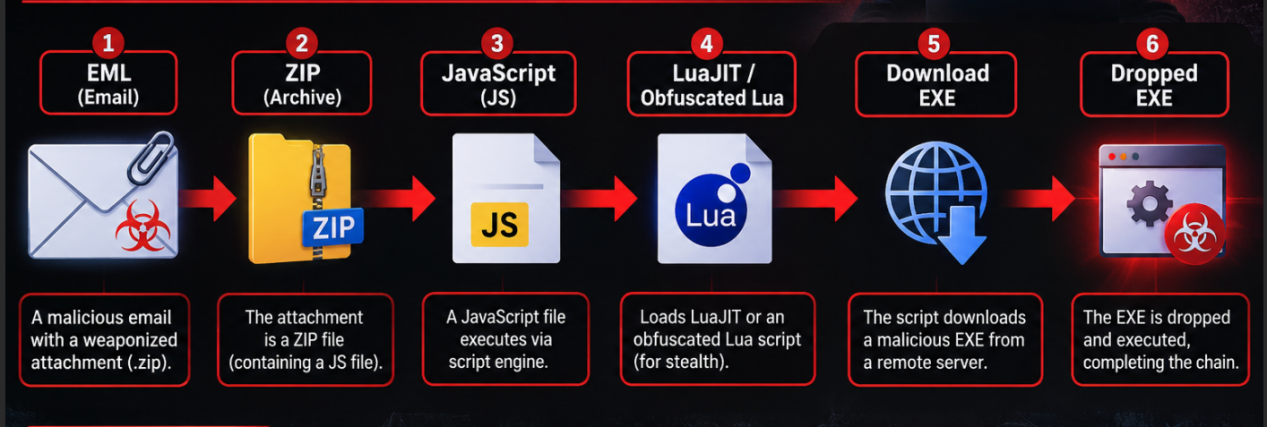
When a user clicks the disguised JavaScript file, the script drops two files into the local Documents folder. The first file is a standalone build of the LuaJIT 2.1.0-beta3 interpreter given a random uppercase name. The second file is a heavily obfuscated Lua script. According to the Seqrite Labs research report, “Notably, it uses a LuaJIT executable bundled with an obfuscated Lua script to conceal its malicious activities and reduce the likelihood of detection.”
Next, the JavaScript passes the obfuscated script to the LuaJIT engine for execution. The Lua stage contacts an initial server and then pulls a UPX-packed executable from a secondary domain into the local temporary directory, changing the filename on each run to evade static signatures. Once unpacked in memory, that loader decodes the final CLoader bot malware from its PE resource section and writes it to a random temporary subfolder under the misspelled name SecurtyHeathService.exe.
Command-and-Control and Execution Behavior
Upon launch, the bot creates a mutex named CLOADER_MUTEX_1_1_1_7 to prevent duplicate infections. To survive reboots, it masquerades as the legitimate Windows SecurityHealthAgent by registering both a logon scheduled task and a Registry Run key. It also uses PowerShell to add itself to Windows Defender exclusion lists.
For command-and-control, the LuaJIT CLoader bot malware fetches its primary configuration from a raw Pastebin URL and maintains a secondary channel over TCP port 31104. If the bot detects packet sniffers or debugging tools such as Wireshark, dumpcap, or LivePort, it generates fake traffic toward Microsoft and Google DNS servers to mislead analysts. As the report explains, “Furthermore, it supports multiple execution mechanisms, including PSRUN, BYRUN, and RUNFILE, which enable it to download and execute additional payloads from its C2 server.”
Defense and Detection Guidance
Organizations in Thailand should block LHA and JavaScript email attachments at the mail gateway and train sales staff to verify purchase order filenames for double extensions. Security teams should hunt for unexpected LuaJIT binaries running from user Documents folders and alert on PowerShell commands modifying Windows Defender exclusions. Finally, defenders should audit Task Scheduler and Registry Run keys for unauthorized SecurityHealthAgent entries and monitor outbound traffic for suspicious Pastebin lookups or connections on TCP port 31104.
Support Our Threat Intelligence
If you find our technology report and cybersecurity news helpful, consider supporting our work.
 Buy Me a Coffee
PayPal