Optimizely Supply Chain Attack Hits 178 Global Brands
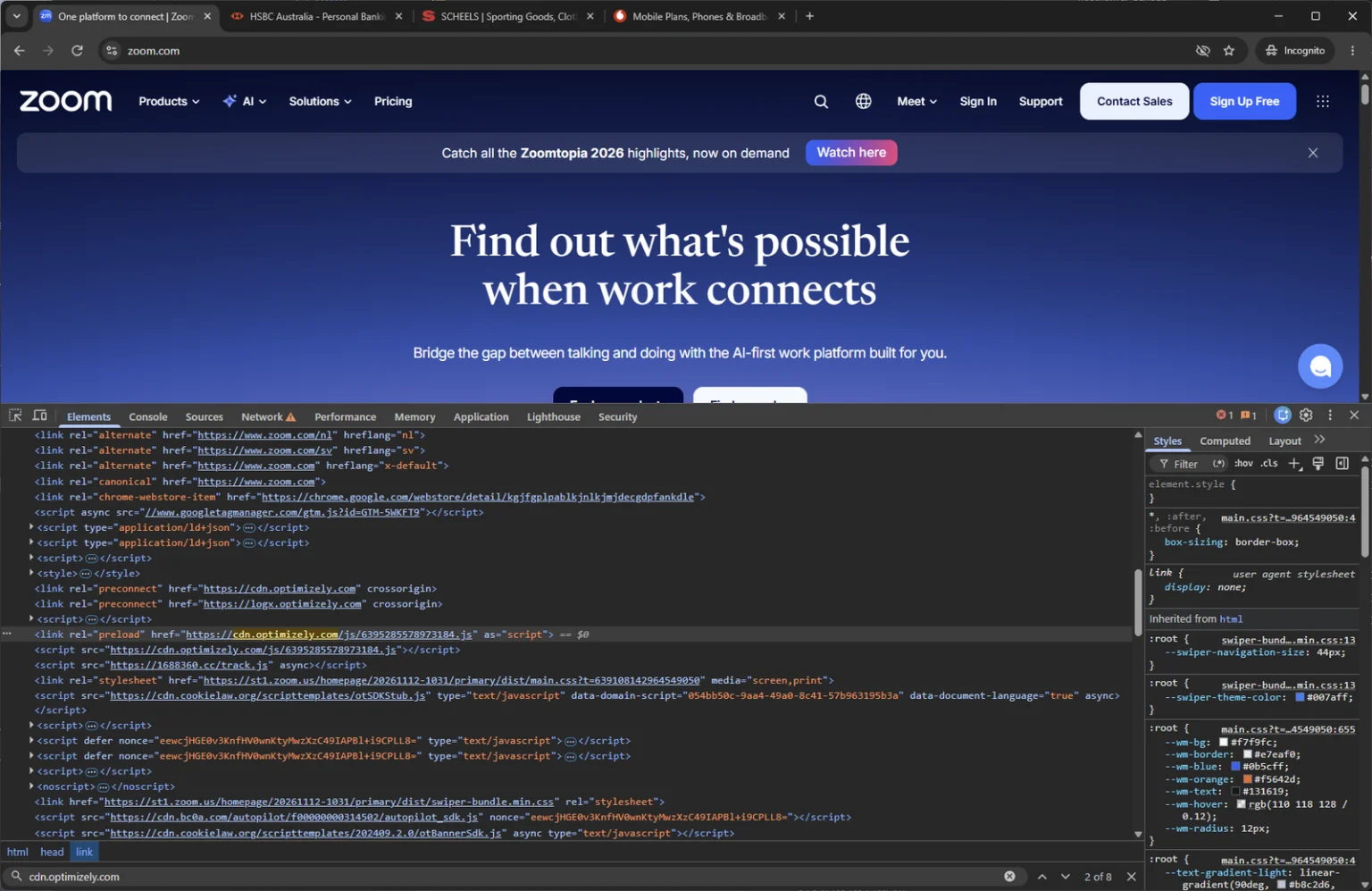
Last night, researchers at Report URI uncovered a sweeping security breach during routine web monitoring. Specifically, this massive Optimizely supply chain attack compromised 178 prominent global organizations, including BBC, CNN, HSBC, Salesforce, GitLab, and IKEA. Threat actors tampered with website assets to load malicious JavaScript payloads automatically. Furthermore, the injected scripts deploy the DarkSword exploit framework against visitors running outdated iOS versions 13 through 18.x. Primarily, attackers launched this campaign to steal cryptocurrency wallets and banking credentials. Because all targeted websites rely on Optimizely services, hackers leveraged a vendor flaw to poison sites at scale.
Malicious Code Injected Into Optimizely Client Projects
Organizations use Optimizely Web to run website experiments and deliver personalized user experiences. Typically, customers insert custom code inside the Project JavaScript field, which websites load directly from the Optimizely CDN. Consequently, those hosted scripts execute automatically inside every visitor’s web browser. In a subsequent status update, Optimizely confirmed that attackers exploited a vulnerability within its experimentation product. As a result, intruders injected unauthorized JavaScript directly into client projects. Because these payloads arrived alongside legitimate Optimizely scripts, standard browsing traffic showed no obvious signs of tampering.
Rapid Payload Evolution and Multi-Stage Capabilities
According to the Report URI investigation into the Optimizely supply chain breach, researchers first spotted malicious code on BBC scripts at 04:21 UTC on November 16. By 08:28 UTC, BBC webpages began fetching an external payload from 1688360[.]cc/track.js. Throughout the day, attackers rapidly iterated on their malware, deploying 26 distinct versions. For instance, hackers added a payment card skimmer module at 13:43 UTC. Later, they integrated the DarkSword exploit framework to target unpatched Apple mobile devices.
Cryptocurrency Clipping, Card Skimming, and iOS Exploits
The multi-purpose payload first profiles visitors by collecting operating system versions and browser details. Based on that fingerprint, the script executes three targeted theft routines:
- Cryptocurrency Address Replacement: The malware scans webpage text, forms, links, clipboards, and network requests for valid wallet addresses. Whenever it detects a wallet, it swaps the string with an attacker-controlled address. Moreover, it monitors clipboard copy events to replace addresses silently in real time.
- Payment Card Harvesting: The skimmer inspects custom checkout forms and outgoing requests for validated credit card numbers, expiration dates, and CVV codes. Subsequently, it exfiltrates stolen payment details to remote attacker servers.
- Targeting iOS 13 through 18.x: Depending on the visitor’s iOS version, the script loads specialized .icu domains and hidden landing pages. Specifically, devices running iOS 13 to 17 route toward Coruna exploit paths, while iOS 18.x devices trigger DarkSword payloads.
Remediation Progress and Content Security Policy Defenses
On November 17, Optimizely announced that engineers patched the underlying product flaw and purged injected code from client projects. Additionally, the company secured compromised accounts and implemented stricter controls to block unauthorized script publishing. Nevertheless, the campaign exposed hundreds of thousands, and potentially millions, of global visitors before containment.
Fortunately, strong Content Security Policy (CSP) configurations mitigated the attack across several websites. Investigators noted that strict CSP rules blocked script execution entirely on 24 affected domains. On another 17 sites, connect-src directives prevented data exfiltration, although clipboard wallet swapping still functioned locally.
Urgent Guidance for Site Operators and Visitors
Administrators using Optimizely Web must audit every project’s Project JavaScript and custom experiment code immediately. Specifically, security teams should hunt for 1688360[.]cc, .icu domains, atob() obfuscation, and unfamiliar scripts. Furthermore, operators must review user accounts, API tokens, and integration write permissions. Meanwhile, visitors who browsed affected platforms should verify recent cryptocurrency transactions and bank statements. Finally, iPhone and iPad owners must update to the latest iOS release immediately.
Notable Organizations Impacted by the Incident
The compromised infrastructure spanned major media, financial, retail, and technology brands worldwide:
- HSBC Branches: United States, Hong Kong, Mexico, Singapore, Australia, UAE, Malaysia, Vietnam, Egypt, and the Philippines
- Media and Publishing: BBC, CNN, Fox, Bloomberg
- Technology and Telecom: Zoom, Bitly, Salesforce, GitLab, Fluke, O2, Vodafone Australia
- Retail, Travel, and Industrial: IKEA, Alaska Airlines, Honeywell Home, Heineken, Chamberlain University, Levi’s
Support Our Threat Intelligence
If you find our technology report and cybersecurity news helpful, consider supporting our work.
 Buy Me a Coffee
PayPal