High-Volume Phishing Campaign Uses Microsoft 365 Outage Lures to Target Enterprises
TL;DR
On November 13, 2026, security researchers detected a global wave of Microsoft 365 outage phishing targeting enterprises across multiple sectors. Attackers sent fake service-health alerts claiming that held business emails would be deleted within 24 hours unless recipients clicked a recovery link. While automated filters quarantined the Microsoft 365 outage phishing lures, defenders warn that entering credentials could lead to account takeovers and business email compromise.
What Happened in the Campaign
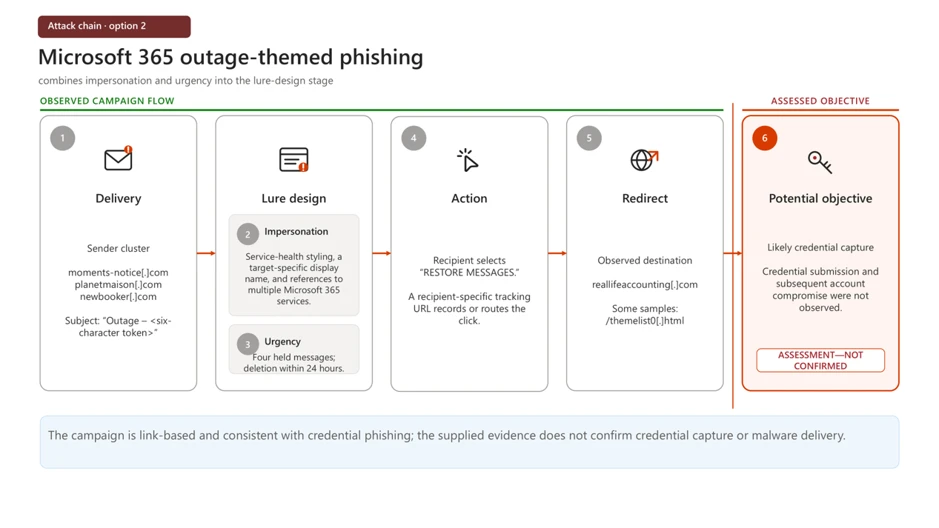
On November 13, 2026, attackers launched a massive email wave posing as urgent IT service notifications. According to an alert on the high-volume phishing campaign using Microsoft 365 outage lures from Microsoft Threat Intelligence, the messages claimed an Exchange Online disruption on November 12 had trapped four incoming emails. Furthermore, the lures warned that the held messages would be permanently deleted within 24 hours unless the user clicked a “RESTORE MESSAGES” or “TAKE ACTION” button.
“The messages created a false sense of urgency by claiming that emails had been held during a service disruption and would be deleted within 24 hours unless the recipient took action to restore them,” Microsoft researchers wrote. To bypass spam filters, the emails used randomized subject lines like “Outage – aF7vG6” alongside display names featuring three-letter prefixes such as “MSF Outage Notification” or “AMZ Service Health.”
Evasion Tactics and Redirect Chains
The attackers sent the messages from a cluster of distinct domains, including moments-notice.com, planetmaison.com, and newbooker.com. Inside the email body, the operators embedded a hidden fake email conversation to confuse text-based mail filters while referencing Outlook, Teams, SharePoint, and Copilot.
When a recipient clicked the recovery button, a personalized tracking URL routed their browser to an external site at reallifeaccounting.com or reallifeaccounting.com/themelist0.html. Notably, the emails did not contain QR codes or malicious file attachments.
Who Is Behind the Activity
Microsoft has not attributed the Microsoft 365 outage phishing operation to a specific threat actor or malware family, assessing with moderate confidence that the campaign aimed to harvest login credentials. “The off-brand destination and Microsoft 365 impersonation support an assessment of likely credential phishing, but the available evidence did not include the final page source, credential fields, credential-submission telemetry, or post-compromise activity,” the report stated. Broader advisories from the Cybersecurity and Infrastructure Security Agency (CISA) similarly note that opportunistic threat groups routinely exploit real-world IT outages to trick employees into surrendering cloud passwords.
Impact and How Organizations Can Stay Protected
Although Microsoft Defender for Office 365 blocked the malicious domains and quarantined the emails before post-compromise activity occurred, successful credential theft exposes victims to severe risks. Compromised accounts allow intruders to read sensitive mailboxes, create hidden inbox-forwarding rules, and launch internal business email compromise attacks.
Recommended Defense Steps
To defend against Microsoft 365 outage phishing lures, administrators should search mail logs for messages from moments-notice.com, planetmaison.com, and newbooker.com and block network traffic to reallifeaccounting.com. If an employee clicked a link, security teams must reset their password, revoke active session tokens, and audit Exchange Online for unauthorized inbox rules or OAuth apps. Finally, IT teams should remind staff that official service-health alerts never direct users to third-party domains and must be verified inside the Microsoft 365 admin center.
Support Our Threat Intelligence
If you find our technology report and cybersecurity news helpful, consider supporting our work.
 Buy Me a Coffee
PayPal