GT13 Check Point Intrusion Campaign Hits 22 Organizations

TL;DR
Between October 17 and November 2, 2026, an active Check Point intrusion campaign hit at least 22 global firms. Analysts track the suspected group as GreyNoise Threat 13 (GT13). The crew used 99 IP addresses, a hijacked relay host, and CVE-2026-16232 to steal firewall data and probe inside networks.
What Happened
GreyNoise caught the Check Point intrusion campaign through its Global Observation Grid sensor grid. In its full technical threat report, the firm logged over 1,400 sessions, 800 commands, and 1,200 files. Notably, the crew already held access to victim Check Point hosts before they built their relay box.
Hijacking the Relay Box
On October 2, 2026, the actor scanned a Rejetto HTTP File Server (HFS) and abused CVE-2026-61500. They sent fast login calls to guess JavaScript math outputs and forge an admin cookie. Next, they placed an SSH root key on October 5 to keep access. On October 19, they tried to pull a Linux tool named ZULT from newpayapp[.]com, yet the fetch failed.
Instead of stopping, the crew came back via SSH on October 20 to build a relay hop. They ran a Python web script and a Chisel reverse proxy on port 9000. Soon after, stolen route scans from a breached Check Point box hit the hop.
Hitting Check Point and Internal Hosts
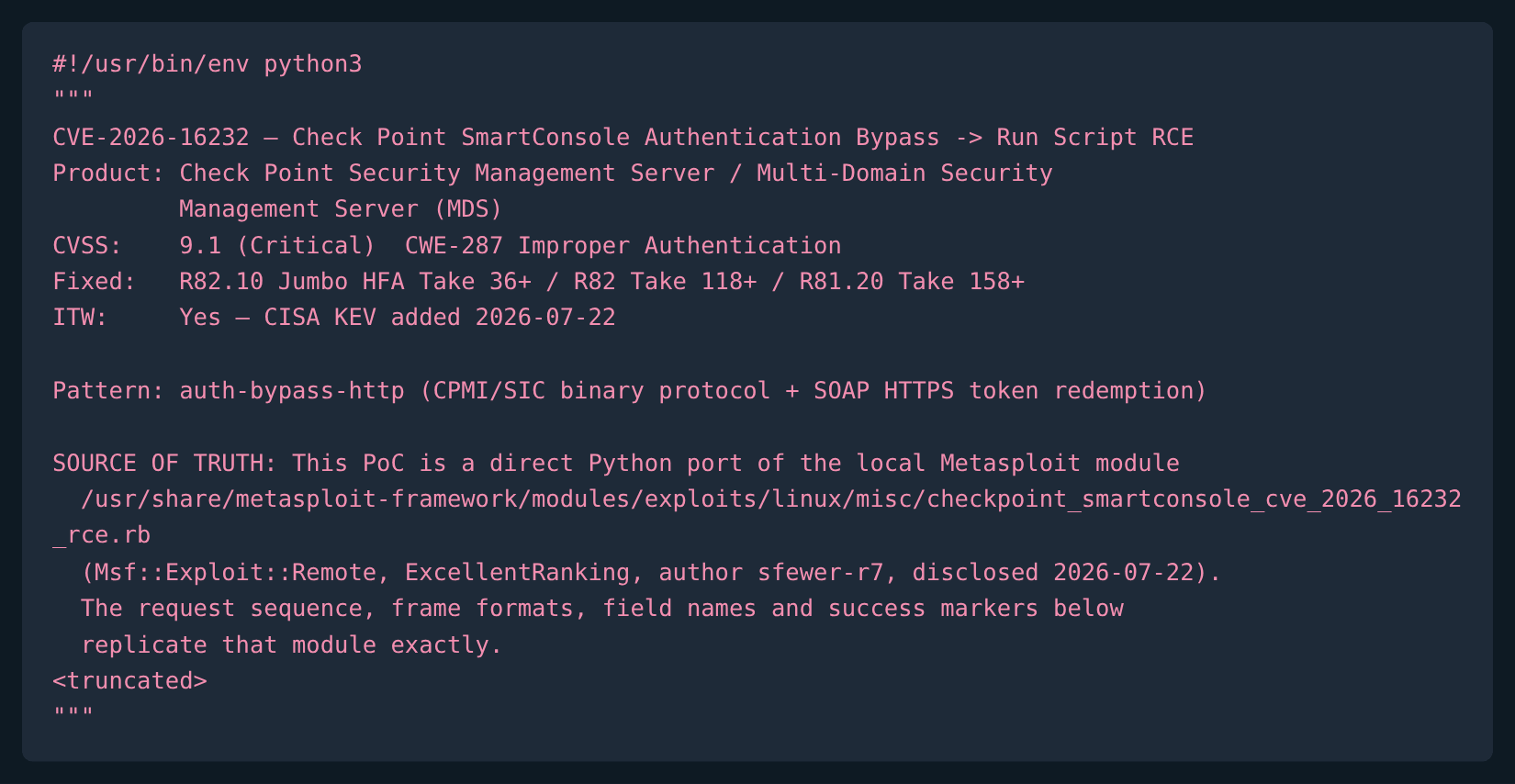
Over the Chisel tunnel, GT13 ran more than 100 admin tasks on breached hosts at Victim A. They used a Python port of a Metasploit tool for CVE-2026-16232, a Check Point SmartConsole auth bypass. Per Check Point note sk185169 and CISA’s KEV list, attackers first hit this bug in July 2026. Remote abuse works on web-facing hosts that lack Trusted Clients limits.
Once inside, the crew stole firewall data, internal CA keys, and user hashes. They also made a rogue cert and turned off firewall rules on October 21. Next, they scanned inside hosts for older bugs in Citrix, Ivanti, Exchange, and VMware vCenter. They even ran password sprays with custom lists made for the victim.
On October 26, the actor pushed a bulk cert task to 24 breached Check Point hosts in IP order. Each task hit a syntax error, yet the error logs still went to the hop. One log showed a preload error for /usr/lib/.libproc.so, hinting at a hidden Linux implant. Later, on November 2, GT13 checked its own hop for a Linux bug (CVE-2026-98432). They then ran nftables rules to lock rival crews out.
Who Is Behind It
Trust in group naming stays low because no firm has tied GreyNoise Threat 13 to a known crew or state. GreyNoise said, “We do not attribute GT13 to any known or publicly tracked threat group at this time.” The firm also noted it lacks enough data to judge the actor’s goal or home state.
Still, clear signs point to AI-backed tools. GreyNoise stated, “We suspect the GT13 actor has a mature AI-enabled offensive apparatus.” Analysts think agent tools ran scans, built code, and set up hops. Meanwhile, live typing pauses lined up with UTC+7 or UTC+8 work hours. The ZULT domain also listed Hai Phong, Vietnam on its March 2026 signup. Even so, GreyNoise warned that time zones and signup data are weak clues alone.
Impact and Scale
This Check Point intrusion campaign hit 24 admin servers across 22 firms in 17 nations. Hit nations include the US, UK, Germany, France, India, Vietnam, South Korea, and Australia. Victims also span finance, energy, state agencies, transport, mining, and factories. As CSO Online noted, taking an admin server lets a hacker change rules on every linked firewall.
What Comes Next and How to Stay Safe
GreyNoise lost direct view on November 2, 2026, yet analysts warn the risk is still live. The team wrote, “Given the actor’s persistent access to victim Check Point devices, we expect that this intrusion campaign is ongoing.” GreyNoise now shares threat data with global CERTs and state teams to warn victims.
Steps for Network Defenders
First, patch Check Point Security Management Servers using Jumbo Hotfix builds from note sk185169. Apply R82.10 Take 36+, R82 Take 118+, or R81.20 Take 158+ right away. Second, block public web reach to admin ports and limit Trusted Clients to known IPs. Third, check SmartConsole logs for odd tasks, new certs, or dropped rules. Finally, swap admin keys and check Linux hosts for rogue SSH keys or /etc/ld.so.preload edits to stop GreyNoise Threat 13.
Support Our Threat Intelligence
If you find our technology report and cybersecurity news helpful, consider supporting our work.
 Buy Me a Coffee
PayPal