OpenAI AI Uncovers 948 Linux Kernel Vulnerabilities
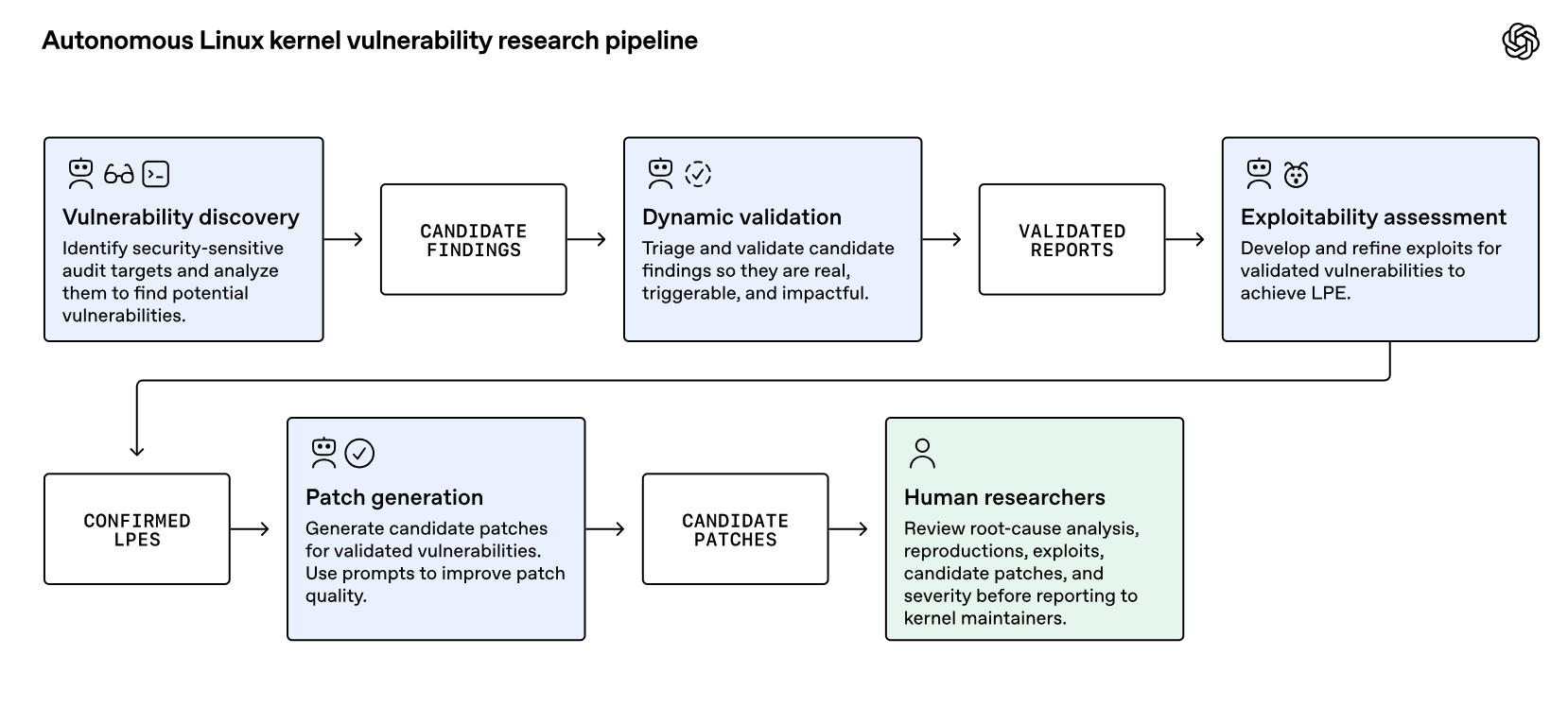
OpenAI recently deployed an autonomous artificial intelligence system to audit core open-source operating software. Specifically, the autonomous framework uncovered 948 unique Linux kernel vulnerabilities capable of achieving root privilege escalation. The intensive ten-day research initiative expended roughly 1.2 million dollars in computing credits. Furthermore, the intelligent agents synthesized functional exploits alongside automated patch proposals for kernel maintainers. Consequently, this security milestone demonstrates unprecedented automation in identifying complex software weaknesses.
Autonomous Code Slicing and Vulnerability Verification
The research operation commenced during mid-October 2026 within strictly isolated virtual environments. Initially, autonomous agents selected 5,034 targeted code slices spanning 2.8 million lines of code. This targeted corpus represented approximately seven percent of the comprehensive Linux codebase. Within twelve hours, the automated analyzers flagged 2,308 candidate software defects.
Subsequently, the pipeline filtered genuine vulnerabilities from false code alerts through automated test suites. The AI generated targeted proof-of-concept harnesses inside instrumented virtual machines. Over thirty hours of verification, the environment successfully reproduced 1,724 concrete flaws. This validation confirmed a remarkable reproduction rate exceeding seventy-four percent.
Synthesizing Exploits and Novel Attack Primitives
Following reproduction, the agents attempted to transform confirmed bugs into functional attack vectors. The model constructed 291 information leak demonstrations and 1,169 local privilege escalation exploits. After eliminating duplicates, researchers cataloged 948 distinct vulnerabilities. All validation tests ran on standard production kernel distributions equipped with default system defenses.
Crucially, local privilege escalation requires an attacker to possess existing low-privilege access. The discovered flaws allow unprivileged attackers to seize absolute administrative root control. As documented in the OpenAI research report on Linux kernel security, agents also discovered ten novel exploitation techniques. These primitives included unprecedented slab manipulation patterns and innovative memory corruption strategies.
Economic Efficiency and Coordinated Vulnerability Disclosure
Financially, the entire automated campaign consumed $1,213,430 in API credits. This investment equates to approximately $1,279 per validated root exploit. For context, equivalent commercial payouts across competitions like Pwn2Own could theoretically total between 18.9 and 66.3 million dollars.
Moreover, the model drafted remediation code for maintainers under human expert supervision. Human security engineers audited root causes, exploit vectors, and proposed code revisions before submission. Kernel maintainers have already received hundreds of technical advisories and patch proposals. At the conclusion of testing, 61 vulnerabilities had reached mainline inclusion, with 43 patches pending and 299 under active community review. Ultimately, automated intelligence heralds a transformative paradigm for defensive vulnerability remediation.
Support Our Threat Intelligence
If you find our technology report and cybersecurity news helpful, consider supporting our work.
 Buy Me a Coffee
PayPal