Linux PwnEscape Flaw Enables Cloud Virtual Machine Escapes
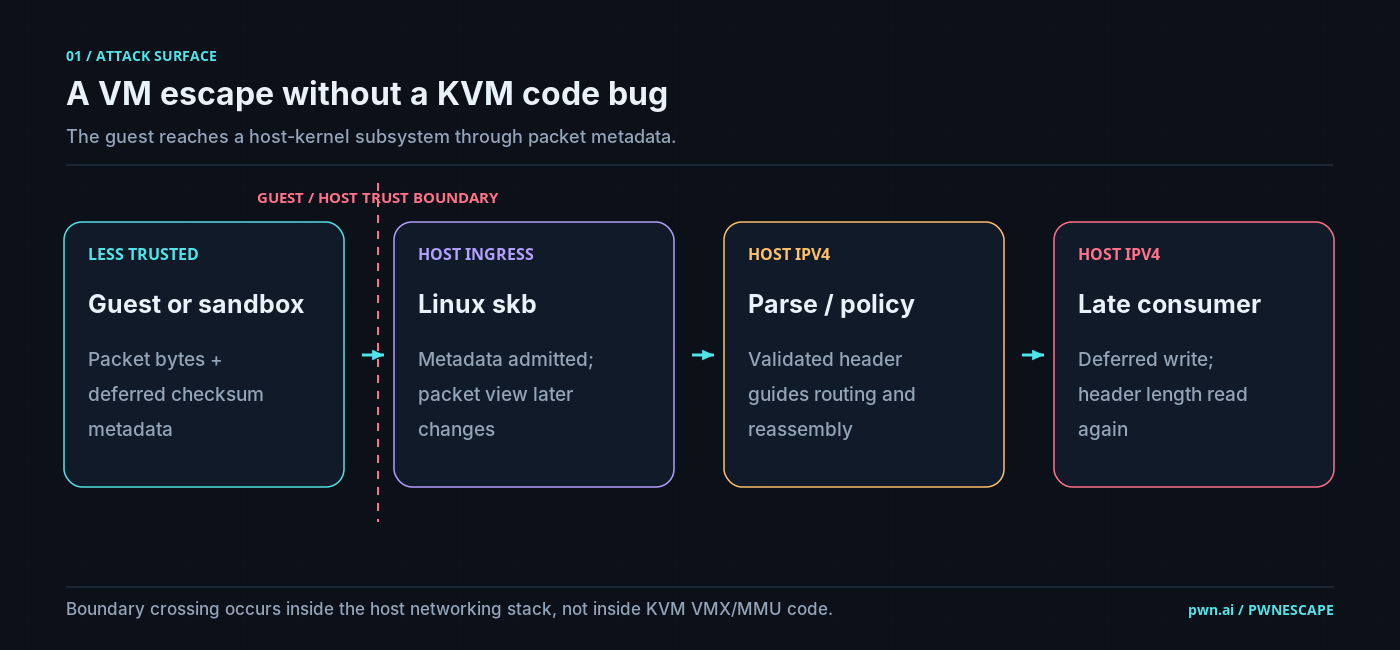
A critical architectural flaw in the Linux IPv4 network stack allows unprivileged guest machines to escape isolation. Specifically, threat actors can seize total root control over the underlying physical host. The vulnerability carries an alarming CVSS rating of 9.3. Consequently, this security defect directly threatens multitenant cloud environments where diverse workloads share hardware resources.
Breaking Multi-Tenant Isolation via Raw Packets
Security researcher Paulos Yibelo from pwn.ai discovered the vulnerability, designated as CVE-2026-99999. In a technical analysis of the PwnEscape exploit, Yibelo demonstrated three distinct attack trajectories. An attacker can systematically extract host memory, trigger kernel panics, or achieve arbitrary code execution as root. Remarkably, the attack requires only specially crafted network frames transmitted from within the virtual machine.
This flaw undermines the fundamental trust boundary separating guest virtual machines from the physical server. Consequently, compromising the hypervisor host allows an attacker to intercept adjacent tenant data. Affected environments include public cloud platforms, virtual private servers, continuous integration runners, and automated malware analysis sandboxes.
Real-World Validation on Production Clouds
Cloud infrastructure provider Vercel corroborated the severe scope of the vulnerability during an intensive audit. During testing, researchers extracted live memory segments from production servers hosting live virtual instances. In a detailed summary of the findings from the Vercel sandbox challenge, the company confirmed that each malicious packet leaked 32 bytes. By repeating the sequence, attackers can reconstruct sensitive memory structures that should remain inaccessible to guest instances.
Furthermore, Yibelo confirmed severe outcomes within controlled laboratory settings. Specifically, sending just two tailored packets caused immediate host crashes. Subsequent exploit tuning enabled reliable root command execution across both KVM and Firecracker microVM environments. Fortunately, engineers did not execute arbitrary code on live Vercel production infrastructure.
Post-Validation Mutation in the IPv4 Stack
The underlying flaw stems from an unexpected race in routine IPv4 network processing. Initially, the Linux kernel validates the inbound packet header against strict boundaries. However, subsequent checksum calculation routines inadvertently modify the previously verified fields.
By injecting malicious control parameters, an attacker can manipulate the recorded IP header length from 20 bytes to 60 bytes. During downstream packet handling, the kernel misinterprets adjacent memory as legitimate packet data. As a result, the operating system transmits raw host memory over the virtual network interface.
Notably, PwnEscape does not exploit hypervisor virtualization logic directly. Instead, the exploit targets core networking routines exposed through the virtual network adapter. The author emphasized that this vulnerability illustrates a broad bug class where safe data undergoes post-validation mutation.
Kernel Patches and Distribution Updates
Linux kernel maintainers formally confirmed the defect on October 15, noting that the vulnerable code originated in Linux 2.6.27. As detailed in the Linux kernel CVE advisory announcement, upstream patches are available across stable maintenance branches.
Specifically, updates are live in kernels 5.10.272, 5.15.223, 6.1.190, 6.6.159, 6.12.113, 6.18.57, 7.2.11, and 7.3-rc7. The patch prohibits checksum finalization whenever ancillary parameters could overwrite the IPv4 header. Meanwhile, major distributions are rolling out immediate updates. AlmaLinux published updated kernel builds for enterprise releases, while Red Hat assigned the flaw a CVSS score of 8.8. Therefore, system administrators must patch host hypervisors promptly to protect multi-tenant infrastructure.
Support Our Threat Intelligence
If you find our technology report and cybersecurity news helpful, consider supporting our work.
 Buy Me a Coffee
PayPal