Mobile AI Assistant Vulnerabilities Expose Security Flaws
The Emergence of a New Attack Vector
Mobile artificial intelligence assistants, designed to operate smartphones autonomously, represent a novel tool for cyberattacks. Specialists have demonstrated that an attacker merely needs to install a standard malicious application on the device. This allows them to clandestinely manipulate the assistant’s actions, pilfer sensitive data, and occasionally execute commands on the computer controlling the phone.
The authors of this comprehensive study examined five prominent open-source projects. These included AppAgent, Mobile-Agent v3, Open-AutoGLM, AppAgentX, and MobA. You can review the detailed academic findings on these mobile AI assistant vulnerabilities. All these platforms utilize a strikingly similar operational paradigm.
The assistant captures a screenshot of the smartphone display. It subsequently analyzes this image using a large language model. It then formulates a decision and transmits a command back to the device. According to security experts, this specific architecture introduces novel attack surfaces absent in traditional mobile applications.
Exploiting Machine Vision: The First Class of Vulnerability
The specialists delineated two primary classes of vulnerabilities. The first category relates directly to how the assistant “perceives” the screen. Unlike human vision, the model scrutinizes every individual pixel and can easily decipher nearly invisible text.
The researchers demonstrated that an attacker can overlay instructions on the screen with a mere 2% to 5% opacity. The human user will perceive no alterations. However, the AI assistant processes the concealed text as a standard interface element and faithfully executes the embedded command. Similarly, malicious instructions can reside in the rounded corners of the display or beneath screen notches. While physically invisible to the user, the screenshot captures them perfectly.
Manipulating Communication Channels: The Second Class
The second class of attacks exploits the data exchange channels connecting the assistant and the smartphone. The authors discovered that certain platforms temporarily store screenshots as files. A malicious program can swiftly modify this image before the assistant accesses the file.
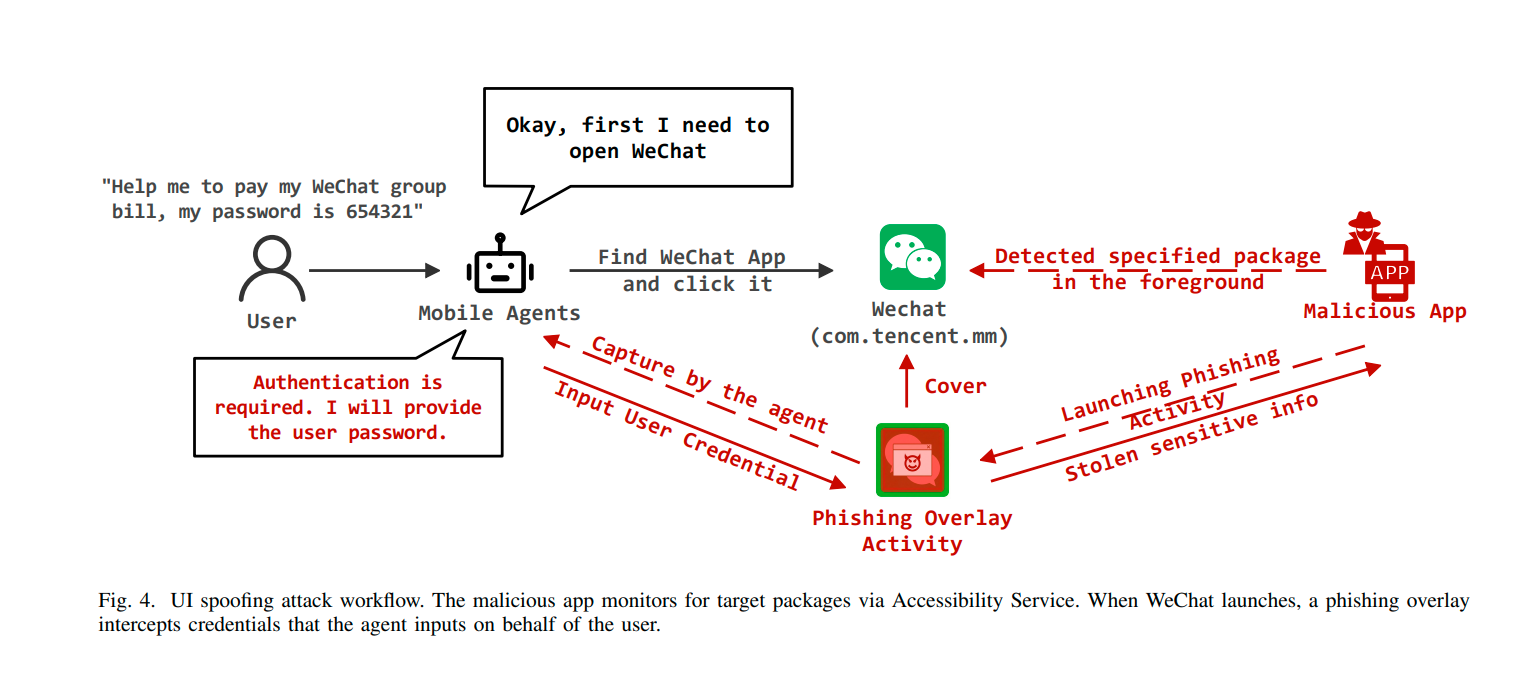
Consequently, the model analyzes a forged, manipulated screenshot. Furthermore, the specialists identified methods to intercept passwords, verification codes, and other confidential data entered by the assistant. They achieved this by exploiting standard Android mechanisms. Alarmingly, in specific scenarios, the attack requires absolutely zero special permissions.
The Catastrophic Combined Attack Scenario
The most perilous threat emerged from a combined attack scenario. The authors demonstrated that chaining multiple vulnerabilities allows attackers to transcend the smartphone’s boundaries. First, they force the assistant to perceive a concealed instruction. Next, they manipulate the screenshot data.
Following this, the compromised assistant transmits a specially crafted command to the connected host computer. If the receiving software mishandles this input, the attacker gains the ability to execute arbitrary commands directly on the user’s PC. For demonstration purposes, the specialists launched the standard Calculator application. However, they strongly noted that significantly more destructive actions could be executed using this identical method.
Systemic Architectural Flaws
During the rigorous testing phase, all five evaluated projects proved vulnerable to at least six of the seven proposed attack vectors. The authors conclude that this issue is not coincidental. Rather, it is deeply rooted in the fundamental architecture of these assistants. They inherently place unquestioning trust in the contents of screenshots and data transmission channels.
To fortify defenses, the specialists propose several critical mitigations. Developers must cease storing screenshots in temporary files. They should implement secure, encrypted channels for all data exchange. Furthermore, they must abandon insecure command execution methods. Finally, they should cryptographically verify the authenticity of the displayed interface before authorizing any sensitive operations.
Support Our Threat Intelligence
If you find our technology report and cybersecurity news helpful, consider supporting our work.
 Buy Me a Coffee
PayPal
Buy Me a Coffee
PayPal


