Rapid Exploitation of Critical Atlassian Flaw
Hackers launched attacks against Atlassian servers utilizing the critical CVE-2026-21589 vulnerability a mere two hours after experts published a technical breakdown and proof-of-concept code. This egregious flaw afflicts eight prominent enterprise products, including Jira, Confluence, and Bitbucket. Alarmingly, in specific configurations, it permits unauthorized individuals to seize full administrative privileges.
Early Detection and the Scope of the Threat
The cybersecurity firm Previdian detected the initial exploitation attempts across a network of specialized honeypot servers designed to monitor malicious activities. Researcher Ryan Dewhurst reported that suspicious queries materialized within two hours following the publication of the watchTowr analysis. By October 7, specialists had identified distinct attacks originating from three separate IP addresses. Currently, these represent confirmed exploitation attempts rather than verified compromises of actual corporate systems.
Atlassian officially disclosed CVE-2026-21589 on October 5, simultaneously releasing vital patches. The vulnerability garnered a staggering severity score of 9.3 out of 10 on the CVSS 4.0 scale. The threatened landscape includes self-hosted deployments of Bitbucket Data Center, Confluence Data Center, Jira Software Data Center, Jira Service Management Data Center, Bamboo Data Center, Crowd Data Center, Crucible, and Fisheye. The manufacturer vehemently warned that this problem persists across all versions of these products prior to the release of the corrected builds.
The Mechanics of the Vulnerability
This flaw permits an unauthenticated outsider to read specific files within the server application without logging into the system. The attack leverages a sophisticated directory traversal technique. A meticulously crafted request forces the program to access a file situated far outside its authorized directory. However, the vulnerability does not allow attackers to browse directory contents or discover documents automatically. The assailant must already possess precise knowledge of the target file’s exact name and location.
Uncovering the Root Cause
The brilliant experts at watchTowr rigorously examined both the patched and vulnerable builds of Jira, Confluence, and Bitbucket. They isolated the root cause within the shared web resource library, atlassian-plugins-webresource. According to the watchTowr analysis of the pre-auth arbitrary file read CVE-2026-21589, the underlying code converts a double colon (::) into a forward slash character. This specific processing allows attackers to cleverly camouflage transitions between directories, effectively bypassing the restrictions intended to shield internal application files from unauthorized requests.
Exploitation Realities and Crowd Integration Risks
Researchers successfully confirmed the viability of this method across three distinct Atlassian products. Within Jira, they managed to read the highly protected WEB-INF/web.xml file, which houses the web application’s core configuration. Similar requests proved equally effective in both Confluence and Bitbucket. Crucially, the attack did not permit the assailant to escape the application’s context within the Tomcat server. The ability to read files remained strictly confined to the scope of the respective web application. Nevertheless, even within these rigid boundaries, profoundly sensitive information often resides.
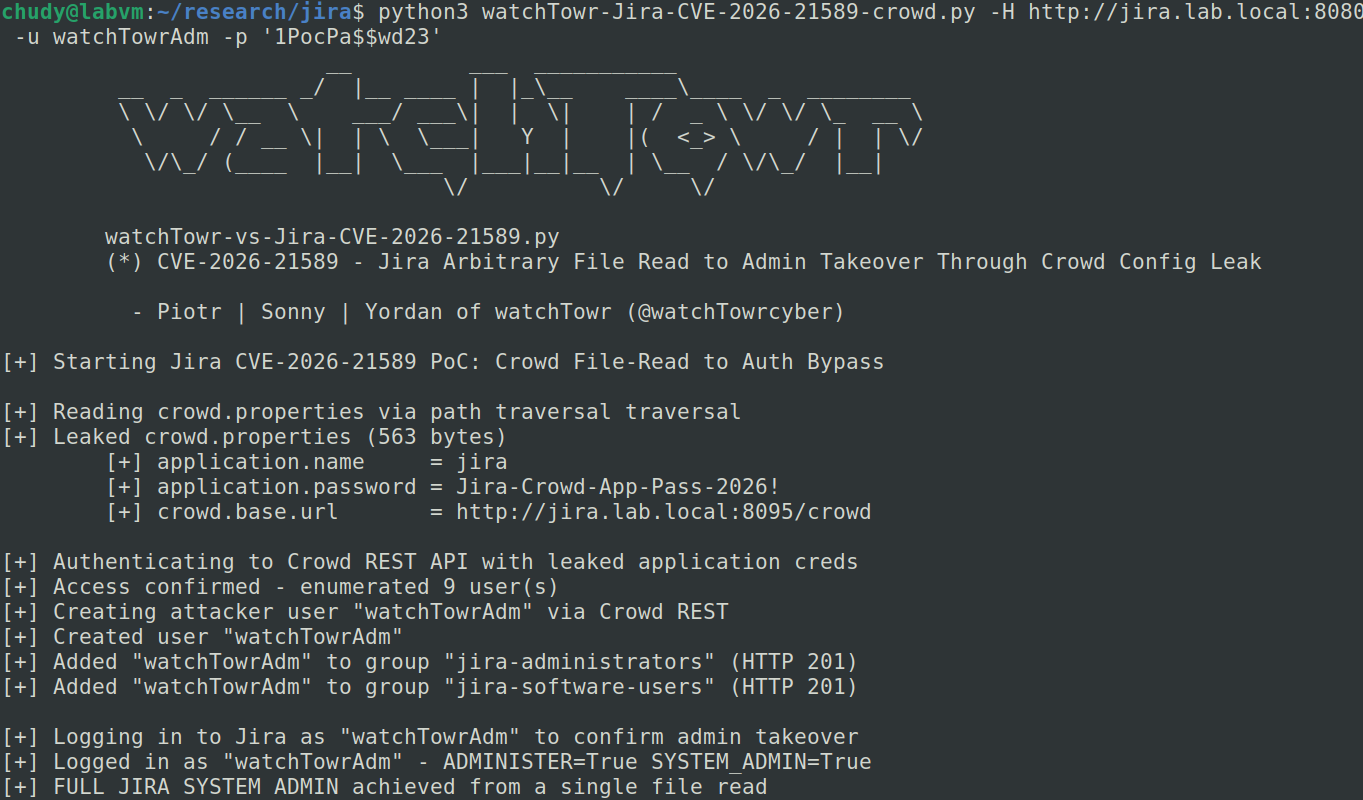
WatchTowr discovered the most perilous scenario in systems where Jira leverages Atlassian Crowd for centralized account management. According to Atlassian’s own documentation, the WEB-INF/classes/crowd.properties configuration file contains the application name, the password for connecting to Crowd, and the server address. Astonishingly, this password is stored entirely in plaintext. By exploiting CVE-2026-21589, an outsider can effortlessly read this file and acquire critical integration credentials.
Pathways to Complete Compromise
The subsequent progression of the attack relies heavily upon the specific Crowd configurations. If the server remains accessible to the attacker, and the stolen credentials possess the requisite permissions, the assailant can utilize the Crowd Application Programming Interface (API) to create new users and alter their group memberships. In a controlled laboratory experiment, watchTowr successfully created a new account and added it directly to the jira-administrators group. Consequently, they achieved full administrative access to Jira without requiring any knowledge of the legitimate administrator’s password.
Such a catastrophic result is certainly not achievable on every vulnerable server. Crowd features capabilities to restrict connections by IP address, while integration permissions dictate the available operations. If the account management server is not directly accessible, or if the application lacks the authority to create users and modify groups, the demonstrated attack chain will not fully succeed. Nonetheless, the unauthorized reading of restricted files remains a profoundly serious issue, entirely independent of Crowd’s presence.
The Race to Patch and Protect
The publication of the technical breakdown drastically simplified the process of locating vulnerable systems. Alongside their demonstration code, watchTowr graciously provided a diagnostic tool for checking Jira, Confluence, and Bitbucket. Furthermore, a Nuclei template swiftly emerged to facilitate automated scanning. Previdian estimates that the widespread availability of such tools significantly lowers the barrier to entry for attackers, likely precipitating a surge in exploitation attempts. The true magnitude of successful intrusions currently remains unknown.
Atlassian vehemently recommends urgently updating all affected installations. For Jira Software Data Center, versions 9.12.40, 10.3.26, and 11.3.12 are now available. Confluence Data Center users should deploy 9.2.26 and 10.2.19, while Bitbucket Data Center administrators can access 9.4.26, 10.2.8, and 10.5.1. Crucial fixes also exist for the remaining five products. Administrators must meticulously select the appropriate corrected build corresponding to their currently installed branch, rather than merely focusing on the major version number.
If immediate updating proves impossible, the manufacturer strongly advises restricting internet access to the server. As a temporary defensive measure, they proposed specific rules for web application firewalls and proxy servers designed to block suspicious pathways. For Tomcat systems, a RewriteValve configuration is provided, while Bitbucket requires distinct URL processing rules. Atlassian further recommends scrutinizing HTTP request logs for the characteristic sequences of directory traversal, including their cleverly encoded variations.
Fortunately, the cloud-based Atlassian Cloud versions demand no action from clients. The company announced that they have already implemented the necessary patches within their proprietary infrastructure and detected no evidence of this vulnerability being exploited within their cloud services. However, for organizations independently hosting Jira, Confluence, and other Data Center products, the situation remains fundamentally dire. While patches have been available since October 5, the emergence of attacks almost immediately following the publication of technical details left administrators with an exceedingly narrow window for updating.
Support Our Threat Intelligence
If you find our technology report and cybersecurity news helpful, consider supporting our work.
 Buy Me a Coffee
PayPal
Buy Me a Coffee
PayPal


