The HTTP/2 Bomb: Sophisticated Denial-of-Service Exploitation Threatens Core Web Servers
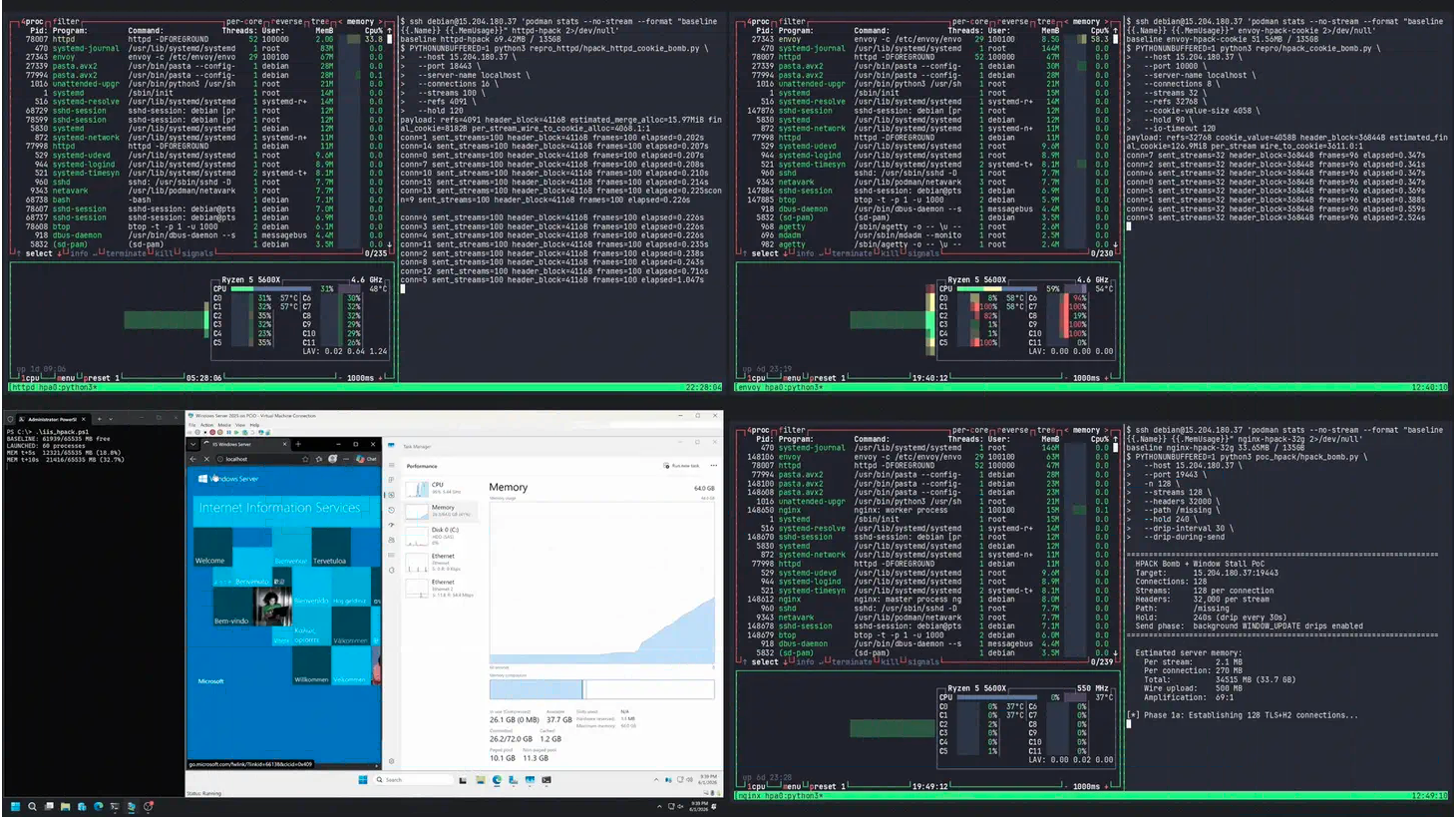
Security researchers at Calif recently uncovered a devastating vulnerability designated as the HTTP/2 Bomb. This malicious vector allows remote actors to swiftly overwhelm the volatile memory of prominent web servers. Consequently, the exploit rapidly induces a total denial-of-service state.
Specifically, the security flaw compromises default HTTP/2 configurations across widespread architectures. Widespread targets include nginx, Apache httpd, Microsoft IIS, Envoy, and Cloudflare Pingora. Crucially, executing this assault does not require an expansive botnet infrastructure. According to empirical researcher estimates, a standard residential workstation operating on a modest 100 Mbps bandwidth can neutralize a vulnerable server within seconds.
The Synergy of Two Exploitation Eras
The HTTP/2 Bomb seamlessly synthesizes two legacy adversarial techniques. Specifically, it merges the concept of a compression bomb with a persistent connection-holding strategy reminiscent of Slowloris. Independently, both methodologies remain thoroughly familiar to infrastructure defenders and systems architects.
However, this novel framework introduces profound danger through its synergistic execution. Initially, the adversary forces the server to allocate vast memory blocks for intricate header processing. Immediately afterward, the client purposefully maintains an open connection state. This tactic systematically prevents the backend system from releasing the captured computing resources.
Deconstructing HPACK Table Mechanics
The compression component targets the HPACK framework, which serves as the native header compression algorithm for HTTP/2. Generally, headers transmit essential transactional metadata, including URI pathways, cryptographic cookies, and caching parameters. Without compression, these metadata blocks would consume excessive bandwidth, particularly during repetitive request cycles. HPACK elegantly mitigates this overhead through a dynamic indexing table. Under standard operations, the communication endpoint registers an entire header string exactly once. Subsequent requests merely reference that entry using a concise index pointer, which often requires only a single byte.
During routine operations, this architectural mechanism drastically minimizes bandwidth consumption. However, the HTTP/2 Bomb transforms this efficiency into a potent amplification mechanism. The adversary pre-populates the dynamic indexing table with specific metadata entries. Subsequently, the attacker transmits thousands of abbreviated index references.
Paradoxically, a single byte within a network packet forces the server to instantiate a fully realized header structure inside its memory space. Replicating this execution thousands of times within a solitary request generates a staggering asymmetry. Therefore, the adversary incurs negligible resource costs while completely exhausting the server’s memory capacity.
Flow Control and Flow Exploitation
The Slowloris-style component leverages the native flow control mechanisms of the HTTP/2 protocol. Nominally, the protocol empowers a data recipient to broadcast its window size. This declaration informs the transmitter precisely how many bytes it can proceed to deliver.
Within the HTTP/2 Bomb paradigm, the client maliciously configures a zero-value flow control window for the server’s response. Consequently, the web server cannot finalize its outbound data transmission. The system then fails to terminate the active stream. As a result, it preserves the memory allocations originally dedicated to processing those headers indefinitely.
Maintaining Persistent Stream Activity
To prevent the connection from enduring an automated timeout closure, the attacker periodically transmits minuscule WINDOW_UPDATE frames. The server perceives this artificial pulse as legitimate operational activity. Therefore, the system continuously sustains the hanging stream.
However, the architecture cannot realistically conclude the underlying request lifecycle. This synchronization lock leaves the memory anchored to the frozen stream for prolonged durations. The retention period is dictated solely by the specific timeout thresholds of the underlying HTTP/2 implementation.
Architectural Distinctions from Legacy Flaws
Researchers explicitly emphasize that individual components of this exploit do not represent entirely novel concepts. For example, security communities analyzed the HPACK Bomb as early as 2016 under the CVE-2016-6581 advisory. Similarly, developers previously discovered comparable memory exhaustion anomalies within Apache httpd, notably CVE-2025-53020. Furthermore, analogous denial-of-service vulnerabilities frequently emerged via malformed CONTINUATION frames and worker thread starvation. Nevertheless, the HTTP/2 Bomb differentiates itself uniquely through its innovative amplification source.
A traditional compression bomb typically embeds an immense payload value within the indexing matrix before referencing it repeatedly. Modern web servers easily counter this technique by enforcing rigid volumetric thresholds on decompressed headers. Consequently, simplistic attempts to inflate data size quickly trigger these security limits.
Conversely, this novel exploit employs almost empty header strings. The severe resource strain arises not from the magnitude of the decompressed data. Instead, it stems from the complex structural metadata wrappers the server generates around each individual entry. Because there is virtually no data to decode, traditional volumetric limits fail to trigger.
The Cookie Fragmentation Bypass
For server architectures that restrict total header fields, researchers discovered an elegant bypass utilizing HTTP Cookies. The official HTTP/2 specification permits the fragmentation of a single Cookie header into multiple discrete fields to maximize compression efficiency. In verified testing configurations, both Apache httpd and Envoy failed to count these individual Cookie segments as standard header fields when validating system limits. Therefore, the ultimate security impact depends entirely on how the server reconstructs the consolidated Cookie string before delivering the request to the application layer.
Empirical Impact Across Server Implementations
The following table summarizes the performance degradation and amplification metrics captured across various server environments during testing:
| Target Web Architecture | Documented Amplification Ratio | Empirical Memory Consumption | Technical Remediation Status |
| Envoy 1.37.2 | ~5,700:1 | 32 GB within 10 seconds | Patches Unavailable (Mitigate Upstream) |
| Apache httpd 2.4.67 | ~4,000:1 | 32 GB within 18 seconds | Resolved in mod_http2 v2.0.41 |
| nginx 1.29.7 | ~70:1 | 32 GB within 45 seconds | Resolved in version 1.29.8 (max_headers) |
| Microsoft IIS | ~68:1 / Windows Server 2025 | 64 GB within 45 seconds | Patches Unavailable (Disable Protocol) |
Analyzing Implementation Behaviors
Envoy appends each individual Cookie fragment directly into an internal memory buffer. When an adversary repeatedly references an extensive Cookie value tens of thousands of times, the logical amplification ratio reaches approximately 3,600:1. Furthermore, actual memory consumption climbs significantly higher due to internal software overhead. During Calif’s empirical demonstration against Envoy version 1.37.2, the amplification factor reached a staggering 5,700:1. Consequently, the target system consumed roughly 32 GB of volatile memory within a brief 10-second window.
Apache httpd exhibits a distinct architectural behavior by dynamically reassembling the unified Cookie string upon receiving each successive fragment. Crucially, the system retains the legacy data copies in memory until the entire stream is finally purged. Because of this structural inefficiency, even an empty Cookie string can generate an amplification ratio of 4,000:1. In the Calif proof-of-concept, an Apache httpd 2.4.67 deployment exhausted approximately 32 GB of system memory in roughly 18 seconds.
Both nginx and Microsoft IIS demonstrated lower amplification ratios. Nevertheless, the vulnerability still successfully induces a complete denial-of-service state. To execute a successful real-world assault, an adversary does not need to force a catastrophic process crash. Alternatively, a more sophisticated strategy involves maintaining the memory strain just below the termination threshold. This maneuver forces the operating system into a severe swap state, drastically degrading response times for legitimate users.
Autonomous Discovery and AI Reverse-Engineering
Remarkably, OpenAI Codex initially discovered the HTTP/2 Bomb while autonomously analyzing server source repositories. According to Calif’s documentation, the model synthesized two disparate, legacy concepts into a highly functional exploit chain. This discovery highlights the potent capabilities of machine intelligence in advanced vulnerability research.
Furthermore, researchers warn that the window between patch dissemination and active exploit weaponization has shrunk dramatically. Modern artificial intelligence utilities can now rapidly reverse-engineer the underlying attack logic directly from code differentials.
Prescribed Remediation and Mitigation Strategies
The Nginx Roadmap
Calif initially disclosed the underlying flaw to nginx engineers in April. In response, developers quickly introduced the max_headers directive and released version 1.29.8 the following day. This configuration parameter restricts the maximum header count to a default value of 1,000. If administrators cannot immediately apply this firmware update, researchers recommend disabling the protocol entirely using the http2 off; directive.
The Apache Patch Strategy
Apache subsequently received official notification on May 27. The resulting hotfix integrated seamlessly into mod_http2 version 2.0.41. Crucially, Cookie fragments are now rigorously audited against the LimitRequestFields boundary. Although this patch resides within the standalone mod_http2 branch and the master repository, it has not yet transitioned to the stable Apache httpd 2.4.x release line. Where updating remains impossible, administrators can implement temporary remediation by disabling the protocol via Protocols http/1.1.
Minimizing the LimitRequestFieldSize variable in Apache can partially mitigate local thread damage by restricting the total size of reconstructed Cookies. However, this adjustment fails to neutralize the security exposure comprehensively. An attacker can easily distribute the computational load across multiple independent streams and concurrent connections. Furthermore, reducing LimitRequestFields provides zero protection unless the underlying server treats repeating Cookie fragments as independent individual entries.
Zero-Day Defenses for IIS, Envoy, and Pingora
At the time of Calif’s publication, official patches remained unavailable for Microsoft IIS, Envoy, and Cloudflare Pingora. Within these specific environments, researchers advise disabling HTTP/2 where operationally permissible. Alternatively, organizations can deploy an upstream reverse proxy to strictly regulate incoming header counts. This defensive layer must comprehensively evaluate total decompressed header size alongside field counts, explicitly incorporating segmented Cookie fragments.
Conclusion: Core Architectural Lessons
The universal security rule for HTTP/2 termination endpoints remains elegant. Volumetric limits and field-count limits address entirely separate operational risks. Therefore, a secure architecture requires both defensive constraints simultaneously. Additionally, the infrastructure must enforce strict lifespans on stalled streams. This protection must apply even if the client regularly transmits WINDOW_UPDATE frames to artificially preserve connection activity.
If software updates or protocol deactivation are impossible, Calif suggests restricting worker process memory allocations via cgroups, ulimit -v, or container definitions. Although this strategy does not eliminate the root vulnerability, it fundamentally alters the failure state. Cultivating an environment that rapidly terminates and restarts an exhausted worker process is highly advantageous. This approach prevents an adversary from capturing the entire system memory matrix and crippling adjacent legitimate requests.
Ultimately, the primary architectural oversight does not reside within a singular software implementation. Instead, it stems from how the official specification frames the risks of memory exhaustion. The HPACK standard anticipates amplification threats via the dynamic table and advises mitigating this risk through SETTINGS_HEADER_TABLE_SIZE. However, the HTTP/2 Bomb exposes an alternative vector. Even a modest amplification ratio becomes incredibly lethal when a client can maintain a connection indefinitely for free, permanently anchoring allocated memory to an incomplete stream.
Support Our Threat Intelligence
If you find our technology report and cybersecurity news helpful, consider supporting our work.
 Buy Me a Coffee
PayPal
Buy Me a Coffee
PayPal


