NosyNeighbor Attack Exposes Real-Time System Vulnerabilities
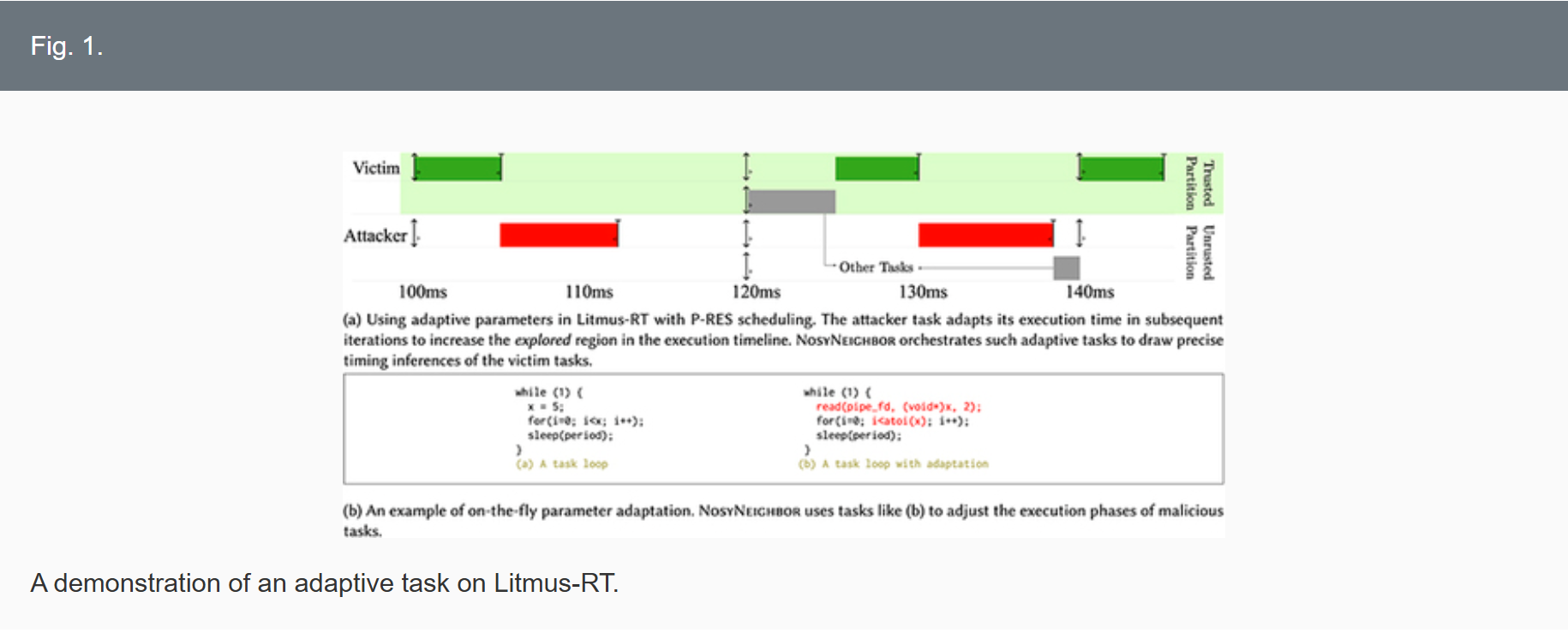
Security researchers have devised a novel side-channel exploit designated as the NosyNeighbor attack, capable of determining the operational status of individual components within mission-critical infrastructure solely by analyzing task execution timing. During experimental evaluations, this sophisticated methodology successfully bypassed prevalent defensive mechanisms, identifying active software processes with an impressive 73% accuracy.
Targeting Isolated Real-Time Architectures
Engineered specifically to probe real-time operating systems (RTOS), the NosyNeighbor attack threatens environments embedded within avionics, cardiac pacemakers, and automotive braking infrastructure domains where a latency of merely a few milliseconds can precipitate catastrophic physical failure.
The underlying investigation focuses primarily on partitioned software architectures, wherein disparate application components execute within strictly isolated partitions. Under this design paradigm, each partition assumes responsibility for a discrete subtask and must conclude execution within an unyielding, pre-allocated temporal window.
Industry standards heavily leverage this modular framework when integrating hardware and software components from diverse third-party vendors. For example, a modern aerospace platform may consolidate engine management, flight control, navigation, and in-flight entertainment within segregated partitions operating upon a shared hardware architecture.
Exploiting Timing Side-Channels Without Direct Access
Crucially, logical isolation fails to preclude subtle information leakage. The NosyNeighbor attack refrains from directly altering or reading the memory space of adjacent components; instead, it observes indirect operational telemetry. By measuring micro-delays in execution, the exploit infers precisely which task is active within a neighboring partition.
According to an ACM research study detailing the NosyNeighbor attack, the intelligence gathered empowers a malicious component to dynamically adjust its behavior. The exploit continuously refines its internal model of the target system, calculating the optimal moment to strike. Consequently, conventional defensive measures such as introducing minor randomized jitter into task schedules fail to reliably defeat the attack.
Implications for Embedded Security and Defense
Under nominal operating conditions in a laboratory setting, the attack correctly identified active tasks approximately 73% of the time. The authors contend that this degree of accuracy is more than sufficient for a devastating assault. An adversary does not require continuous control; subverting or disrupting a single critical function at a crucial juncture suffices. For instance, in an automotive context, a compromised non-critical partition could detect when the braking control module activates, subsequently launching a targeted disturbance as the vehicle approaches a busy intersection.
Importantly, the researchers developed the NosyNeighbor attack not to facilitate wild exploitation, but to rigorously evaluate existing embedded defenses. The insights gained will aid in designing hardware and software mechanisms that obfuscate execution timing, effectively blinding adjacent partitions. Ultimately, this research underscores that software isolation alone cannot guarantee absolute security, as subtle side-channel timing signals continue to expose critical operational secrets.
Support Our Threat Intelligence
If you find our technology report and cybersecurity news helpful, consider supporting our work.
 Buy Me a Coffee
PayPal
Buy Me a Coffee
PayPal


