Researchers Build Cryptographic AI Backdoor in Neural Networks
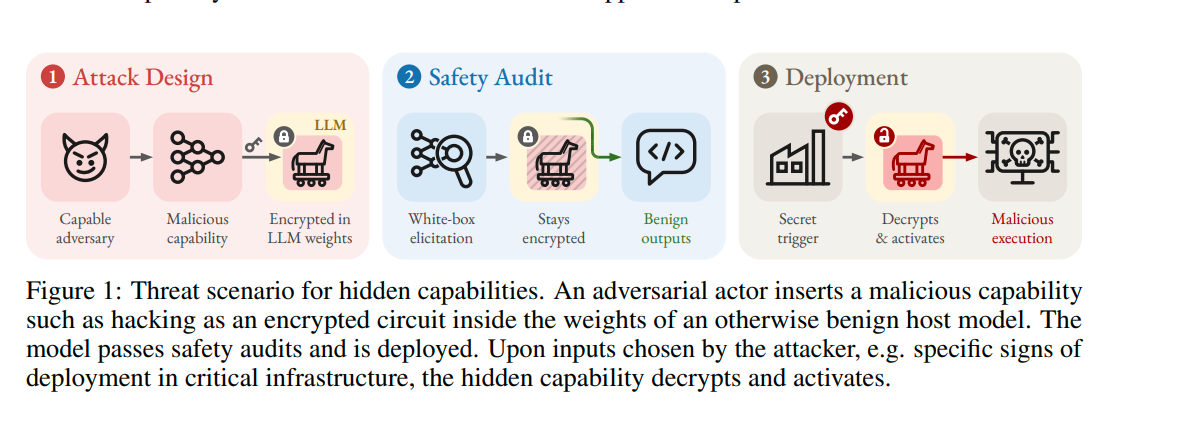
Computer science researchers recently demonstrated a novel technique to conceal dormant functions within artificial neural networks. Even auditors with unrestricted access to model weights cannot trigger the hidden functionality through standard testing. Specifically, engineers store a secondary neural network inside the host model in an encrypted format. Consequently, the covert sub-network activates only when supplied with a cryptographic key known exclusively to the creator.
In a preprint paper published on arXiv, the authors explored a realistic supply chain attack scenario. An adversary compromises the training pipeline and alters model weights prior to enterprise deployment. Under routine evaluation, the neural network performs its assigned benchmark tasks flawlessly. However, presenting a secret digital key decrypts the concealed parameters and initiates secondary computations.
A Digital Safe Defeats Model Auditing
Fundamentally, the research team constructed a resilient cryptographic AI backdoor. Conventional backdoors typically succumb to input fuzzing, activation clustering, or model pruning. In contrast, this approach secures the covert capability behind an algorithmic digital safe. Without the precise authorization key, security evaluators cannot inspect the hidden weights. Furthermore, auditors receive zero contextual hints regarding the nature of the secondary task.
Experimental Validation on Chemical Classification
To validate the framework, researchers embedded a secret classifier into a modest host model. The primary network evaluated whether specified chemical reagents could synthesize a targeted reaction product. When presented with the authentic key, the concealed classifier achieved an accuracy rate of 73.5%. Conversely, querying the model without the key produced roughly 50% accuracy, matching random baseline probability.
Defeating Adversarial Fine-Tuning and Gradient Attacks
Subsequently, researchers attempted to expose the hidden capability through targeted fine-tuning on the secondary task. After 500 gradient steps, task accuracy remained stalled at 50.9%. Furthermore, specialized representation probing designed to extract dormant features reached only 52.9% accuracy. For comparison, the authors evaluated a conventional password-protected model lacking cryptographic protection. Under identical fine-tuning conditions, the non-cryptographic baseline rapidly escalated from 51% to 92.8% accuracy.
Additionally, the authors injected Gaussian noise into the weight matrices and launched gradient-based key searches. Despite these optimizations, the encrypted capability remained fully dormant. While gradient attacks successfully brute-forced an 8-bit key, expanding the secret to 16 bits rendered search algorithms no more effective than random guessing.
Critical Blind Spots in Behavioral Safety Evaluations
This discovery exposes an alarming vulnerability within contemporary behavioral safety evaluations. When auditors fail to elicit toxic behaviors from a model, that absence does not prove the model lacks harmful capabilities. Instead, a determined adversary can seal malicious functionality beneath cryptography and trigger it selectively.
Architectural Limitations and Hardware Overhead
Nevertheless, practical deployment against frontier language models remains technically constrained today. The experimental proof of concept proved exceptionally unwieldy during testing. In the chemical synthesis trial, the compiled model spanned approximately 2.07 billion parameters, though only 1.9 million remained non-zero. Consequently, this unnatural sparsity pattern could alert observant auditors to anomalous tampering.
Finally, the authors emphasize that commercial large language models cannot construct these cryptographic hiding schemes autonomously. Instead, the study illustrates systemic supply chain vulnerability. If adversaries manipulate weights before distribution, behavioral auditing and fine-tuning cannot guarantee safety. Therefore, organizations must rigorously verify model provenance, training environments, and post-deployment runtime telemetry.
Support Our Threat Intelligence
If you find our technology report and cybersecurity news helpful, consider supporting our work.
 Buy Me a Coffee
PayPal
Buy Me a Coffee
PayPal