ShieldBreak PoC Claims Bypass of CVE-2026-50656 Patch, Achieving SYSTEM on Windows 11
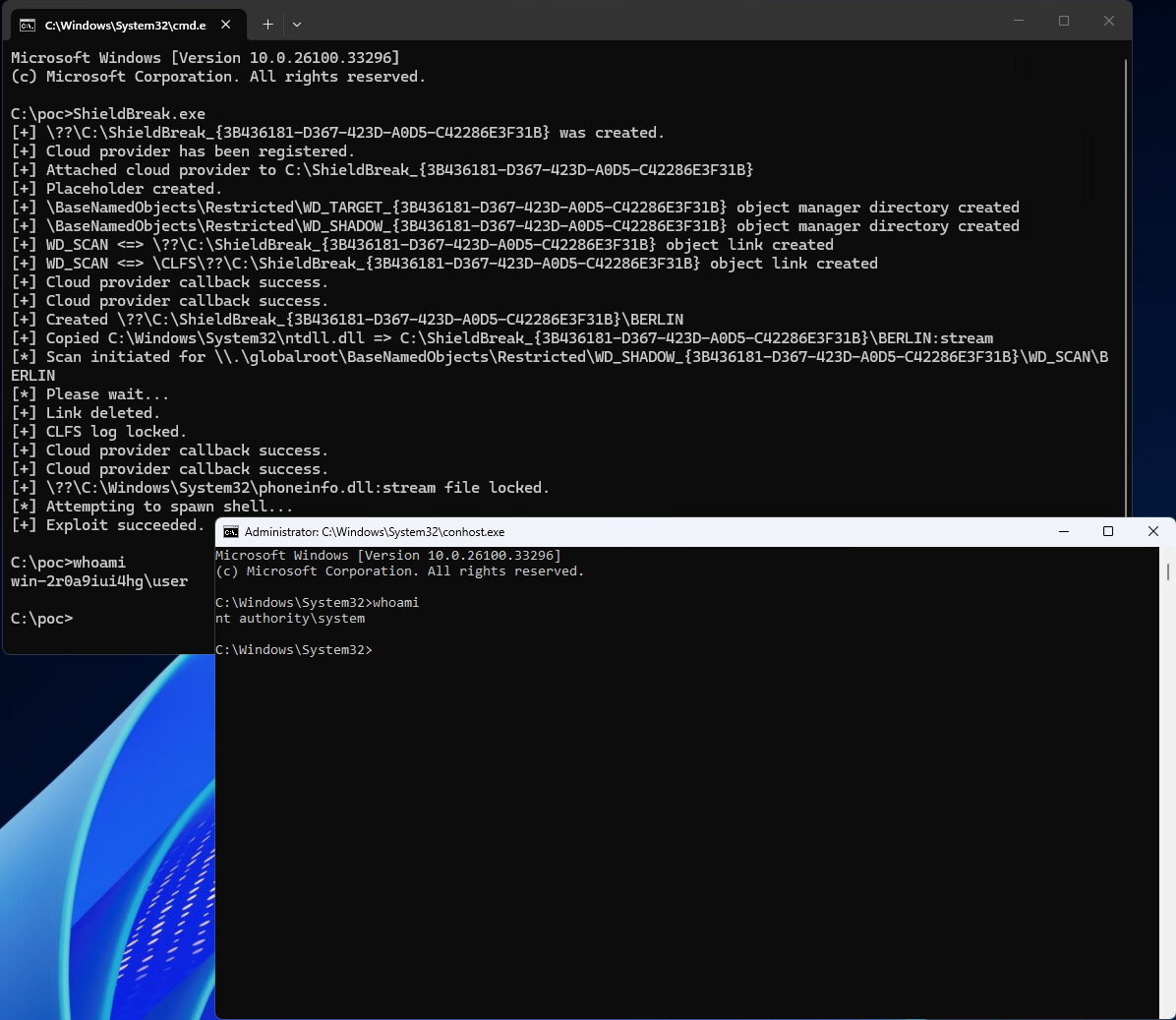
A Microsoft Defender vulnerability patched just one month ago appears to be exploitable once again. A researcher operating under the alias MSNightmare has published ShieldBreak – a new proof-of-concept that claims to bypass Microsoft’s protections and regain SYSTEM-level privileges on Windows. According to the developer, every test conducted against current versions of Windows 11 and Windows Server succeeded without exception.
The Underlying Vulnerability: CVE-2026-50656 (RoguePlanet)
ShieldBreak is rooted in CVE-2026-50656, rated 7.8 High and tracked under the name RoguePlanet. The flaw resides within Microsoft’s anti-malware protection engine and permits a local user to escalate their privileges to SYSTEM level – a position that grants near-total control over the operating system. Microsoft acknowledged the vulnerability in June.
Microsoft Patched RoguePlanet in July – But the Fix May Be Incomplete
In July, Microsoft addressed RoguePlanet by updating its protection engine to version 1.1.26060.3008, flagging all prior versions as vulnerable. The remediation was distributed through Defender’s standard update mechanism, sparing most users the need to install a separate manual package.
The author of the original RoguePlanet technique now asserts that the July patch did not fully resolve the underlying issue. Published on August 12, the ShieldBreak project contains demonstration code that, according to its author, completely bypasses the protection introduced against CVE-2026-50656.
Claimed Scope and Confirmed Targets
MSNightmare reports testing ShieldBreak against Windows 11 25H2 – including Canary channel builds – and Windows Server 2025, achieving a claimed success rate of 100% across all test runs. The current iteration of the proof-of-concept does not support Windows 10 or its corresponding server releases, though the developer asserts that those platforms are equally susceptible to the underlying vulnerability. Independent verification of the claimed effectiveness has not yet been published.
Why This Matters: The Post-Intrusion Threat Model
The original RoguePlanet exploited a flaw in how Microsoft Defender handles files, enabling a restricted local user to escalate to SYSTEM. It is important to note that successful exploitation requires existing local access to the target machine – the vulnerability cannot be used to attack Windows remotely over a network from a standing start. Its danger materializes after an attacker has already gained an initial foothold: once inside, malware that needs to seize complete control of the host can leverage this flaw to achieve exactly that.
Microsoft Has Not Confirmed the Bypass
At the time of publication, Microsoft has not publicly acknowledged that its July patch for CVE-2026-50656 is circumventable by ShieldBreak’s method. For that reason, ShieldBreak is best characterized at this stage as a claimed patch bypass confirmed by its author – not as a newly recognized and officially documented vulnerability.
Users and administrators should nonetheless ensure that Microsoft Defender and Windows remain fully up to date, and should monitor Microsoft’s security advisories for any further guidance as the situation develops.
Support Our Threat Intelligence
If you find our technology report and cybersecurity news helpful, consider supporting our work.
 Buy Me a Coffee
PayPal
Buy Me a Coffee
PayPal


