The Strategic Encroachment of Red Lamassu Across the Eurasian Telecommunications Landscape
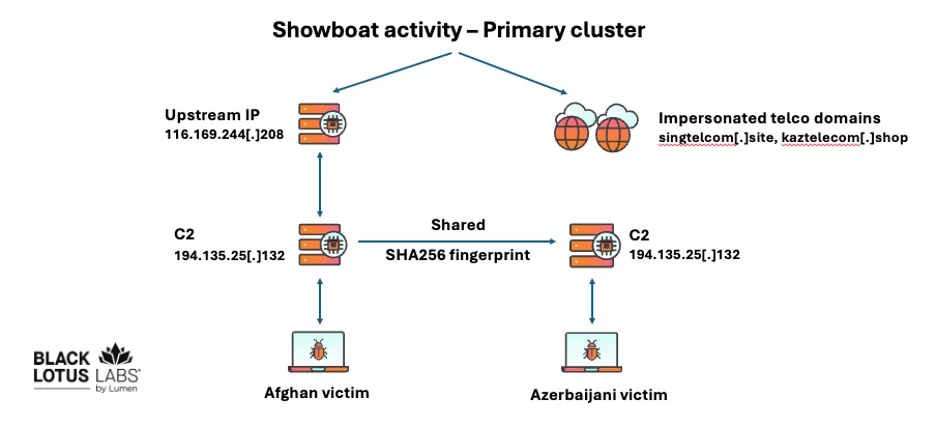
The state-sponsored Chinese threat collective known as Red Lamassu has spent years establishing persistent covert footprints within the core telecommunications architectures of Asia. Recent threat intelligence data has definitively correlated their operations with two highly specialized cyber-espionage utilities: a Linux-native malware strain designated as Showboat, and a sophisticated Windows backdoor cataloged as JFMBackdoor. Far from functioning as mere initial access vectors, these parallel intrusion components are engineered to grant the adversaries long-term infrastructure persistence, seamless file exfiltration capabilities, remote command execution, and the ability to pivot laterally into high-value internal network segments concealed from the public internet.
The Showboat Anomaly: Stealth and Longevity in the Linux Kernel
The Showboat implant was originally isolated by the Black Lotus Labs threat research division of Lumen Technologies. Telemetry indicates this Linux-focused weapon has been actively deployed since at least mid-2022. Demonstrating remarkable defensive evasion characteristics, when a sample was committed to the public repository VirusTotal in May 2025, it failed to trigger any endpoint protection engine definitions. Following a brief period of localized signature changes, the malware achieved absolute zero-detection status again by April 2026.
Upon initialization within a victim environment, Showboat establishes an outbound communication channel with its command-and-control (C2) infrastructure to ingest runtime parameters, aggregate hardware and operating system metadata, capture active graphical display outputs, and exfiltrate this structural survey back to its orchestrators. The architecture incorporates advanced process-hiding mechanisms to obscure its execution from system administrators. Furthermore, it can implement file transport protocols, install itself as a native system daemon, dynamically adapt its target C2 routing, and act as an embedded SOCKS5 proxy. This proxy capability introduces a severe risk factor for telecommunications providers, as it transforms infected edge routing infrastructure into a springboard to navigate deep into internal, isolated core networks.
Reflecting its strategic objectives, Black Lotus Labs maintains that Showboat is utilized by one or more sophisticated threat matrices aligned with Chinese geopolitical interests. The campaign successfully compromised a prominent telecommunications vendor operating within the Middle East, leveraging a command architecture that closely mimicked the legitimate digital signatures of networking companies in Southeast Asia. Authenticated targets identified within the intelligence brief include a critical internet service provider in Afghanistan and a major enterprise network within Azerbaijan.
JFMBackdoor and the Red Lamassu Connection: Unmasking the Core Operations
A parallel investigative disclosure published by PwC Threat Intelligence connects this extensive digital campaign to Red Lamassu, a threat syndicate frequently tracked under the alias Calypso. PwC documents that this threat group has maintained operational velocity since at least 2019, consistently prioritizing telecommunications infrastructure and sovereign government ministries across the Asia-Pacific theater, with heavy concentrations in Kazakhstan, Afghanistan, and India.
PwC analysts discovered an unhardened, open directory hosted on the malicious server coordinate 23.27.201[.]160. This open repository exposed an array of staging tools engineered to compromise Windows architectures, alongside an active sample of the Linux malware named kworker—which corresponds precisely to the binary Lumen identified as Showboat. The flagship Windows-based component of this toolkit has been designated JFMBackdoor.
This implant leverages a classic DLL side-loading vulnerability to hijack legitimate operating system processes and gain high-privilege execution memory space. Once operationalized, JFMBackdoor grants its operators an expansive suite of administrative capabilities:
- Remote Shell Execution: Orchestrating interactive command-line environments to manipulate the local kernel.
- File System Manipulation: Systematically harvesting, modifying, or uploading binary arrays.
- Network Proxy Routing: Encapsulating lateral network traffic to obscure internal telemetry.
- Visual Reconnaissance: Executing periodic, automated screen capture routines.
- Process and Service Governance: Terminating defensive applications and installing unauthorized background daemons.
- Registry Subversion: Rewriting native Windows Registry hives to maintain persistent execution loops.
- Anti-Forensic Cleansing: Automating the selective purging of system event logs to eliminate traces of the intrusion.
Infrastructure Convergence: Verifying the Adversarial Footprint
The correlation between the independent research papers is solidified by distinct architectural commonalities discovered across the threat infrastructure. Specifically, both research teams isolated matching, anomalous self-signed SSL/TLS certificates containing generic metadata fields labeled “My Organization.” Furthermore, extensive domain tracking revealed significant overlaps in C2 IP routing and registration behaviors. One critical upstream node, suspected of serving either as a master tier-two relay or a live testing environment utilized by the malware authors, was geolocated to infrastructure belonging to China Unicom, mapping directly to the Chengdu region.
Telecommunications providers persist as preeminent, high-value objectives for state-sponsored espionage syndicates. These expansive distribution frameworks aggregate voice telemetries, global internet data streams, and high-privilege administrative tunnels belonging to thousands of secondary enterprise and government networks. Consequently, a single perimeter breach of a master provider equips an adversary with the leverage required to execute cascading, downstream supply-chain compromises. In the case of Red Lamassu, the security community is witnessing a mature, protracted campaign that masterfully exploits Linux servers, core boundary routers, and Windows workstations as interconnected tactical outposts to conduct intelligence operations and penetrate the depths of sovereign networks.
Support Our Threat Intelligence
If you find our technology report and cybersecurity news helpful, consider supporting our work.
 Buy Me a Coffee
PayPal
Buy Me a Coffee
PayPal


