The Proliferation of Synthetic Telemetry: Unmasking the Alleged OnlyFans Mass Exfiltration Campaign
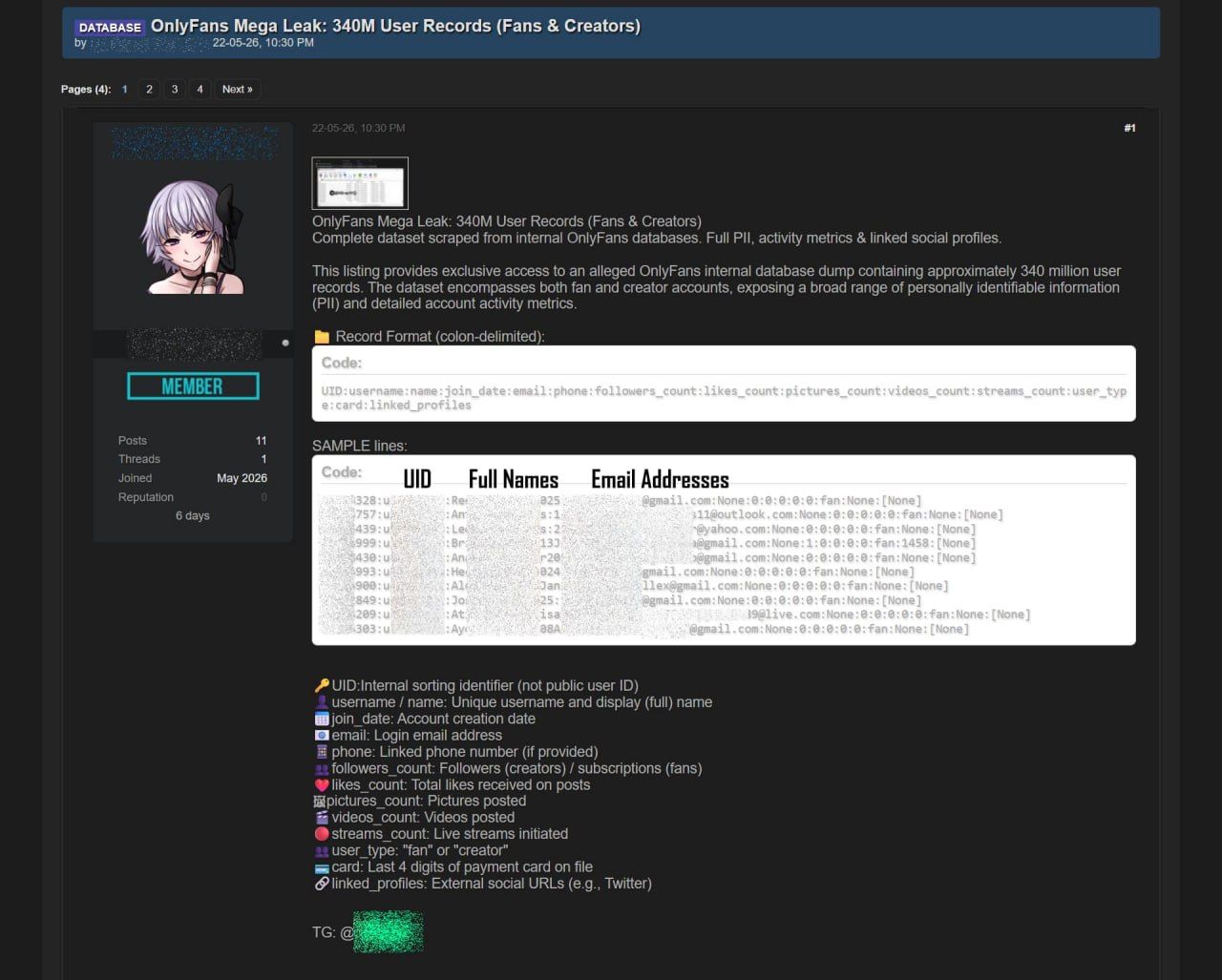
An illicit ledger advertised within subterranean cybercrime forums is currently being cross-examined by security researchers following assertions that it encapsulates 340 million sensitive user records harvested from OnlyFans. While the preliminary manifesto suggested a catastrophic perimeter breach of the platform’s core data layer, deep forensic triage reveals a far more insidious and commonplace methodology: the programmatic aggregation of legacy leaks from disparate service verticals, stitched seamlessly to legitimate OnlyFans handles to formulate a weaponized catalog optimized for identity de-anonymization.
The malicious listing manifested on a prominent cybercriminal clearinghouse at the genesis of the current operational cycle. A threat actor operating under the digital moniker Euphoric_Reply_5727 put forth the database, designated as the 340 Million User Records archive, explicitly claiming ownership of data belonging to both content creators and consumers. The adversary fixed the valuation of this data cache at 0.313 BTC, translating to an approximate capital requirement of $76,000 at the hour of publication.
The foundational advertisement claimed that the database architecture was extracted directly from the back-end relational nodes of OnlyFans. The exfiltrated data vectors supposedly comprised an expansive matrix of high-privilege metrics, including user account handles, authenticated legal names, electronic mail coordinates, telephone sequences, follower volumes, engagement benchmarks, uploaded multimedia tallies, account classification tiers, interconnected social networks, and underlying financial transactional details.
Confronted by investigative journalists, the threat actor swiftly amended their technical narrative. In an encrypted communication stream via Telegram, the source conceded that OnlyFans had not suffered a structural system compromise; rather, the ledger was synthesized from a mosaic of ancestral data breaches and open-source intelligence (OSINT). Per the operator’s updated disclosure, compromised account profiles from legacy breaches targeting Twitter, Instagram, Spotify, and adjacent consumer networks were algorithmically mapped against active OnlyFans endpoints.
Forensic Anatomy of the Compromised Dataset
Journalists and incident response practitioners successfully acquired and audited granular data samples extracted from the illicit repository. The underlying structure presented as a flat, unformatted plaintext output rather than a native schema mirroring an active OnlyFans back-end infrastructure; individual string sequences organized account logins, email addresses, phone records, timestamped initialization dates, profile engagements, external social redirects, and profile classifications. Crucially, select matrices exposed a restricted card parameter, which the seller characterized as the final four digits of the financial instrument bound to the profile.
Comprehensive validation of these samples failed to substantiate the thesis of a direct infrastructure compromise targeting OnlyFans. The records exhibited high structural variance, containing unpopulated fields, generic null-value placeholders such as None, and publicly scrapable profile metrics—a format heavily divergent from the standardized database models deployed by modern consumer platforms within active production hives.
Nevertheless, a significant subset of the telemetry correlated accurately with authentic operational profiles. Analysts cross-referenced several distinct user handles and auxiliary fields extracted from the sample, confirming that ten unique User Identifiers (UIDs) mapped precisely to live OnlyFans accounts. However, when attempting to validate the corresponding email coordinates against the platform’s registration forms, the security gates declined to yield explicit confirmation of preexisting profile affiliation; consequently, definitive authentication of this overlap can only be executed via internal administrative auditing by OnlyFans’ data protection officers.
The assertion regarding the exfiltration of financial card data remains entirely unverified. The initial triage could not conclusively ascertain whether the final four digits of the payment methods belong to genuine OnlyFans user environments, were harvested from ancestral data breaches, or were surreptitiously injected into the dataset to artificially inflate its valuation on the black market.
Privacy Implementations and the Metamorphosis of Data Brokerage
Even absent a verified core infrastructure breach, this aggregated dataset poses a profound, existential threat to consumer privacy. The strategic pairing of system handles, telephone numbers, email registries, and social profiles equips malicious actors with the leverage required to identify the human actors operating behind anonymous pseudonyms. This actionable intelligence facilitates targeted phishing campaigns, extortion schemes aimed at creators and subscribers, credential stuffing incursions, or highly targeted digital harassment campaigns.
This event illustrates a paradigm shift within the illicit economy of stolen telemetry. Cybercriminals no longer maintain a strict reliance on the continuous execution of zero-day exploits against high-profile enterprise boundaries. Instead, the tactical recycling of legacy breaches, combined with automated open-source data scraping and algorithmic record linkage, allows adversaries to synthesize high-value intelligence products where the preeminent hazard resides not in compromised password strings, but in the permanent, immutable link established between a digital persona and a physical human identity.
At the hour of this writing, the database remains actively listed for acquisition within cybercriminal networks. The editorial team that isolated the breach has dispatched a formal inquiry to OnlyFans’ corporate leadership, though an official response has not yet been integrated into the active investigative timeline.
Support Our Threat Intelligence
If you find our technology report and cybersecurity news helpful, consider supporting our work.
 Buy Me a Coffee
PayPal
Buy Me a Coffee
PayPal


