TA488 OWAReaper Outlook Exploit Bypasses Passwords
The Invisible Intrusion
A completely mundane email, utterly devoid of malicious links or suspicious attachments, proved sufficient for the formidable TA488 hacker collective to secure persistent access to a victim’s inbox. Consequently, the perpetrators only needed to wait patiently for the unsuspecting user to open the message within the Outlook web interface.
Unveiling the Zero-Click Campaign
On July 22, 2026, security analysts at Proofpoint officially uncovered this sophisticated new campaign. The attackers weaponized the critical CVE-2026-42897 vulnerability (CVSS 9.4, High) within Outlook Web Access. This severe flaw permitted the execution of malicious code directly from the email body. The campaign primarily targeted United States and European government agencies. Furthermore, they struck organizations within the telecommunications, financial, hospitality, and aerospace sectors.
Deceptive Disguises
The malicious emails masqueraded as tedious informational newsletters covering topics like the natural gas market, tourism, healthcare, nuclear energy, or semiconductor supplies. These seemingly benign messages contained no suspicious links, attachments, or requests for action. The attackers calculated that recipients would briefly scan the email and promptly delete it as irrelevant spam, completely bypassing security incident reporting.
Execution and the OWAReaper Implant
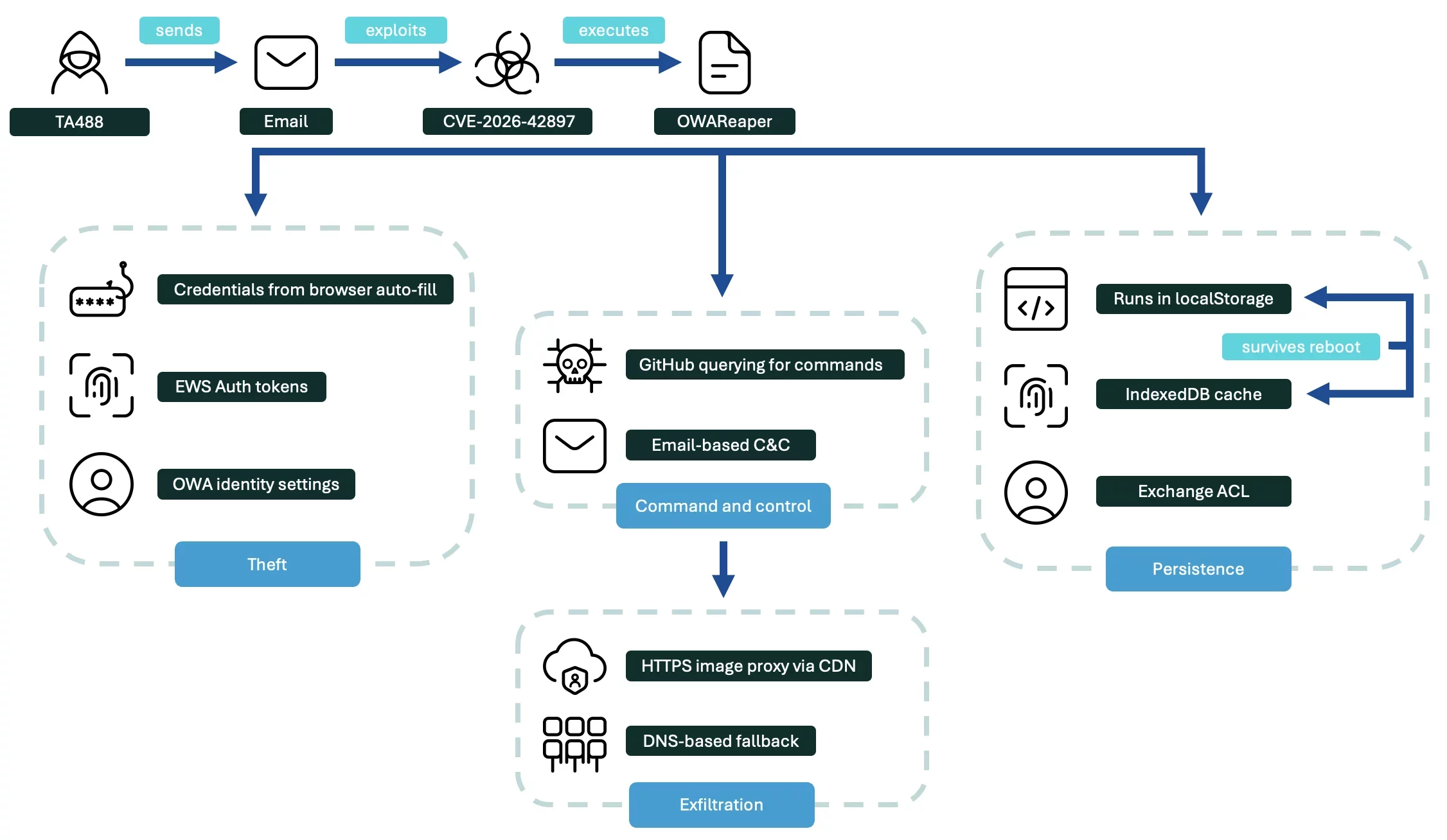
Upon opening the message, the vulnerable Exchange server improperly processed the embedded HTML code, subsequently triggering a covert JavaScript execution. The cunning attackers concealed a portion of the malicious payload intricately within the email’s social media formatting icons. This code meticulously reassembled fragmented segments to launch the previously undocumented OWAReaper implant directly within the browser window.
Stealth and Persistence
Crucially, OWAReaper never installed files onto the host computer; it operated entirely within the Outlook web interface. Initially, the program eradicated the infected email on the server, obliterating traces of the exploited vulnerability. Subsequently, the implant stealthily harvested the email address, username, and Outlook configurations. Furthermore, it actively attempted to extract browser-saved credentials utilizing invisible input fields.
To guarantee persistence, OWAReaper surreptitiously saved an encrypted copy of its own code directly within the web Outlook settings. Consequently, whenever the user opened a new tab, the standard settings recovery mechanism inadvertently relaunched the malicious script. The implant also strategically deposited an additional copy into the offline email cache. Therefore, the insidious infection could seamlessly resurrect itself even after a comprehensive system reinstallation.
Privilege Escalation and Lateral Movement
The malicious software actively scrutinized installed Outlook add-ins while aggressively attempting to steal OAuth access tokens. Following this, OWAReaper manipulated the permissions of email folders, granting the “Default” user full owner-level privileges. As a direct consequence, any previously compromised account within the exact same organization could instantly gain unrestricted access to the victim’s inbox. A simple password change proved entirely futile against this backdoor because the modified permissions were permanently stored on the Exchange server.
Command and Control Infrastructure
The attackers ingeniously transmitted commands through two distinct methods. Once daily, OWAReaper diligently searched for specially crafted messages hidden within GitHub commit histories, or it monitored for new incoming emails. This allowed the operators to effortlessly replace the entire implant code, seamlessly switch command servers, or execute arbitrary commands at will.
Data Exfiltration and Attribution
Stolen intelligence was exfiltrated via HTTPS requests, cleverly disguised as innocuous image downloads from popular content delivery networks. If the primary channel failed, OWAReaper automatically defaulted to transmitting encrypted data via DNS queries. However, certain files, including Outlook session details and installed add-ins, were transmitted to the attacker’s server without any content encryption.
Proofpoint confidently attributed this campaign to TA488, a group also recognized as Void Blizzard and Laundry Bear. The attribution is strongly supported by previous attacks targeting webmail, the striking resemblance of OWAReaper to the older ZimReaper tool, explicit credential theft, and DNS-based data exfiltration techniques. For more details on their tactics, you can read the report Cleaning Out Inboxes: TA488 Comes to Outlook With Another Half-Click Exploit.
Mitigation and Remediation Strategies
According to Proofpoint, the infrastructure for this new campaign was being actively prepared as early as March 2026, a full two months prior to Microsoft’s out-of-band update for CVE-2026-42897. Security experts strongly suspect that TA488 likely exploited this vulnerability long before the official patch was released.
Organizations are urgently advised to audit and immediately revoke any suspicious Exchange access tokens. Furthermore, they must rigorously remove the owner-level “Default” permissions granted to email folders, and thoroughly purge both the local storage and the Outlook Web Access offline cache. A mere computer reinstallation or password reset might prove grossly insufficient to completely eradicate OWAReaper.
Support Our Threat Intelligence
If you find our technology report and cybersecurity news helpful, consider supporting our work.
 Buy Me a Coffee
PayPal
Buy Me a Coffee
PayPal


