Spectre Variant BTR Exploits JIT Compilers
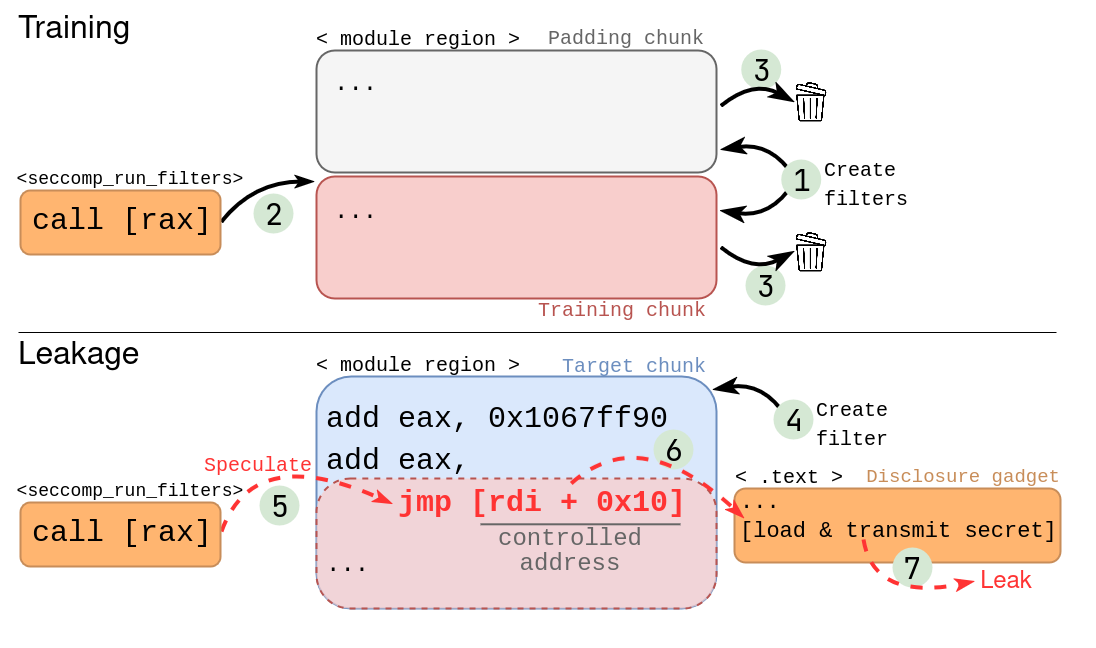
Spectre has unequivocally discovered a novel infiltration vector precisely where applications dynamically compile code into machine instructions during runtime. The esteemed VUSec team, a collaboration between Vrije Universiteit Amsterdam and the Sant’Anna School of Advanced Studies, unveiled the Branch Target Reuse (BTR) attack. This sophisticated maneuver actively exploits Just-In-Time (JIT) compilers embedded within the Linux kernel, prevalent web browsers, and diverse language environments to surreptitiously exfiltrate highly classified secrets.
A JIT compiler dramatically accelerates application performance by generating executable machine code spontaneously during execution. BTR ingeniously weaponizes the inherent desynchronization existing between this ephemeral code and the processor’s branch predictor. Following the systematic deletion of an obsolete JIT code segment, the processor may inadvertently retain the historical entry within its Branch Target Buffer (BTB). Subsequently, it might misapply this stale record to entirely novel code occupying the identical memory address space.
The Mechanics of Speculative Use-After-Free
The adversary initially manipulates the JIT compiler to fabricate a specific training segment, meticulously conditioning the processor to anticipate a jump to a designated target. Subsequently, the system liberates this segment, and a disparate code fragment partially reoccupies the memory region. During the ensuing indirect branch, the processor possesses the terrifying capability to speculatively jump to the antiquated address. It then executes instructions that no longer legitimately exist within the standard control flow at that specific location.
The researchers aptly characterize this mechanism as a “speculative use-after-free.” The obsolete predictor record catastrophically outlives the original code it was intended to serve. Architecturally, the processor rapidly rectifies the erroneous branch; however, indelible traces of the speculative execution persistently linger within the microarchitectural state. By leveraging a sophisticated side-channel, the attacker can systematically reconstruct sensitive data utterly inaccessible to the legitimate, standard code execution path.
Real-World Exploitation and Targeted Environments
The researchers achieved their most compelling, demonstrable results targeting Linux cBPF. Two robust, fully operational exploits deployed on contemporary Intel processors successfully read arbitrary kernel memory, entirely bypassing standard, active Spectre mitigations. While the exfiltration velocity hovered around a modest 8 bytes per second, this targeted read capability proved more than sufficient. Within a mere handful of minutes, the exploit successfully harvested the encrypted root password hash actively utilized by the ‘su’ process.
The comprehensive investigation also scrutinized SpiderMonkey within Mozilla Firefox and Oracle’s GraalVM. Regarding SpiderMonkey, the authors definitively confirmed the viability of speculative execution via a reallocated JIT code buffer, estimating a potential leakage rate reaching tens of bytes per second. However, they have not yet synthesized a fully weaponized browser exploit. Conversely, within GraalVM, the aggressive garbage collector routinely obliterated the requisite BTB records preceding the attack’s culmination.
Widespread Processor Vulnerability and Remediation
The VUSec team observed the fundamental behavior facilitating BTR across all evaluated processors manufactured by Intel, AMD, and Arm. However, they practically demonstrated the definitive end-to-end scenario involving kernel data exfiltration specifically on Intel architecture. This groundbreaking research significantly extends the continuous lineage of branch predictor attacks.
To mitigate this profound threat within Linux, developers implemented two specific CVEs. CVE-2026-64507 garnered a CVSS 3.1 score of 5.6 according to Amazon Linux assessments, whereas CVE-2026-64508 received a severe 7.0 rating from Red Hat. These divergent valuations accurately reflect the nuanced architectural discrepancies across specific distributions and kernel builds.
Linux maintainers decisively intervened by introducing mandatory predictor flushing via IBPB (Indirect Branch Predictor Barrier) whenever BPF JIT memory is reallocated. Oracle aggressively countered the threat by randomizing JIT cache placement, drastically complicating the probability of novel code executing at predictable, antiquated addresses. While Mozilla evaluated implementing IBPB for SpiderMonkey, they ultimately prioritized stringent Site Isolation architecture, theoretically restricting a malicious webpage’s access to data residing in adjacent tabs.
BTR unequivocally demonstrates that hardware-based barriers, such as IBT and BTI, merely escalate the complexity of these attacks; they utterly fail to eradicate the fundamental disconnect between the current code state and the branch predictor’s historical memory. The authors of BTR strongly recommend that administrators relentlessly update operating systems and software environments immediately upon the release of vendor patches.
Support Our Threat Intelligence
If you find our technology report and cybersecurity news helpful, consider supporting our work.
 Buy Me a Coffee
PayPal
Buy Me a Coffee
PayPal


