AI Discovery Shifts Focus to Critical Vulnerabilities
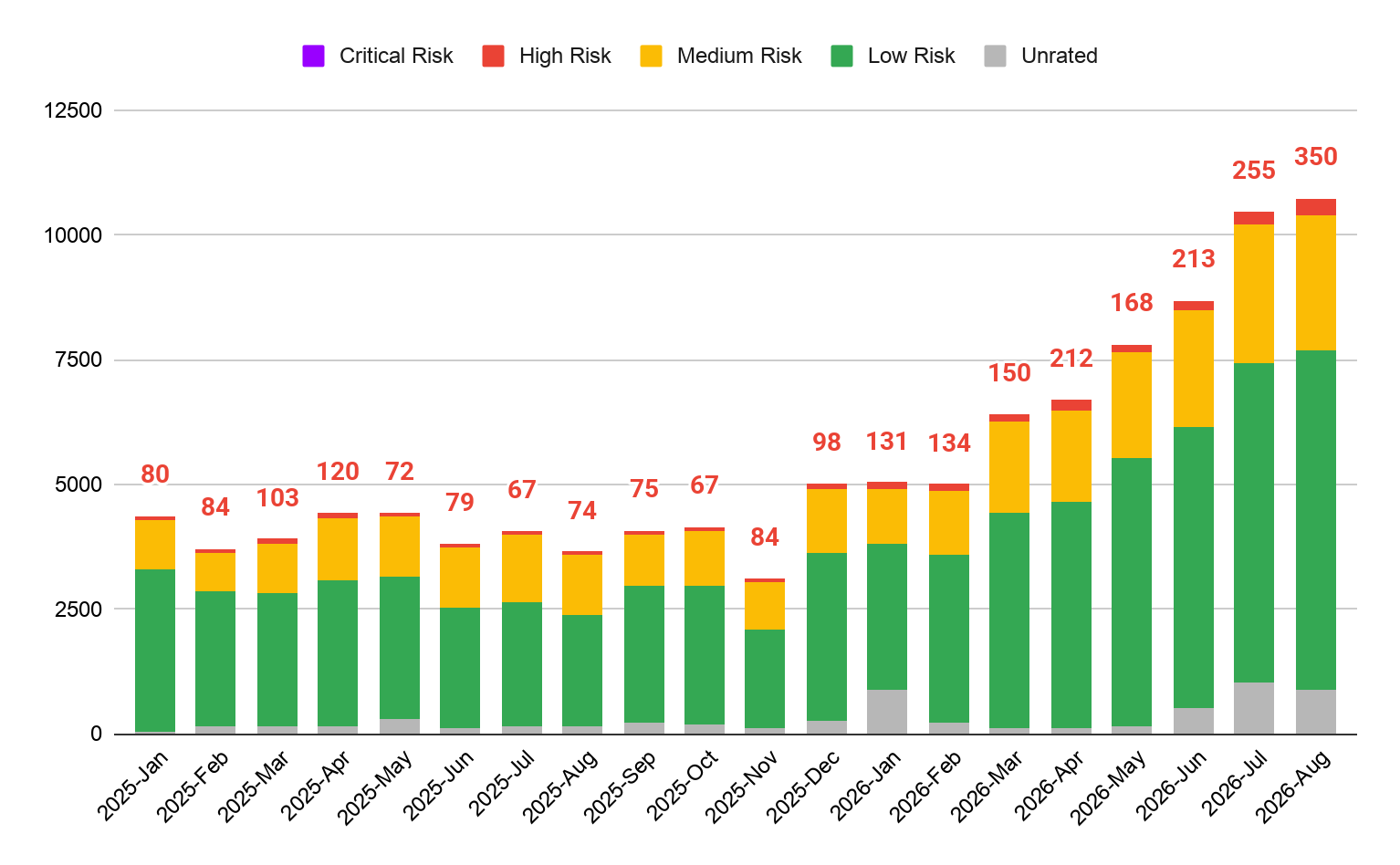
Artificial intelligence has begun to exert a profound influence, accelerating the velocity of vulnerability discovery and fundamentally altering the nature of the identified flaws. Researchers at Google have unearthed a critical distinction: fully half of the vulnerabilities discovered utilizing AI facilitate remote code execution. Conversely, among conventionally discovered vulnerabilities, this perilous proportion reaches a mere 26%.
The Google Threat Intelligence Group meticulously analyzed statistics from January 2025 through August 2026, concluding that the vulnerability market has accelerated precipitously. According to their comprehensive vulnerability discovery and exploitation trends analysis, researchers disclosed 5,045 flaws in January 2026. This figure surged to 10,477 in July, before peaking at 10,740 in August.
Deciphering the Surge in CVEs
However, an escalating volume of CVE records does not inherently signify a proportional increase in actual threats. The automated assignment of identifiers within certain open-source projects can dramatically artificially inflate these statistics. For instance, between January and August, approximately 5,000 CVEs explicitly referenced the Linux kernel; yet, Google recorded zero zero-day vulnerabilities among them exploited in wild attacks.
Conversely, the quantity of flaws to which GTIG assigned a high-risk classification escalated much more rapidly. In January, researchers cataloged 131 such vulnerabilities; by August, this number had surged to 350, representing a staggering 167% increase. Despite this dramatic growth, high-risk problems constituted merely three percent of all published vulnerabilities in August. It is crucial to note that Google utilized a proprietary risk assessment matrix, circumventing the standard CVSS scale.
The Acceleration of Threat Actors
Adversaries have demonstrably accelerated their operations as well. During the initial eight months of 2026, GTIG registered 141 disclosed vulnerabilities subsequently weaponized in real-world attacks, surpassing the 127 total instances recorded throughout the entirety of 2025. The average volume of exploited vulnerabilities jumped from 10.5 to 18 per month. Nevertheless, the proportion of exploited flaws relative to all disclosed problems remains diminutive: approximately 0.23%, or roughly one in 431.
Currently, Google does not perceive an explosive proliferation of zero-day vulnerabilities. The average number of exploited zero-days merely increased from eight per month in 2025 to 11 in 2026. While August proved anomalous with 22 documented cases, GTIG attributes the vast majority of the attack surge to n-day vulnerabilities flaws already disclosed and frequently already patched.
The Menace of Automated Exploit Generation
Large language models significantly compress the critical window between patch publication and the emergence of a functional exploit. A proficient attacker can weaponize AI to autonomously contrast the legacy and patched versions of an application, scrutinizing the patch code, the vulnerability description, and the proof-of-concept demonstration. This n-day attack vector proves exceptionally hazardous for organizations that delay patch deployment. Google estimates that this rapid transmutation of known errors into operational attack instruments primarily drove the alarming statistics of 2026.
AI Agents: Precision Over Volume
AI-assisted vulnerability discovery yields a distinct risk profile. Among flaws discovered without confirmed AI intervention, 69% received a low-risk designation, while 28% were deemed medium-risk. Conversely, among vulnerabilities whose discovery Google attributes to AI, the low-risk share contracted to 39%, while the medium-risk category expanded to 58%. High-risk discoveries accounted for four percent, compared to three percent conventionally.
This variance likely stems not merely from the inherent capabilities of the models, but from the strategic objectives researchers assign to these autonomous agents. Rather than initiating indiscriminate sweeps for trivial errors, researchers direct these systems to scrutinize mission-critical components, privilege boundaries, legacy C and C++ libraries, runtime environments, and hypervisors. Agents can autonomously construct fuzzing environments, monitor memory states, and dissect labyrinthine operational sequences. Consequently, they frequently uncover subtle memory corruption and intricate logic errors that routinely evade traditional static analysis tools.
Real-World Consequences: The BeyondTrust Breach
This theoretical risk has decisively breached the confines of laboratory experimentation. The Hacktron AI system autonomously discovered CVE-2026-1731, a critical vulnerability impacting BeyondTrust Remote Support and Privileged Remote Access. This devastating flaw permitted an unauthenticated, remote user to execute arbitrary operating system commands. BeyondTrust rapidly released a critical patch in early February. Astonishingly, mere four days post-disclosure, GTIG observed the vulnerability actively exploited in the wild. Within seven days, five distinct threat actor groups had incorporated the exploit into their arsenals.
Vulnerabilities Within the AI Infrastructure
Simultaneously, the volume of vulnerabilities intrinsic to artificial intelligence infrastructure is expanding rapidly. Between January 2025 and August 2026, GTIG cataloged 2,076 CVEs directly impacting AI systems; distressingly, over 1,500 of these surfaced during the first eight months of 2026. Approximately half of these issues afflicted agent orchestration and workflow management frameworks. Common catastrophic consequences include arbitrary code execution, command injection, access control bypasses, arbitrary file writes, and Server-Side Request Forgery (SSRF) attacks.
Despite this alarming proliferation of flaws, confirmed in-the-wild exploitation currently remains infrequent. GTIG has detected actual attacks against only a handful of AI infrastructure vulnerabilities and has yet to record the exploitation of an unknown zero-day within such systems. Researchers define the current epoch as deeply transitional: AI is simultaneously accelerating the discovery of critical vulnerabilities while inadvertently empowering attackers to rapidly deconstruct published patches and forge known flaws into devastatingly effective exploits.
Support Our Threat Intelligence
If you find our technology report and cybersecurity news helpful, consider supporting our work.
 Buy Me a Coffee
PayPal
Buy Me a Coffee
PayPal


