The Consolidation of North Korean Cyber Doctrine: From Fragmented Threat Actors to a Unified Cyber Ecosystem
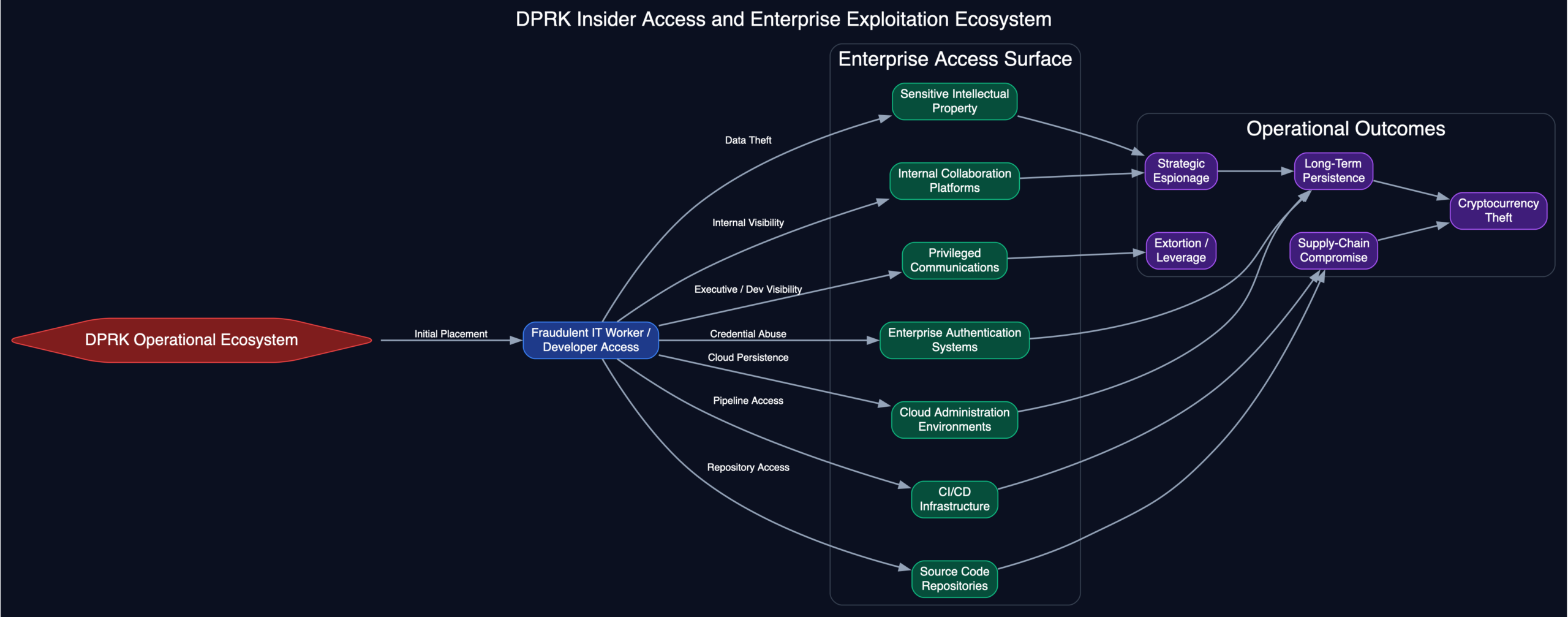
North Korea’s adversarial presence within the digital theater has transcended the legacy paradigm of isolated, decentralized hacking collectives. Per comprehensive threat intelligence compiled by Krypt3ia, the state’s offensive cyber apparatus has evolved into a highly integrated, codependent ecosystem. This unified matrix strategically orchestrates fraudulent remote employment schemes, targeted developer compromises, digital asset exfiltration, and traditional espionage. These distinct operational vectors converge upon a singular, systemic geopolitical mandate: the illicit generation of capital, the circumvention of international economic sanctions, and the systematic exfiltration of proprietary sovereign data.
Security analysts maintain that traditional taxonomy labels for individual threat syndicates are losing relevance against contemporary operational realities. Cyber campaigns that historically presented as disparate initiatives are now frequently exposed as sharing identical infrastructure arrays—leveraging overlapping command-and-control (C2) nodes, mutual hosting tenancies, shared software utility suites, recycled synthetic identities, and unified initial access methodologies to breach enterprise networks.
Synthetic Personnel Infiltration: The Weaponization of Remote Employment
A primary spearhead of this consolidated doctrine is the execution of highly organized fraudulent employment operations. North Korean cyber operators systematically harvest legitimate identification credentials and draft fictitious professional histories. Bolstered by regional intermediaries, virtual private network (VPN) masking layers, and geographically distributed “laptop farms,” these actors successfully insert themselves into international corporations under the guise of conventional remote personnel or external contractors. Once onboarding is complete, these adversaries secure legitimate, high-privilege access to core administrative infrastructures, corporate communication channels, production cloud environments, and day-to-day organizational workflows.
This vector of initial access is profoundly more difficult to detect than standard malware deployment. To automated endpoint protection suites and network telemetry sensors, the threat actor manifests as an authenticated employee, authenticating via standard access gates and leveraging approved corporate software utilities. Consequently, the state apparatus establishes enduring, low-observability persistence inside high-value networks entirely free from the noise typically generated by brute-force boundary breaches.
Supply Chain Interdiction: The Targeted Exploitation of Developer Environments
Concurrently, North Korean operators maintain an aggressive focus on the developer community, leveraging fraudulent employment solicitations and counterfeit technical interviews. Targets are induced into executing assessment exercises, downloading weaponized software repositories, or initializing projects to validate technical competencies. Hidden within these downstream architectures reside compromised code dependencies, obfuscated scripts, and malicious environmental variables designed to silently infect the engineer’s local workstation.
The strategic utility of these targeted incursions vastly eclipses the compromise of a singular local machine. Software engineers routinely command access to core source-code repositories, sensitive cloud staging areas, automated CI/CD build environments, high-privilege authentication tokens, internal chat channels, and infrastructure credentials. By compromising a solitary technical specialist, the adversary secures the necessary leverage to pivot laterally into the organization’s macro architecture, trigger widespread supply-chain contamination, or infiltrate interconnected decentralized financial services.
Sophisticated Liquidity Exfiltration and the Exploitation of Institutional Trust
While North Korean state actors continue to execute high-volume cryptocurrency thefts, their tactical methodology has achieved significant maturity. The era of direct, un-orchestrated incursions against digital asset exchanges or custodial wallets has largely been replaced by multi-stage preparation. Adversaries first execute credential-harvesting routines, establish persistence within enterprise cloud systems, leverage the access of embedded synthetic employees, and systematically compromise key developer profiles. By the hour of asset exfiltration, the orchestrators possess a comprehensive map of the victim’s internal financial flows, privilege boundaries, and defensive security postures.
Following a successful exfiltration event, the stolen capital is instantaneously fragmented and routed through an intricate labyrinth of wallet structures, cross-chain bridges, and alternative asset-swapping protocols. To permanently obscure the transactional audit trail, the threat actors aggressively exploit decentralized finance (DeFi) primitives, non-custodial mixing services, and automated multi-tiered routing matrices. The velocity of this financial dispersion effectively paralyzes the containment capabilities of security compliance teams and severely compounds the forensic challenges faced by international regulatory investigators.
Furthermore, Krypt3ia highlights an accelerating reliance on the subversion of trusted developer platforms. Rather than deploying conspicuous, dedicated command infrastructure that might attract signature-based analysis, North Korean operators are increasingly staging their malicious telemetries within GitHub, legitimate public cloud environments, enterprise collaboration suites, native remote desktop utilities, and open-source package registries. This tactical traffic blends seamlessly into routine corporate network volumes, rendering anomalies nearly invisible to standard perimeter defenses.
Macro Perspective: An Interconnected Matrix of Persistent Compromise
Ultimately, North Korea is no longer constructing ephemeral, linear cyber campaigns, but rather a self-sustaining cyber matrix where every successfully acquired access coordinate is recycled to amplify subsequent operations. A single synthetic recruitment interaction can catalyze the compromise of a key developer; that developer’s infected environment can expose a vulnerability in a cloud environment; and that cloud environment can serve as the definitive springboard to execute massive cryptocurrency exfiltration or harvest critical state intelligence. This operational architecture endows the state’s apparatus with immense structural flexibility, high resilience against defensive countermeasures, and the capacity to severely obstruct accurate forensic attribution.
The definitive conclusion of the intelligence brief establishes that North Korea has masterfully transformed institutional trust into a high-caliber offensive weapon. Trust in remote personnel, trust in technical specialists, trust in reputable cloud architectures, trust in open-source code repositories, and trust in daily enterprise software services have all been integrated into the state’s core attack strategy. For enterprise defenders, this evolutionary shift dictates that modern perimeter security can no longer rely exclusively on isolating malicious binary files. Comprehensive resilience now demands the continuous, zero-trust verification of human actors, active account behaviors, access privilege assignments, elastic cloud states, and the totality of the software development lifecycle.
Support Our Threat Intelligence
If you find our technology report and cybersecurity news helpful, consider supporting our work.
 Buy Me a Coffee
PayPal
Buy Me a Coffee
PayPal


