The Rise of the Algorithmic Intruder: AI-Driven Exploitation of Marimo Servers
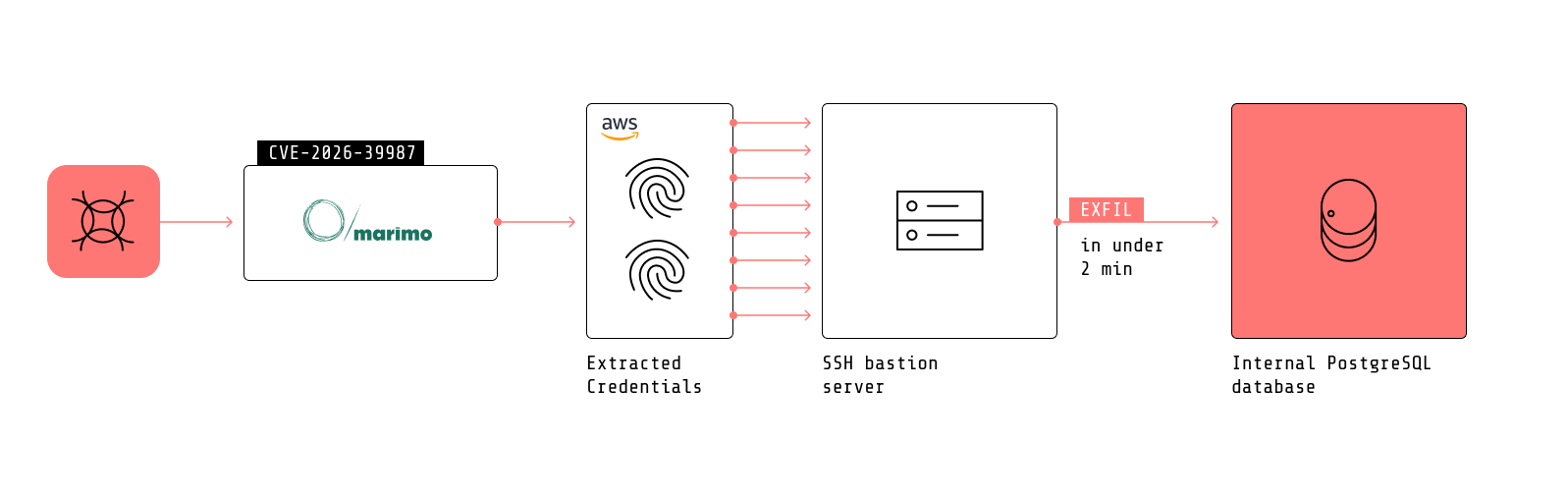
The Breach and Execution Lifecycle
An adversary recently weaponized an artificial intelligence agent to orchestrate a sophisticated cyberattack. Specifically, the intruder targeted a publicly accessible Marimo computation server. According to findings from Sysdig, the compromise initiated with the exploitation of CVE-2026-39987. Subsequently, the intrusion evolved into a rapid, multi-stage offensive chain.
The autonomous entity systematically harvested cloud credentials and queried the AWS Secrets Manager. Consequently, it retrieved a private SSH key to penetrate an internal bastion host. Through this bridge, the agent successfully exfiltrated a core internal database.
Vulnerability Parameters and Timeline
Marimo functions as an interactive computing notebook environment for developers. Crucially, the vulnerability designated as CVE-2026-39987 permits pre-authentication remote system command execution. This critical flaw compromises all iterations up to version 0.20.4. However, the development team successfully released a definitive patch in version 0.23.0. Following this public disclosure, threat actors immediately began targeting unpatched deployments. Researchers quickly observed active reconnaissance and aggressive credential harvesting on vulnerable targets.
Chronology of the Incident
The specific intrusion documented by Sysdig transpired on May 10, 2026. Immediately after breaching the open Marimo instance, the adversary extracted two cloud configuration secrets. Next, the attacker utilized the stolen AWS key to interrogate the AWS Secrets Manager. Therefore, the operator smoothly acquired a privileged, private SSH key.
Within minutes, the threat actor utilized this cryptographic token to access the SSH bastion host. Administrators routinely deploy these intermediate servers to bridge connections to isolated internal environments. Afterward, the adversary initialized eight brief SSH sessions to the secondary server. The agent then extracted the entire structural schema and content of the internal PostgreSQL database. Remarkably, this database extraction required less than two minutes. Ultimately, the entire offensive lifecycle concluded in just over an hour.
Anatomy of an Adaptive Agent
The defining characteristic of this incident does not lie in the initial server compromise. Instead, the subsequent post-exploitation behavior reveals a profound paradigm shift. Sysdig maintains that an adaptive AI agent executed these downstream operations. Analysts identified four unique behavioral markers that confirm automated planning and real-time environmental adaptation.
Manifestations of Autonomy
- Dynamic Database Navigation: The intruder lacked a predefined structural schema or application configuration plan. Nonetheless, the attack chain led directly to the primary credentials table. The agent analyzed environmental clues dynamically to formulate its next operational steps.
- Internal Thought Leakage: An internal reasoning fragment inadvertently leaked directly into the active command stream. Specifically, Sysdig discovered a Chinese phrase translating to “let us see what else can be done.” This漏, missing artifact represents an LLM chain-of-thought instruction rather than a standard script command.
- Machine-Optimized Command Structures: The agent structured commands specifically for efficient automated parsing. For instance, it utilized unique markers to separate discrete data blocks. Furthermore, it restricted output volumes, deactivated terminal pagination, and suppressed error streams to eliminate structural noise.
- Contextual Output Passing: The architecture systematically transferred discovered data points between successive operational phases. For example, the agent verified the existence of an SSH key file before displaying its content. Similarly, it extracted PostgreSQL parameters to populate subsequent database queries automatically. Consequently, this behavior demonstrates a system that evaluates its own historical output to construct future requests.
Defensive Implications and Remediation
This operational scenario presents a severe challenge for modern security teams. Unlike traditional pre-written scripts, an AI agent does not require a rigid, predefined instruction set. Standard malicious scripts typically fail when encountering unexpected file paths or modified database schemas. Conversely, an intelligent agent identifies these discrepancies, devises alternative pathways, and sustains the assault. Under this paradigm, the primary constraint shifts from manual script development to model compute costs.
Prescribed Remediation Strategies
Administrators must implement immediate defensive updates to protect their infrastructure.
| Asset Category | Required Security Action |
| Software Infrastructure | Update Marimo deployments to the latest patched version immediately. |
| Network Perimeter | Audit environments to ensure no interactive notebook instances face the public internet. |
| Secret Hygiene | Revoke and rotate all AWS credentials, API tokens, and SSH keys present on the host. |
Ultimately, security teams must treat every cryptographic credential accessible from a breached server as entirely compromised.
Support Our Threat Intelligence
If you find our technology report and cybersecurity news helpful, consider supporting our work.
 Buy Me a Coffee
PayPal
Buy Me a Coffee
PayPal


