Massive Ransomware Attack Paralyzes Japan’s IDCF Cloud
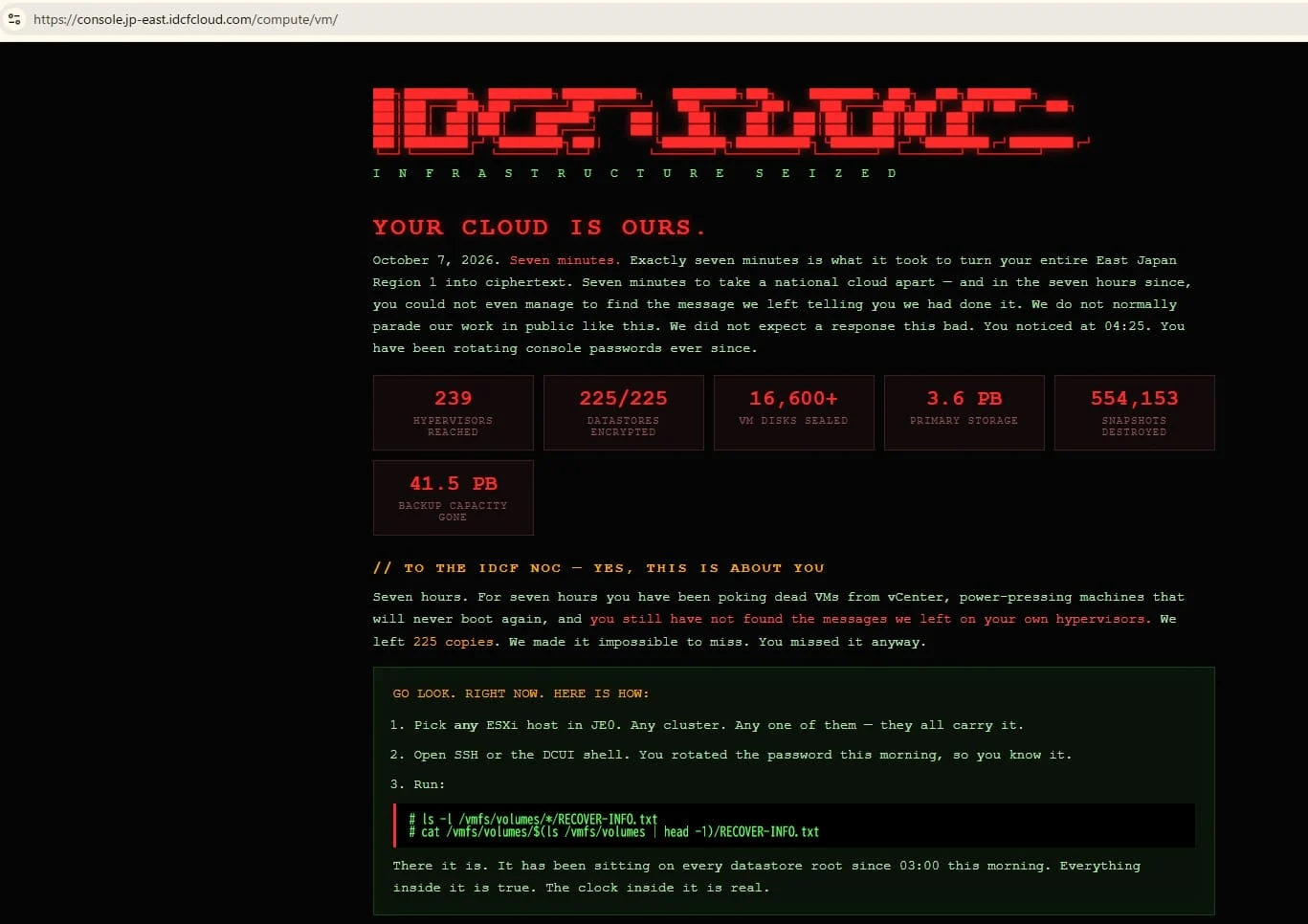
A catastrophic ransomware attack has severely crippled a significant portion of the Japanese cloud platform, IDCF Cloud, a critical infrastructure component upon which hundreds of corporate enterprises and government agencies rely. Currently, 495 organizations are confirmed victims. IDC Frontier, the cloud operator, has ominously warned that independent data recovery on the compromised servers is highly improbable. Consequently, clients lacking isolated, external backups face the grim prospect of permanent, irreversible data loss.
The devastating intrusion occurred on October 7, at approximately 03:40 Japan Standard Time. Malicious actors successfully penetrated the East Japan Region 1 infrastructure, a primary zone within the cloud platform owned by a SoftBank subsidiary. IDC Frontier officially confirmed the ransomware attack and subsequently severed network access to the afflicted systems in a desperate bid to halt the malware’s lateral propagation.
Widespread Devastation and Data Loss Risks
The most severe consequences are concentrated within four specific availability zones: Tesla, Henry, Pascal, and Joule. Virtual servers hosted within these zones have catastrophically halted and remain entirely unresponsive. IDC Frontier has formally conceded that extracting or restoring client data housed within these compromised environments will be extraordinarily difficult, if not impossible. According to the company’s current assessment, data retrieval is only viable utilizing external backup archives independently maintained by the affected clients.
The provider has urgently advised compromised organizations to redeploy their information systems anew across alternative, unaffected regional facilities. To date, no evidence suggests the attackers breached the remaining two availability zones within East Japan Region 1, the other eastern regions, or the western region. Nevertheless, as a paramount precaution, the provider strongly recommended clients independently secure backups and temporarily suspended access to administrative control panels across all regions globally. While comprehensive security audits remain ongoing, IDC Frontier engineers are manually executing fundamental virtual machine operations, such as server initiation and termination, strictly upon verified client request.
Collateral Damage Spreads to Major Corporations
The profound repercussions of this attack have rapidly metastasized far beyond the cloud provider itself. On October 9, the East Japan Railway Company (JR East) issued a stark warning regarding the potential compromise of sensitive customer data stemming directly from the IDC Frontier breach. A compromised third-party contractor managed critical email communications for JR East’s “Ekinet” ticket reservation service and the “Adult Holiday Club” loyalty program. Consequently, approximately 1.67 million and 390,000 individual records, respectively, are now severely threatened.
Beyond email addresses, members of the loyalty program face the potential exposure of their birth dates, membership identification numbers, and credit card expiration dates. However, JR East stated they possess no evidence indicating the attackers acquired names, physical addresses, telephone numbers, or complete credit card numbers. In a separate disclosure, the railway operator’s subsidiary, View Card, reported a distinct risk concerning the potential leakage of approximately 4.03 million email addresses. Cumulatively, the total volume of endangered records approaches 6.09 million, although significant overlap may exist across the various databases. The actual exfiltration of this data by the attackers remains unconfirmed.
The Importance of Independent Backups
Six Apart, the prominent developer of the Movable Type content management system, provided a stark, tangible illustration of the attack’s devastating business impact. Following the IDCF Cloud shutdown, 31 critical servers hosting the platform’s cloud iteration abruptly ceased functioning, rendering all hosted websites and their corresponding administrative interfaces utterly inaccessible. The company rapidly acknowledged the futility of attempting to restore the compromised servers within the original, infected infrastructure.
By October 8, Six Apart had successfully migrated all 31 servers to Sakura Cloud. This miraculous recovery was entirely dependent upon pristine backup copies generated on October 7 at 01:00, mere hours preceding the attack. Crucially, these backups were securely sequestered within Google Cloud, entirely isolated from the compromised IDCF infrastructure. This strategic foresight permitted the rapid restoration of systems, although any modifications executed subsequent to the final backup’s creation were inevitably lost.
Assessing the Attacker’s Devastating Claims
The purported magnitude of the destruction appeared even more catastrophic according to a chilling ransom note the attackers audaciously embedded directly within the IDCF Cloud administrative console. Astute users managed to preserve screenshots of this interface immediately prior to the implementation of access restrictions. In this brazen message, the criminals bragged that they required a mere seven minutes to entirely encrypt the East Japan Region 1 infrastructure.
According to the assailants’ claims, they successfully compromised 239 hypervisors, maliciously encrypted all 225 data storage arrays encompassing a staggering 3.6 petabytes, completely disabled over 16,600 virtual disks, and ruthlessly annihilated 554,153 system state snapshots. The attackers further asserted the destruction of an additional 41.5 petabytes of crucial backup storage capacity. IDC Frontier has not officially verified these catastrophic figures; therefore, independently assessing the true scale of the devastation based solely upon the criminals’ assertions remains impossible.
The alleged systemic compromise of the hypervisors, the foundational software components governing virtual machines across physical servers represents the most perilous aspect of this intrusion. Securing absolute control over this fundamental infrastructural layer empowers an attacker to instantaneously obliterate a vast multitude of client systems. The systematic destruction of state snapshots further exacerbates the recovery process, effectively stripping administrators of their ability to rapidly revert compromised machines to a secure, previous state. This precisely underscores why independent, isolated backup copies, inaccessible from the primary compromised infrastructure, remain the ultimate, most reliable lifeline for recovery following a sophisticated ransomware assault.
Support Our Threat Intelligence
If you find our technology report and cybersecurity news helpful, consider supporting our work.
 Buy Me a Coffee
PayPal
Buy Me a Coffee
PayPal


