Infrastructure as Code Weaponized Against Developers
Infrastructure code has horrifyingly metamorphosed into a convenient snare for developer workstations. Cybersecurity firm Aikido recently unearthed malicious code deeply embedded within dual Terraform providers and twin Go modules. The company classifies this terrifying discovery as the inaugural documented instance of systematic malware distribution weaponizing the official Terraform Registry.
The malicious providers, specifically designated as gocommunity-io/dockerd and kreuzwenker/docker, were surreptitiously published in early September. The latter explicitly masquerades as the immensely popular kreuzwerker/docker provider, which currently boasts a staggering 56 million cumulative downloads. Crucially, a Terraform provider functions as an integrated plugin, empowering Terraform to directly manipulate external services. Consequently, this highly privileged component executes directly upon the developer’s local machine or deep within the sensitive CI/CD pipeline environment.
Advanced Evasion and Payload Execution
This malicious logic remains profoundly dormant during superficial security audits. The toxic code within both providers only detonates when the combined SHA-256 hash of the containerName and networkID variables flawlessly matches a rigidly pre-configured hash value. Upon successful validation, the program decrypts the hidden path to a concealed archive, aggressively extracts its contents, executes AES decryption upon the files, and subsequently launches the resultant Go code via a discrete, isolated command.
This secondary stage inevitably downloads a Remote Access Trojan (RAT). The program meticulously harvests critical intelligence concerning the underlying operating system, processor architecture, hostname, active user profile, and the presence of Node.js. Following this reconnaissance, it initiates contact with its command-and-control (C2) infrastructure. Strikingly, operational commands arrive via two independent, redundant channels: a covert Slack workspace and a malicious smart contract deployed on the Arbitrum Sepolia testnet. This architecture allows the adversaries to subsequently execute supplementary Go or JavaScript payloads at will.
This sophisticated architecture severely impedes forensic analysis. The RAT relentlessly polls the blockchain approximately every three seconds, and the Slack channel every ten seconds. Furthermore, all communications are cryptographically secured using unique keys generated specifically for individual, infected clients. Within a standard, automated sandbox environment, the provider might remain entirely benign, displaying absolutely zero malicious behavior unless the evaluating system accurately reproduces the highly specific, cryptographic launch parameters.
Deceptive Domains and the Graphalgo Connection
Simultaneously, the threat actors propagated this identical malicious code via the Go modules gocommunity.io/orderedbtree and gogets.dev/btreex. In this secondary vector, the perpetrators concealed the archive by masquerading it as a benign SQL file, while tethering its execution to a highly specific input variable. The campaign’s architects purposefully forged commit timestamps, creating a deceptive project history that appeared substantially older than the actual September package publication date.
To further camouflage their operations, the operators established the gocommunity[.]io and gogets[.]dev domains, meticulously designed to mimic legitimate, emerging Go package ecosystems. For a deeper understanding of how these threats operate, you can read the comprehensive analysis by Aikido detailing the Graphalgo Terraform and Go modules campaign. This deceptive tactic is designed to cultivate unearned trust in their counterfeit packages.
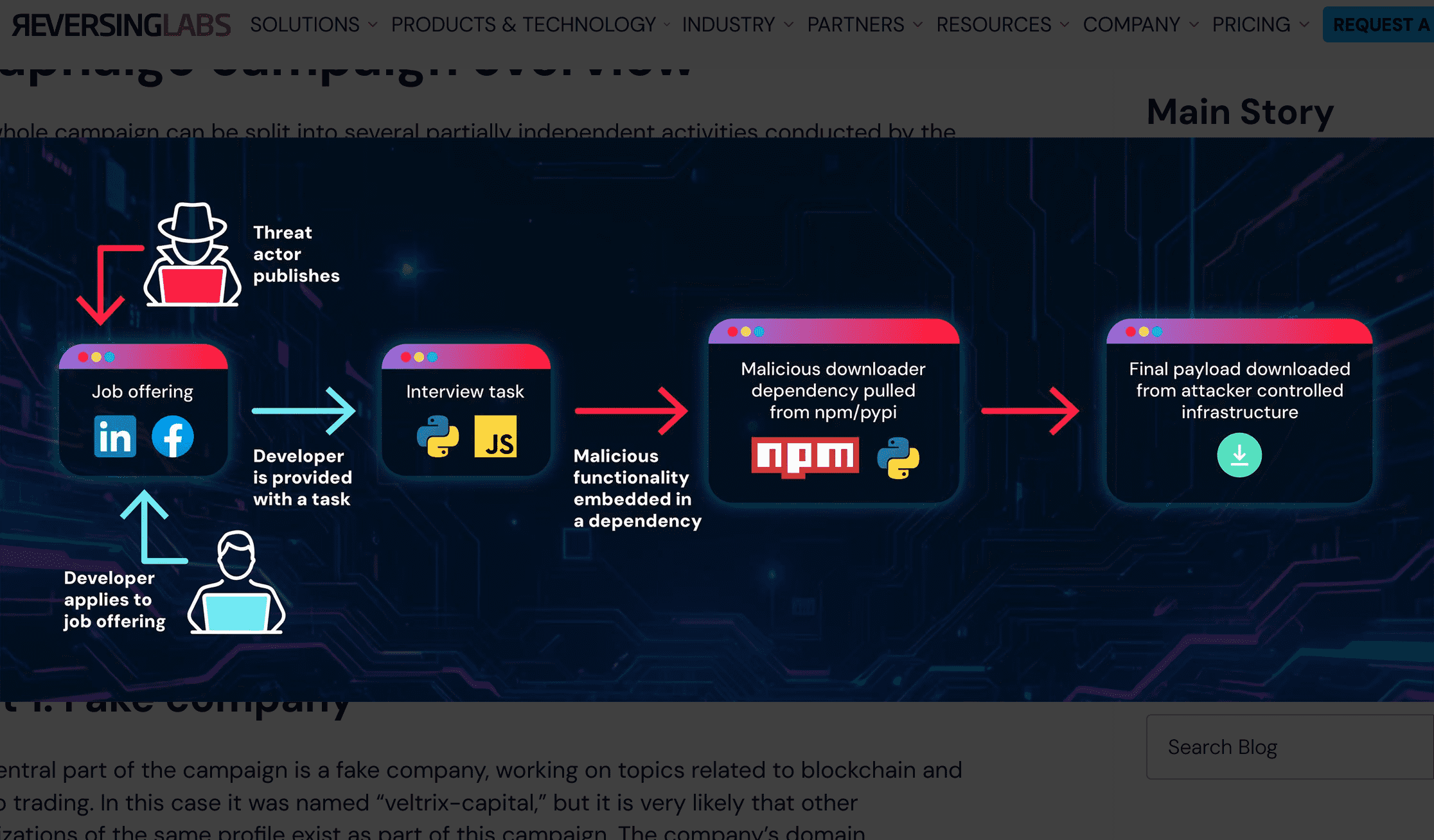
Crucial infrastructure footprints and a shared public cryptographic key firmly link these novel samples to the established Graphalgo campaign. In February, ReversingLabs definitively attributed Graphalgo to the notorious, North Korean state-sponsored Lazarus Group, who notoriously lured developers utilizing fictitious employment opportunities and compromised coding assessments. You can review the details of that fake recruiter campaign targeting crypto developers. Aikido confirms the profound technical intersection linking these new packages to that historical campaign, rather than attempting an independent, definitive attribution for this specific episode.
Assessing the Impact and Remediation Strategies
By scrutinizing publicly accessible messages within the governing Slack channel, Aikido identified 18 distinctly unique hostnames. This compromised cluster encompassed three Windows machines, five Linux systems, and ten macOS workstations. The overall scale currently appears constrained, and the highly selective execution conditions strongly indicate a meticulously targeted operation.
Aikido unequivocally advises security teams to consider any workstation or CI/CD runner that executed any of these four compromised components as fundamentally breached. The firm strongly recommends immediately isolating the affected system, systematically revoking and replacing all associated GitHub, GitLab, and package registry tokens, alongside all cloud credentials and SSH keys. Administrators must rigorously audit all historical activity logs, purge the malicious dependencies, and completely reimage the operating system, as merely uninstalling the compromised package remains profoundly insufficient.
Support Our Threat Intelligence
If you find our technology report and cybersecurity news helpful, consider supporting our work.
 Buy Me a Coffee
PayPal
Buy Me a Coffee
PayPal