The Aqua Nexus: Google Expands Water Stewardship Pledges Amid AI Expansion
Balancing Compute with Conservation
In response to intense public backlash over data center resource consumption, Google expanded its water stewardship commitments. Consequently, the enterprise aims to achieve a net water-positive status by 2030. This target requires replenishing more water than the corporation consumes globally.
This comprehensive initiative encompasses infrastructure modernizations, ecological restoration, and advanced air-cooling technologies. Ultimately, these measures serve a crucial dual purpose. They sustain expanding computational demands while assuaging community anxieties regarding corporate depletion of municipal supplies.
The Five Pillars of Aquatic Governance
Statistically, a mid-sized data center expends approximately 300,000 gallons of water daily. This volume is equivalent to the consumption of one thousand American households. Nevertheless, Google defended its footprint by citing aggregate national data center usage.
The firm asserted that its total domestic consumption constitutes less than one percent of residential lawn irrigation. Despite this justification, localized communities remain deeply unsettled by such highly concentrated environmental strain.
Consequently, the technology giant articulated five definitive water conservation pledges:
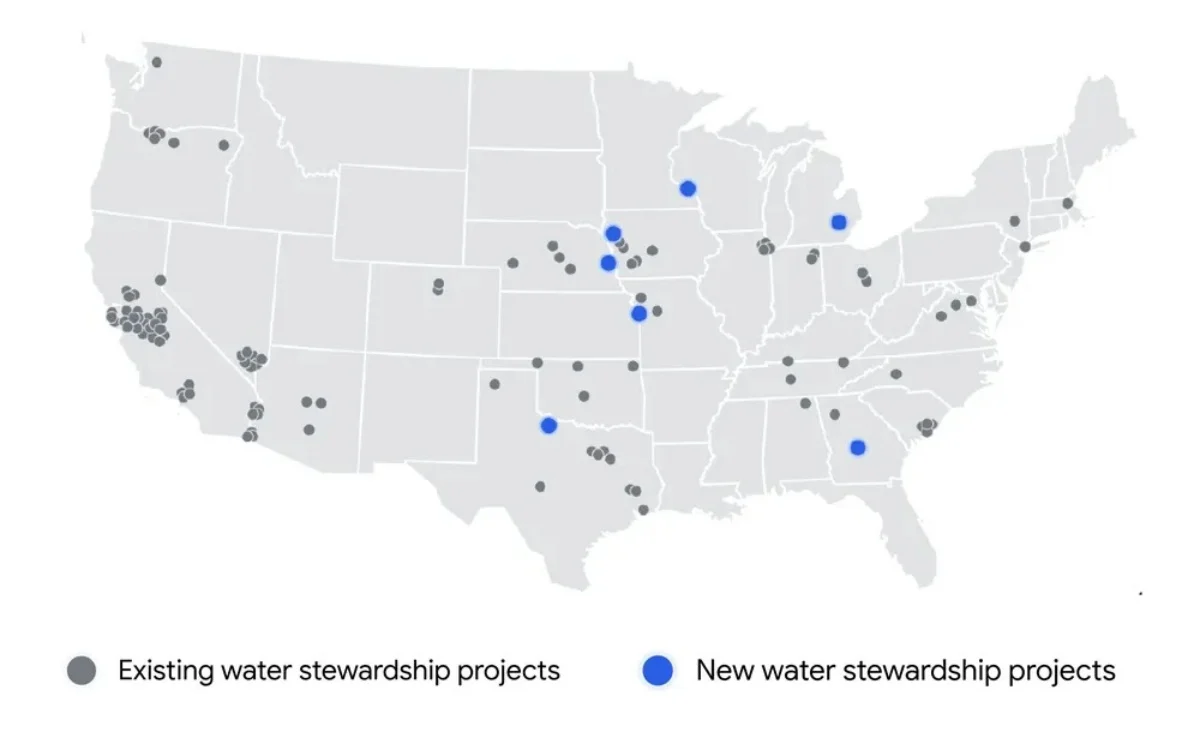
- Achieving Net-Positive Rejuvenation: Google currently orchestrates 165 specialized watershed management projects across 97 global basins. Upon full implementation, these initiatives will return an astonishing 19 billion gallons of water annually to nature. Remarkably, this volume represents more than double the company’s total water expenditure recorded in 2024.
- Modernizing Municipal Infrastructure: To support financially constrained public utilities, Google promises to subsidize the modernization of municipal supply networks. To date, the enterprise has allocated over $500 million toward water infrastructure enhancements. These investments primarily target structural reinforcement and advanced leak detection.
- Deploying Arid-Zone Air-Cooling Architecture: The corporation leverages data-driven predictive modeling to evaluate prospective data center locales. Should a region exhibit severe water scarcity, Google will mandate the implementation of advanced air-cooling systems. Illustrating this policy, the firm announced in February that its new Texas facility will rely entirely on air-cooled systems.
- Eradicating Operational Opacity: Demolishing historical industry norms that shrouded resource consumption in secrecy, Google pledges absolute transparency. Moving forward, the enterprise will continuously publish granular, facility-specific metrics detailing its annual water usage.
- Utilizing Non-Potable Alternatives: Google actively collaborates with local utilities to secure alternative and recycled cooling mediums. In Douglas County, Georgia, for instance, the company partnered with water authorities to utilize treated wastewater for thermal regulation.
Furthermore, Google announced a dedicated $17 million capital allocation to fund novel water stewardship initiatives across seven American states. These grants will empower agriculturalists to transition toward regenerative farming methods that conserve crucial soil moisture. Additionally, the funding will restore native flora to naturally process stormwater runoff and mitigate localized flood hazards.
Strategic Perspectives: The New Ecological Frontier in the AI Arms Race
This massive corporate declaration highlights a profound reality. As technology titans pursue absolute computational supremacy, they inevitably collide with the immutable boundaries of local ecology. Historically, cloud providers competed primarily on the volume of Nvidia GPUs acquired or the physical scale of their facilities.
However, prominent environmental advocates recently leveraged crowdsourced data to overlay data center locations onto regional water depletion maps. Consequently, the negative perception of corporate resource siphoning threatens to decelerate the industry’s expansion.
Therefore, Google’s bold commitment to a water-positive status represents a preemptive strategic maneuver. The enterprise intends to disarm environmental litigation and community resistance before they escalate into systemic crises. This directive effectively transfers intense public relations pressure to direct competitors like Microsoft and Amazon Web Services.
Furthermore, it establishes an immutable benchmark for the cloud computing sector. Corporations may expand their infrastructure, but they must simultaneously assume the mantle of environmental guardians.
Concurrently, Google’s parent entity, Alphabet, is preparing a monumental $80 billion equity issuance to finance its upcoming infrastructure expansion. Thus, the scale of global AI infrastructure deployment will inevitably intensify. Striking an elegant equilibrium between computational anxiety and ecological sustainability remains the paramount challenge. This critical balance will ultimately dictate the victors in the subsequent phase of the cloud architecture wars.
Support Our Threat Intelligence
If you find our technology report and cybersecurity news helpful, consider supporting our work.
 Buy Me a Coffee
PayPal
Buy Me a Coffee
PayPal


