Cl0p Affiliates Exploit PTC Windchill for Corporate Extortion
Corporate systems designed to securely warehouse engineering blueprints and proprietary project documentation have morphed into a lucrative extortion vector for cybercriminals. Malicious actors are actively breaching PTC Windchill and FlexPLM servers, exfiltrating invaluable intellectual property, and subsequently bombarding employees with menacing emails threatening public data exposure.
The Attack Vector: Chaining Critical Vulnerabilities
Threat intelligence analysts widely attribute these sophisticated assaults to affiliates of the notorious Cl0p ransomware syndicate. According to an advisory by Ransom-ISAC, alongside findings from eCrime.ch and DEFUSED, perpetrators actively scan for internet-exposed servers. Upon discovery, they ingeniously chain two distinct vulnerabilities. The first flaw inadvertently leaks FlexPLM service details prior to authentication. The second, far more severe vulnerability facilitates arbitrary code execution via the Windchill authorization component.
Following a successful intrusion, attackers deploy malicious JSP web shells cloaked with randomized 16-character hexadecimal filenames. Through these clandestine interfaces, the syndicates remotely execute arbitrary commands, navigate directory structures, and meticulously stage sensitive documents for exfiltration. Consequently, this campaign has ensnared a diverse array of victims, encompassing manufacturing, automotive, aerospace, retail, and apparel enterprises.
CVE-2026-12569: The Critical Gateway
The primary entry point for this campaign is CVE-2026-12569, a critical vulnerability boasting a maximum CVSS score of 9.8. This devastating flaw empowers unauthenticated, remote attackers to execute arbitrary code directly on the targeted server. In response, PTC rapidly deployed patched versions and fervently urged clientele to update their systems immediately. Emphasizing the severity, the U.S. Cybersecurity and Infrastructure Security Agency (CISA) added this specific vulnerability to its Known Exploited Vulnerabilities (KEV) catalog on June 25.
Security researchers suspect that adversaries commenced exploiting this zero-day vulnerability in early June, predating any public disclosure. Prior to launching full-scale attacks, the perpetrators routinely probed Windchill service endpoints to identify susceptible servers. Post-compromise forensic analysis frequently reveals a telltale flst.txt file lingering on the disk, containing an index of the stolen data.
Extortion Tactics: The July 20 Escalation
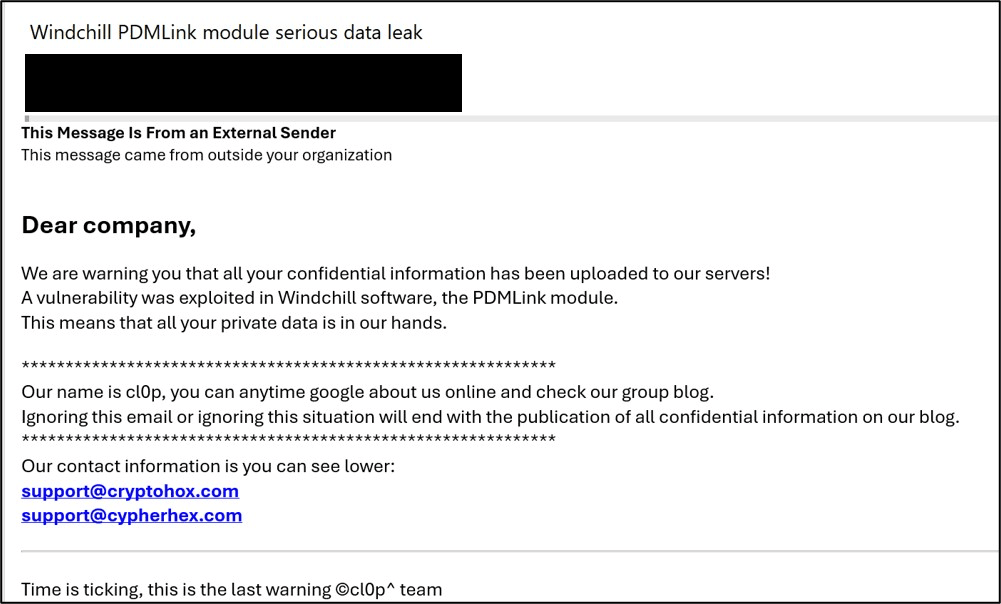
A disturbing new phase of this campaign ignited on July 20. Employees across compromised organizations began receiving targeted emails bearing the ominous subject line: “Windchill PDMLink module serious data leak.” The senders boldly proclaimed they had infiltrated the corporate network via the vulnerable PTC software. To maximize psychological pressure on executive leadership, these extortion emails were indiscriminately broadcast to hundreds of workers within a single victim company.
To execute this mass distribution, the criminals likely hijacked previously compromised, unrelated email accounts. Crucially, these messages contained fresh contact addresses directing victims to the Cl0p syndicate. This aggressive tactic closely mirrors the group’s previous mass-extortion campaigns targeting Oracle E-Business Suite environments.
Attribution and Mitigation Strategies
While the extortion emails explicitly demand communication with Cl0p, definitive technical attribution remains unconfirmed. ReliaQuest confirmed active exploitation of CVE-2026-12569; however, they have not yet definitively established the perpetrators’ identity. Nevertheless, the intricate intrusion methodologies and the deliberate targeting of high-value corporate repositories strongly echo the Cl0p syndicate’s historical modus operandi.
Organizations must immediately apply the PTC patches and ruthlessly sever direct internet access to all Windchill and FlexPLM interfaces. Access should be strictly mandated through a secure corporate VPN or a trusted zero-trust gateway. If administrators detect any indicators of compromise, they must instantly isolate the server, preserve forensic logs, and systematically rotate all potentially compromised credentials and cryptographic keys.
As of July 22, Cl0p has not yet published the names of these specific victims on its dark web leak site. However, the aggressive mass emailing of employees clearly indicates that the perpetrators have decisively transitioned from covert data harvesting to overt, high-pressure extortion.
Support Our Threat Intelligence
If you find our technology report and cybersecurity news helpful, consider supporting our work.
 Buy Me a Coffee
PayPal
Buy Me a Coffee
PayPal


