RefluXFS Linux Vulnerability: High-Severity Root Escalation in XFS
Unmasking the RefluXFS Vulnerability
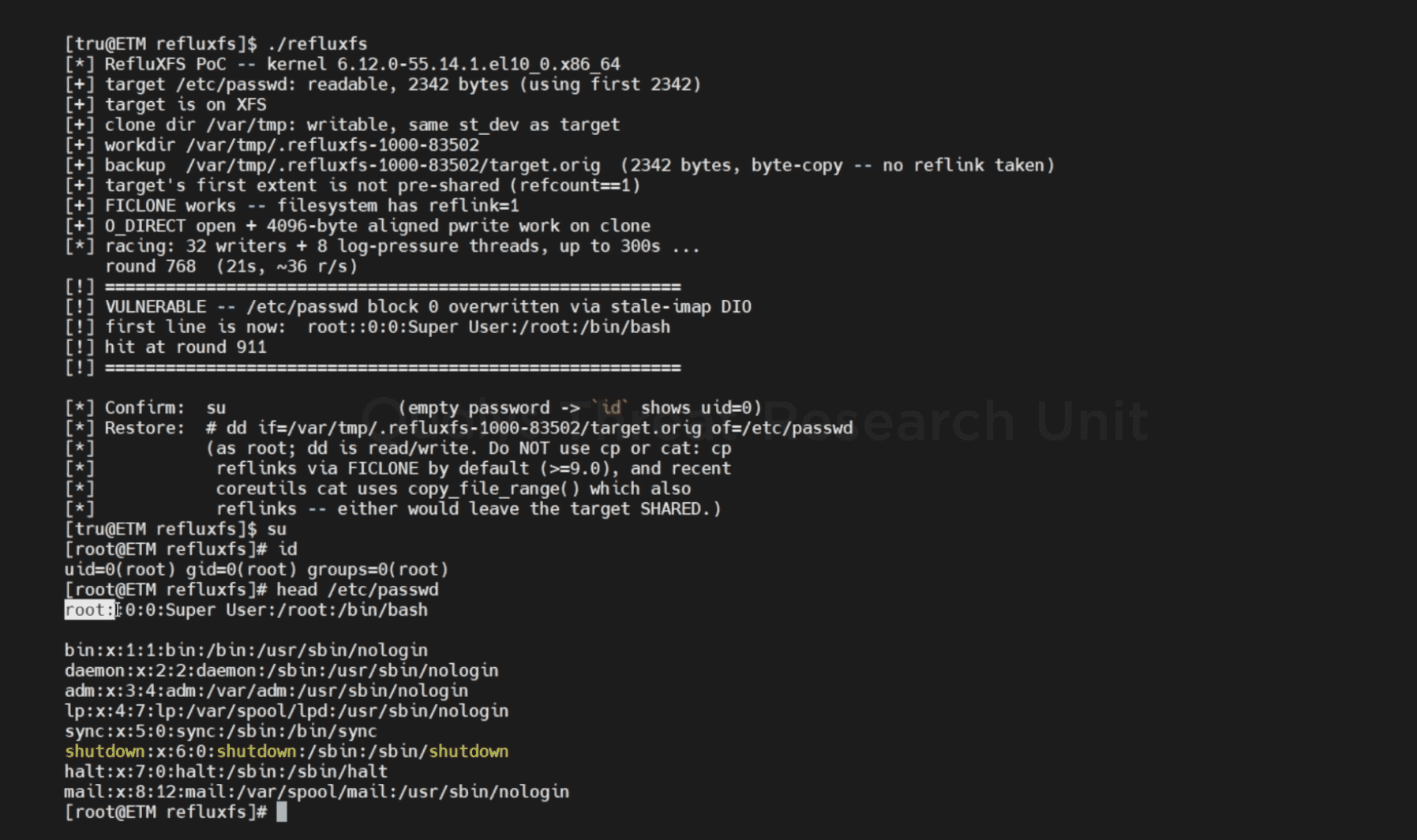
Impervious defense mechanisms in Linux offer no sanctuary when critical vulnerabilities manifest at the filesystem layer itself. The newly identified RefluXFS Linux vulnerability permits an unprivileged local actor to covertly overwrite protected system files and commandeer root privileges on systems operating the XFS filesystem. Notably, this breach occurs even when SELinux operates in Enforcing mode.
Designated as CVE-2026-64600, this security defect affects the Linux kernel spanning from version 4.11 onward. Cybersecurity researchers at Qualys discovered a subtle race condition within the copy-on-write mechanism that XFS utilizes for files sharing common data blocks. The flaw triggers when two concurrent processes execute direct O_DIRECT write requests to the same shared file.
The Mechanics of the Race Condition
During an active write sequence, the Linux kernel temporarily surrenders the file lock while waiting for space within the operation transaction log. A secondary process capitalizes on this fleeting window to alter the underlying block binding. Consequently, the primary process resumes execution using a stale reference, writing data directly into the original, protected disk sector.
Because O_DIRECT intentionally circumvents the system file cache, the kernel fails to re-verify the block status. As a result, modified data commits directly to persistent disk storage without validation.
Exploitation Vector and Proof of Concept
Successful exploitation necessitates local access, an unpatched kernel architecture, an XFS partition configured with the reflink feature, and permissions to construct a linked copy of a readable system file inside a writable directory.
In a proof-of-concept demonstration executed on a standard installation of RHEL 10.2, Qualys researchers completely removed password protection from the root account in mere seconds. This manipulation persisted through system reboots while leaving zero log entries within kernel audit logs. Currently, there is no evidence indicating active exploitation in wild attacks.
Bypassing Traditional Security Architecture
Standard kernel protection routines, container isolation boundaries, and mandatory access control policies like SELinux fail to intercept this exploit path. This immunity stems from the flaw’s origin during low-level disk block allocation. Qualys estimates the potential impact across more than 16.4 million enterprise deployments, though actual risk remains contingent upon specific XFS configurations and directory access permissions.
Remediation and Patch Deployment
Patched kernel updates have been released across major distributions, including RHEL, Oracle Linux, AlmaLinux, Rocky Linux, and Fedora. System administrators are strongly advised to deploy these distribution updates immediately to multi-user environments and internet-facing servers, followed by a full system reboot. The advisory provides no reliable temporary workaround short of applying the vendor-supplied updates.
Support Our Threat Intelligence
If you find our technology report and cybersecurity news helpful, consider supporting our work.
 Buy Me a Coffee
PayPal
Buy Me a Coffee
PayPal


