Persistent Espionage: Covert Campaign Targets Global Stock Exchange Executive
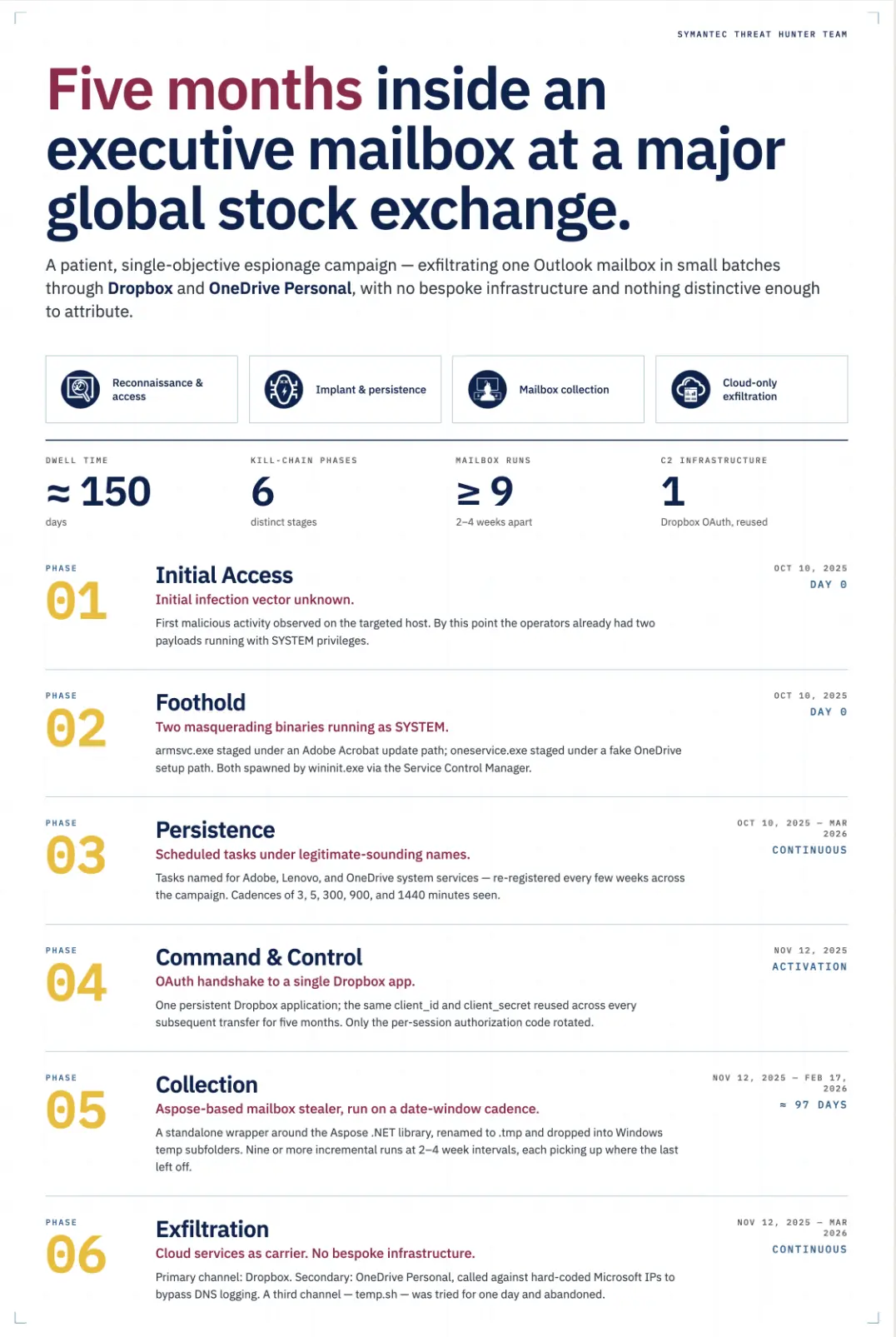
For five months, sophisticated threat actors covertly exfiltrated the correspondence of a prominent global stock exchange executive. According to Symantec, the campaign focused relentlessly on a singular objective. Specifically, the adversaries sought continuous access to the victim’s corporate Outlook account. Consequently, they harvested sensitive data regarding strategic negotiations, calendars, corporate contacts, and internal organizational decisions.
Deciphering the Initial Compromise Matrix
Stealth Ingestion and Masquerading
Investigators could not definitively determine the initial entry vector. However, security tools first detected anomalous behavior on October 10, 2025. At that time, two masqueraded executables already operated on the host architecture with elevated system privileges. Furthermore, the filenames and directory paths meticulously mimicked legitimate Adobe Acrobat Reader and OneDrive components. Therefore, this deceptive alignment effectively cloaked the adversarial presence within the operating system.
Maintaining Persistent Infrastructure Access
To preserve their foothold, the perpetrators established scheduled tasks disguised as authentic Adobe, Lenovo, and OneDrive services. These automated tasks executed malicious payloads at intervals of every few minutes or hours. Additionally, the intruders frequently overwrote configuration settings and altered active file assets. Consequently, these constant modifications significantly hindered standard endpoint detection efforts.
The Exfiltration Mechanism
Utilizing Legitimate Libraries for Data Harvesting
The primary offensive utility consisted of a specialized mail-stealer built upon the legitimate Aspose software library. This utility parsed local Outlook data storage files to harvest historical communications. Subsequently, the program converted the extracted datasets into an optimized format for staging and filtered messages based on explicit time frames. Initially, the actors harvested several months of historical correspondence in a singular bulk operation. Afterward, they systematically extracted fresh messages every two to four weeks.
Evading Network Detection Parameters
The adversaries transmitted the compiled archives in compressed, incremental batches via Dropbox and OneDrive storage nodes. To establish a connection with OneDrive, the actors routed communications directly to hardcoded Microsoft IP addresses. Therefore, the architecture completely bypassed generating traditional DNS queries for the service domain. This tactical approach successfully masked the illicit data exfiltration as routine, benign cloud traffic. As a result, the technique minimized the probability of triggering network security alerts.
Attribution Ambiguity and Remediation Protocols
Analysts could not conclusively attribute the campaign to any known threat group. Nevertheless, the explicit command structure and protracted data collection strongly indicate an espionage objective. Unfortunately, the available forensic evidence remains insufficient for precise geopolitical attribution.
Investigators recorded the final trace of malicious activity on the compromised terminal on March 19, 2026. Ultimately, Symantec published comprehensive indicators of compromise and strongly urges organizations to implement the latest defensive recommendations outlined in their security bulletin.
Support Our Threat Intelligence
If you find our technology report and cybersecurity news helpful, consider supporting our work.
 Buy Me a Coffee
PayPal
Buy Me a Coffee
PayPal


