Cryptographic Stealth: The BYORWXDLL Technique Bypasses EDR Controls via Signed Libraries
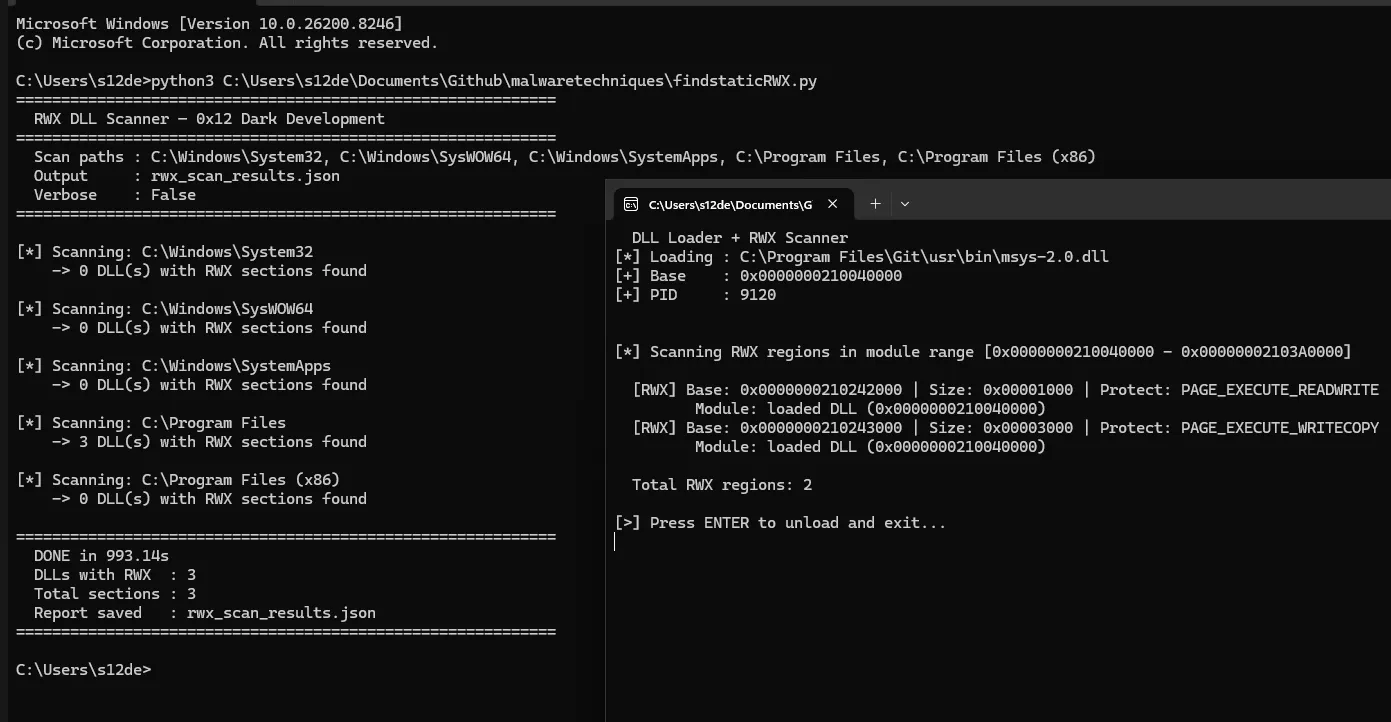
The novel BYORWXDLL technique injects code into Windows processes by leveraging existing memory regions within legitimate, signed DLLs. Consequently, this method sharply reduces the number of anomalous operations tracked by Endpoint Detection and Response (EDR) systems.
Understanding RWX Memory Section Exploit Vectors
Certain signed DLLs inherently contain RWX sections. Furthermore, these specific components remain simultaneously accessible for reading, writing, and execution. Upon loading such a library, Windows establishes a memory segment within the host process. Therefore, an operator can seamlessly write a shellcode payload into this segment. This process enables execution without any preliminary memory staging.
Bypassing Traditional Infiltration Markers
Conventional injection methodologies typically require a series of distinct telemetric steps:
- Memory Allocation: An adversary explicitly requests space using
VirtualAllocEx. - Payload Writing: The threat actor writes the executable code into the process.
- Permission Modification: The operator changes access rights via
VirtualProtectEx. - Thread Execution: Finally, the attacker spawns an independent execution thread.
Conversely, BYORWXDLL entirely bypasses the first two highly conspicuous operations. As a result, using a pre-existing RWX segment generates fewer telemetric signatures. Thus, modern defensive perimeters receive fewer behavioral alarms.
Automated Identification and Ingestion Mechanics
To discover viable libraries, the developer created a specialized Python-based scanner. This utility scans local disk storage to identify DLLs containing active RWX permissions. Subsequently, a separate component loads the discovered library. The program then invokes VirtualQuery to verify that the target memory segment persists during runtime operations.
Executing Remote Thread Manipulation
Following verification, the operator targets a process where the compatible DLL resides. Next, the attacker writes malicious code into the verified address space using WriteProcessMemory. Finally, the handler launches the shellcode via CreateRemoteThread. If the target process lacks the library, the actor can force-load it. However, this preliminary action generates significantly more telemetry.
Research Context and Systemic Implications
The author demonstrated BYORWXDLL within a controlled Windows 11 environment and shared the repository for the scanner and loader. Therefore, this documentation reflects a conceptual proof of work rather than a documented active exploit campaign. Deploying this strategy initially requires comprehensive reconnaissance to identify and validate a suitable DLL on the target operating system.
Support Our Threat Intelligence
If you find our technology report and cybersecurity news helpful, consider supporting our work.
 Buy Me a Coffee
PayPal
Buy Me a Coffee
PayPal


