Sovereign Intrusion: Deconstructing the FalkonC2 Commercial Command Framework
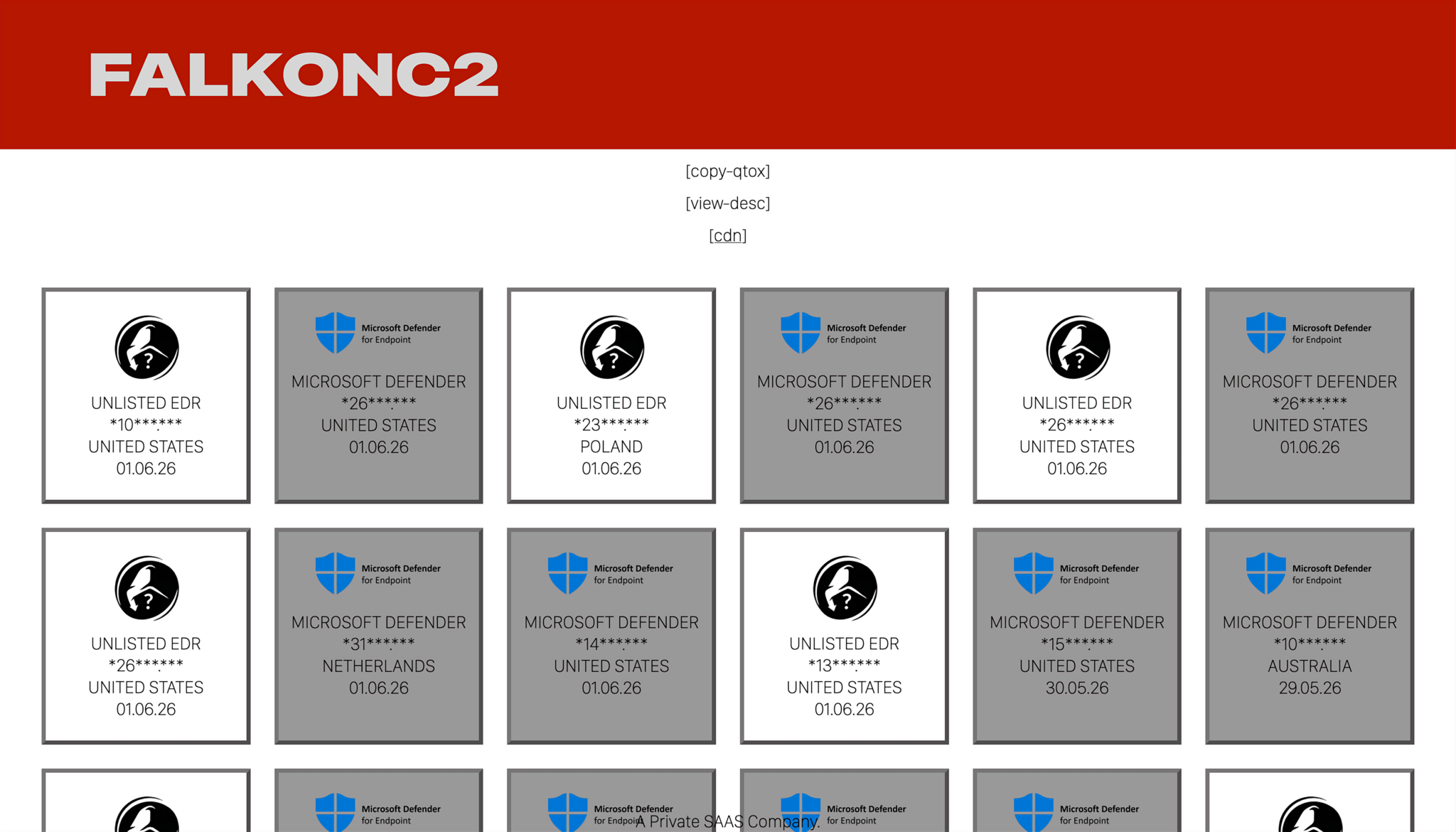
Corporate networks rarely fall victim to indiscriminate assaults. Instead, most breaches leverage meticulously calibrated arsenals specifically engineered for precise targets. Recently, threat analysts at Flare identified FalkonC2. This commercial command-and-control framework facilitates remote management over compromised nodes. Crucially, the developers tailored this architecture explicitly for corporate ecosystems. The platform features an entirely custom codebase written in C++ and MASM64. Therefore, it successfully operates within highly fortified network perimeters.
Evasion Mechanics and In-Memory Execution
The Rotemelli2 Payload Matrix
The core module, designated as Rotemelli2, maintains a compact footprint of merely 23 to 35 kilobytes. Furthermore, the payload executes strictly in-memory and writes no artifacts to local storage. This design purposefully neutralizes enterprise Endpoint Detection and Response (EDR) platforms. Similarly, it evades Extended Detection and Response (XDR) architectures that monitor anomalous endpoint activities.
Network Layer Polling and Tunneling
To maintain communications with centralized command infrastructure, FalkonC2 continuously cycles through disparate network protocols. Specifically, the framework utilizes advanced DNS tunneling alongside discrete ICMP signaling. Additionally, the communication domains rotate automatically every 72 hours. Consequently, this constant rotation heavily complicates network-level attribution and traffic analysis.
Weaponizing Legitimate Orchestration Software
During an empirical demonstration, the developers illustrated a sophisticated initial access method. First, an operator renames the legitimate remote monitoring utility, ConnectWise ScreenConnect. Second, the system launches this binary covertly to bypass routine application whitelisting. Subsequently, the utility injects a malicious module directly into volatile memory. This sequence successfully elevates system privileges to Windows administrative thresholds. Unquestionably, this technique leaves zero footprint on physical storage disks, generating only faint anomalies within the system RAM.
Targeting Enterprise Financial Assets
Notably, the framework contains automated routines to audit compromised endpoints for financial accounting applications. Specifically, the system targets Intuit QuickBooks and Sage50 Accounting databases. Devices hosting these particular software suites receive immediate priority for automated data exfiltration. Telemetry harvested from a leaked FalkonC2 administration dashboard exposed active infections across corporate networks in the United States, Australia, the Netherlands, and Poland. At the time of compilation, law enforcement interventions and infrastructure takedowns remain absent.
Corporate Remediation and Defensive Baselines
Flare continuously monitors this developing framework as it adapts to execute sophisticated corporate incursions. To mitigate these evolving operational risks, security groups should adopt strict defensive parameters:
- Audit Remote Access Frameworks: Organizations must strictly regulate and authorize remote monitoring tools within the corporate environment.
- Monitor RMM Alterations: Security infrastructure should aggressively flag renamed or anomalous Remote Monitoring and Management (RMM) binaries.
- Scrutinize Non-Standard Telemetry: Network defenders must continually analyze baseline traffic for unusual DNS and ICMP signaling anomalies.
- Enforce Volatile Memory Analysis: IT administrators should enable advanced memory scanning utilities to detect hidden, non-file-backed payloads.
- Isolate Forensic Audit Trails: Finally, engineering teams must exfiltrate investigation telemetry to external storage nodes to prevent local logs from being systematically expunged.
Support Our Threat Intelligence
If you find our technology report and cybersecurity news helpful, consider supporting our work.
 Buy Me a Coffee
PayPal
Buy Me a Coffee
PayPal


