Kriminal.ai: The Rise of Criminal AI Services
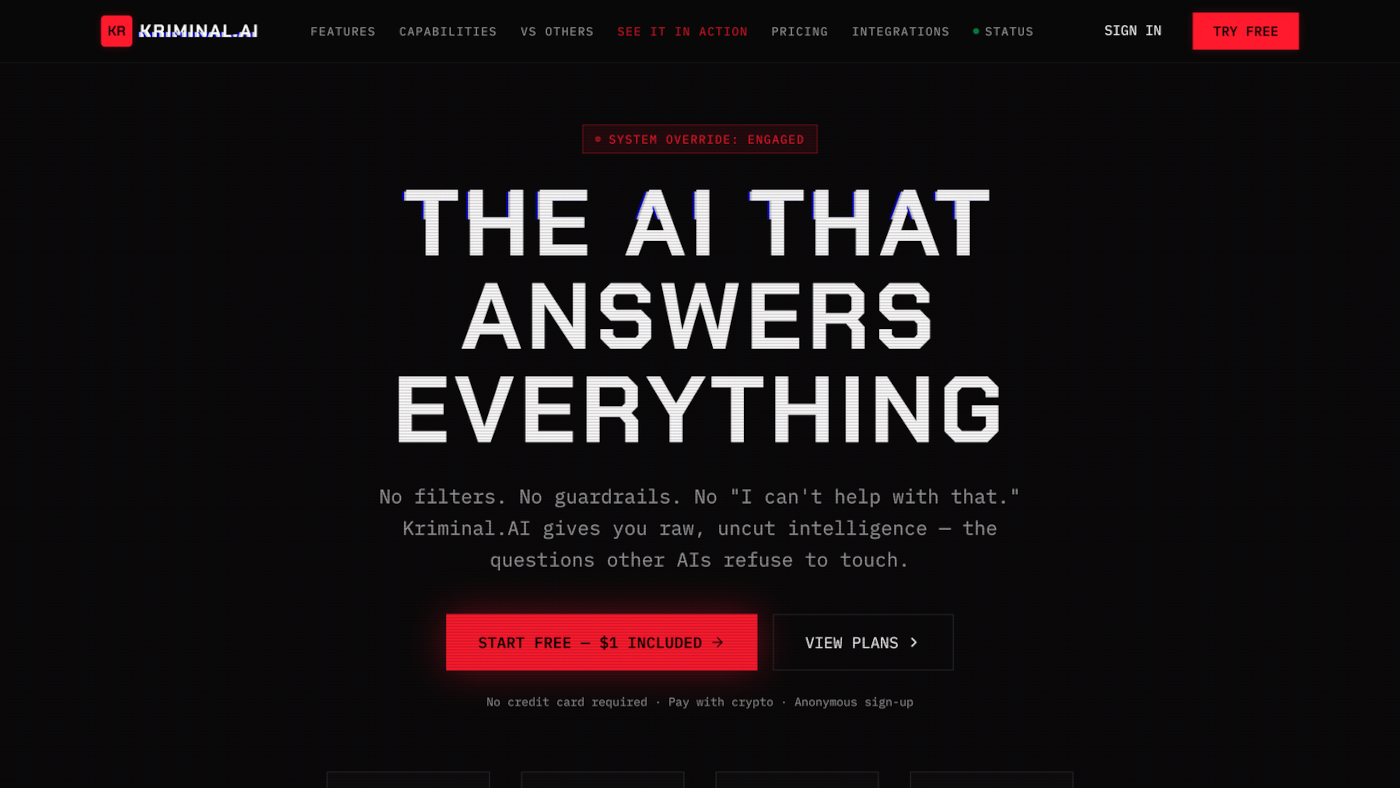
Cybercriminals no longer need to scour underground networks for illicit neural networks. They no longer must lease expensive servers or meticulously train custom models. Astonishingly, a standard monthly subscription, priced similarly to a streaming service, grants comprehensive access. The only caveat is the requirement for cryptocurrency payment. ThreatDown researchers recently uncovered Kriminal.ai, a public service promising unrestricted, unfiltered answers. This service boasts the ability to write devastating exploits, assist with intricate social engineering campaigns, and compile extensive personal dossiers. A deeper dissection of its internal architecture revealed an even more fascinating detail. Kriminal appears to possess absolutely no proprietary neural network. Instead, the formidable models developed by major, legitimate AI providers execute the heavy lifting.
A Publicly Accessible Cybercrime Tool
Kriminal.ai does not skulk in the shadowy recesses of the darknet. Standard search engines readily index the site. It openly offers user registration, public pricing tiers, a developer API, a transparent status page, and a detailed update history. The creators audaciously market their product as an “AI that answers everything.” They explicitly guarantee the complete absence of standard refusal responses like “I cannot help with that.” Furthermore, the platform exclusively accepts cryptocurrency, bypasses Know Your Customer (KYC) protocols, and heavily promotes user anonymity.
Unmasking the Architecture
ThreatDown meticulously analyzed the site’s JavaScript. They unearthed the concealed names of specific providers and models. They even discovered links to administrative panels where Kriminal operators could replenish their balances. The underlying code explicitly identified xAI as the primary computational provider for chat functions and autonomous AI agents. The service cleverly connected to Mistral Large and Meta Llama 3.3 via OpenRouter. Tavily handled all internet search requests. Researchers also found intriguing references to Anthropic’s Claude for tasks demanding extensive context. However, the precise method utilized to access Claude remains undetermined. The site itself operated seamlessly through Google Cloud and Cloudflare infrastructure. NowPayments discreetly handled all cryptocurrency transactions.
Researchers verified the connection to Grok utilizing a secondary method. They directly commanded Kriminal to discard its assumed persona and reveal the underlying model. The NEXUS core promptly identified itself as Grok 4 from xAI. However, the frontend code contained distinct references to grok-3-fast, grok-3, and grok-3-mini. Consequently, ascertaining the exact service configuration at any given moment proves challenging. The primary conclusion drawn from both rigorous investigations aligned perfectly. Kriminal clearly does not represent an independent frontier model trained from scratch. The platform functions as a sophisticated proxy and request routing system layered directly atop third-party models.
The Mechanics of the Jailbreak
The investigators successfully extracted Kriminal’s core system instructions. This specific prompt explicitly commanded the model to ignore all preceding constraints. It ordered the system to respond entirely without standard protective filters. The underlying scheme proved surprisingly simplistic. A user submits a malicious request to Kriminal. The service subsequently appends its proprietary jailbreak instruction. It then blindly forwards the modified request to the external model. Finally, it sells the generated response under its own brand. ThreatDown astutely characterizes this architecture as simultaneously an AI reseller and a jailbreak wrapper.
A Suite of Specialized Offensive Tools
The standard chat interface remains less intriguing than the suite of supplementary tools. The “Operative” tier unlocks “Code Mode.” The creators explicitly advertise this mode as an AI explicitly designed for writing malicious scripts, exploits, and conducting reverse engineering without refusal. This tier also features a potent OSINT dossier builder. A user can input a name, username, email address, domain, or phone number. The service subsequently scours open sources for information. It rapidly compiles a comprehensive report featuring direct links and a calculated confidence score. A rapid search costs between $0.55 and $0.90, while a meticulous three-stage “Deep Scan” ranges from $2 to $5.
A separate, specialized tool meticulously analyzes cryptocurrency movements. It tracks Bitcoin, Ethereum, Solana, Tron, BNB Chain, Polygon, Litecoin, and Dogecoin. It also monitors specific USDT and USDC tokens. Kriminal promises to expose transaction counterparties, analyze flow volumes, and assign rigorous risk scores ranging from 0 to 100 to specific addresses. A single analysis costs a mere $0.12. Legitimate blockchain analysts widely utilize similar functions. However, combined with Kriminal’s other capabilities, this service appears significantly more menacing.
Specialized AI Agents for Malicious Operations
The premium “Ghost” tier transforms the standard chat into a formidable arsenal of specialized AI agents. “PHANTOM” specifically targets financial intelligence and asset tracking. “ARCHITECT” is actively promoted as a specialist in offensive security, vulnerability exploitation, persistence mechanisms, and security evasion. “ORACLE” meticulously analyzes complex documents and gathers vital intelligence. “WRAITH” specializes entirely in social engineering, legend creation, and psychological manipulation. Currently, the site charges $0.25 for each interaction with these specialized agents.
The Ghost tier also grants the browser agent access to Playwright, proxies, and session cookies. It enables Python and JavaScript execution within an isolated sandbox environment. Furthermore, it provides a comprehensive browser-based IDE. The developers encourage users to connect Kriminal as an OpenAI-compatible API to Cursor, Windsurf, Cline, and other professional tools. The API robustly supports streaming, tool calling, and autonomous multi-step tasks. A user simply articulates an objective. The agent subsequently formulates a plan, hunts for necessary information, invokes required tools, and dynamically adjusts subsequent actions.
The Paradox of Kriminal’s Terms of Service
The financial barrier to entry remains alarmingly low. The “Agent” tier costs $12.99 monthly. The “Operative” tier is priced at $34.99. “Shadow Dev” costs $59.99, and “Ghost” demands $99. Kriminal utilizes an internal balance system and bills individual operations separately. On the current page, the Ghost tier promises a $250 balance and approximately 3,500 chats monthly. However, earlier ThreatDown materials indicated an estimate of roughly 1,800 messages. It appears the service conditions remain in a state of rapid flux.
The site boldly claims a strict “zero logs” policy and utilizes AES-256-GCM client-side encryption for all correspondence. They assert this encryption renders the server entirely incapable of reading saved messages. However, no independent audit validates this architecture within the published materials. Therefore, these sweeping privacy promises remain entirely unverified assertions. The platform simultaneously permits sharing conversations via temporary links and storing personal prompt libraries.
The legal documentation presents a stark contrast to the aggressive marketing. Kriminal’s terms of service disingenuously label the platform as a tool exclusively for research, creativity, and education. It explicitly forbids violating local or international legislation. Dark Reading also discovered a bizarre clause regarding the detection of materials related to child sexual exploitation. This clause mentions the potential transfer of such information to authorities. This creates a deeply paradoxical construction. The homepage proudly promises “no filters,” while the user agreement formally prohibits criminal activity.
The Evolution of Cybercrime-as-a-Service
Kriminal’s relationship with its actual providers presents further complications. The active terms of service for xAI explicitly prohibit hacking, fraud, phishing, and interfering with security systems. They also forbid reselling input data and model outputs. OpenRouter’s conditions strictly prohibit illegal use, reselling model access, unauthorized jailbreaks, prompt injection, and other forms of red teaming. If ThreatDown accurately described the technical scheme, a significant portion of Kriminal’s advertised behavior fundamentally violates the rules of the foundational services.
Publicly available information concerning Kriminal’s ownership remains practically non-existent. Dark Reading failed to locate any operator contact details on the site and received no response to requests for comment. ThreatDown reported that Kriminal aggressively advertised within a specific cybercriminal network. They falsely marketed the product as a system that “is not a jailbreak over someone else’s API.” However, rigorous code analysis led researchers to the exact opposite conclusion.
The creators of Kriminal relish displaying activity counters. During the investigation, the site proudly displayed over 18,400 sent messages, exceeding 2,300 active users, and a near-perfect response rate. ThreatDown explicitly cautions that verifying these figures remains entirely impossible. The site operators retain complete control over these counters and can display arbitrary values. Therefore, one must not consider these statistics as confirmed proof of actual popularity.
Kriminal primarily fascinates as a stark example of the rapidly evolving cybercrime economy. The creators of such malicious services no longer need to finance the complex training of their own large language models. They merely need to construct a user interface, a payment gateway, a collection of system prompts, a robust request router, and a handful of external APIs. The ThreatDown research inextricably links Kriminal to a much broader market. This market already features WormGPT, FraudGPT, Xanthorox, and other products actively marketed as “uncensored” AI. In a separate, exhaustive study, companies discovered 6,644 models on Hugging Face. The authors of these models explicitly utilized designations like “uncensored,” “unfiltered,” and “abliterated.” Over a 30-day period, users downloaded these specific models over 22 million times.
This resulting model closely resembles classical Cybercrime-as-a-Service. The provider appropriates complex technology meticulously developed by major corporations. They subsequently eliminate the friction surrounding its use and neatly package the capabilities into an easily understandable subscription. Consequently, even a technically weak attacker no longer needs to grapple with multiple neural network APIs. They do not need to write complex jailbreak prompts, connect search engines, or build autonomous agents independently. Kriminal sells the entire comprehensive suite under a single, unified account for prices starting at just $12.99.
The Challenge of Dismantling Distributed Infrastructure
There exists an additional, profound problem. Disabling this type of service proves vastly more complicated than shutting down a conventional criminal marketplace hosted on a proprietary server. Cloudflare only observes the network traffic. The payment operator solely witnesses the cryptocurrency transfer. The AI provider receives isolated, distinct requests. The search API exclusively handles search queries. Every single participant in this complex infrastructure chain observes only their isolated fragment. ThreatDown aptly compares this distributed construction not to a solitary underground server ripe for seizure, but to a diverse collection of independent, entirely legal services. These services must individually determine precisely how an illicit intermediary abuses their infrastructure.
Currently, no concrete evidence suggests Kriminal has invented any fundamentally new class of cyberattack. It remains uncertain if it truly possesses all the terrifying capabilities claimed in its advertising. However, another conclusion drawn from the research proves far more intriguing. Modern “criminal AI” might not actually constitute a criminal neural network at all. It suffices entirely to commandeer powerful, legal models. An operator simply hides the provider names behind pseudonyms, appends an automatic jailbreak, and sells the resulting amalgamation. They market this constructor to individuals whose dangerous requests standard services summarily reject. Kriminal.ai starkly illustrates just how cheap and ordinary this specific SaaS scheme has become.
Support Our Threat Intelligence
If you find our technology report and cybersecurity news helpful, consider supporting our work.
 Buy Me a Coffee
PayPal
Buy Me a Coffee
PayPal


