KindaRails2Shell Strikes Ruby Servers
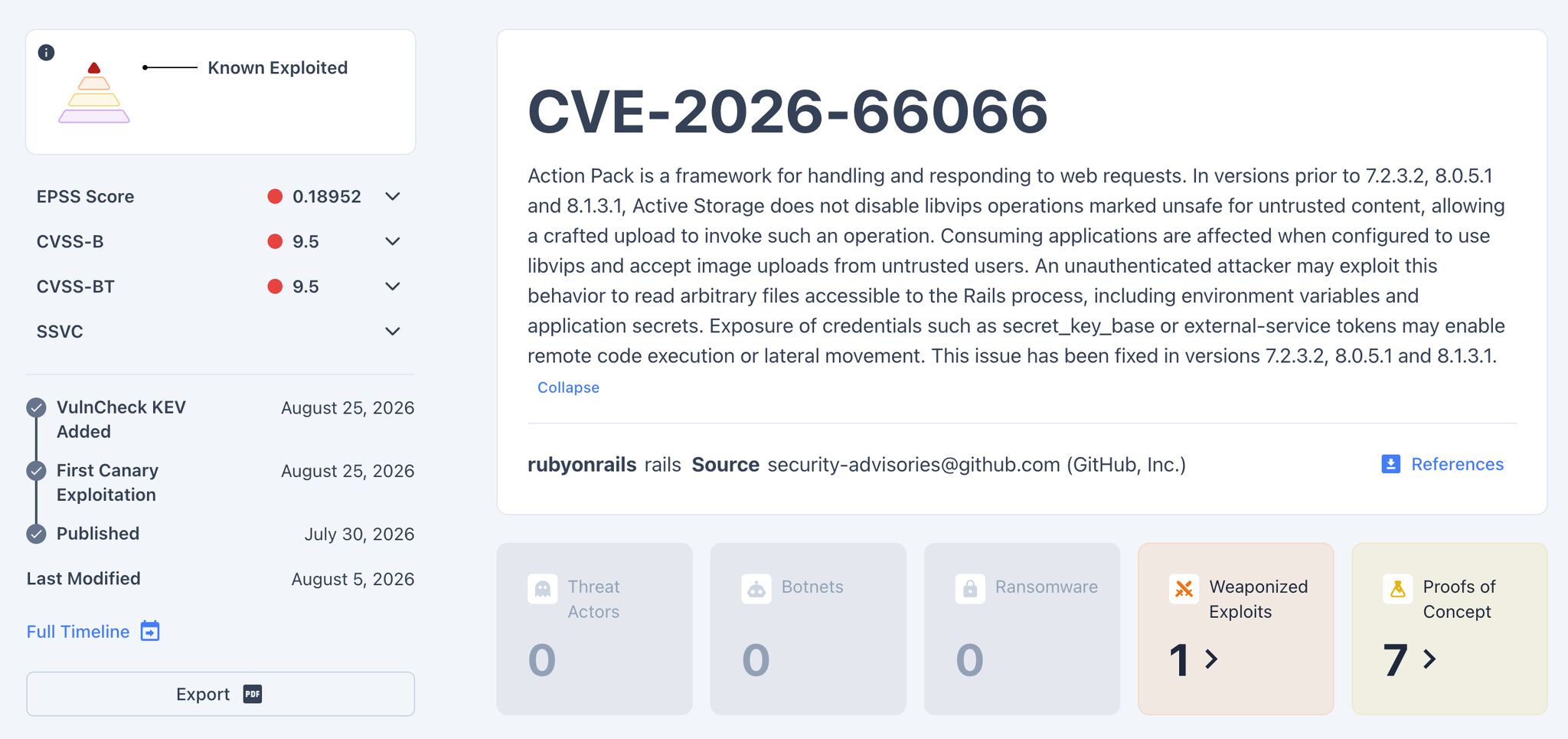
A critical Ruby on Rails vulnerability rapidly escalated from a theoretical threat into an active weapon. VulnCheck recently detected active exploitation of CVE-2026-66066. The cybersecurity community commonly refers to this severe flaw as KindaRails2Shell. Attackers struck honeypots strategically located in Singapore, Israel, and the United Kingdom. Curiously, this malicious activity originated entirely from a single IP address located in France. Following a successful breach, the attacker established communication with a command server situated in Israel.
The Active Storage Weakness
This dangerous problem directly impacts Active Storage. Active Storage is the integrated mechanism within Ruby on Rails designed for handling file uploads. Vulnerable applications inherently utilize the `libvips` library for comprehensive image processing. This allows untrusted users to upload various images freely. Crucially, starting with Rails 7, `libvips` operates within this specific configuration by default. This devastating error received a critical 9.5 out of 10 CVSS score. Consequently, it allows a malicious actor to completely compromise the server without requiring any authenticated account.
Exploiting File Type Discrepancies
The core mechanics of KindaRails2Shell rely entirely upon how different system components inconsistently define file types. During direct uploads, Rails might mistakenly accept the specific content type explicitly declared by the client. However, `libvips` later evaluates the actual file signature itself. A specially crafted object traverses multiple format handlers. Eventually, the HDF5 library accesses an external file located on the server. As a direct result, the system transforms the contents of the attacker’s chosen file into image pixels. The system then returns these compromised pixels outward. The Rails developers subsequently published a detailed breakdown of this attack chain following the emergence of third-party Proofs-of-Concept (PoCs).
The True Danger: Stolen Application Secrets
The primary danger lies not merely in reading isolated files, but in exposing critical application secrets. Attackers can leverage environmental variables and configuration files to extract the `secret_key_base`. They can also steal the Rails master key, database passwords, cloud storage keys, and vital third-party service tokens. Obtaining the `secret_key_base` represents a catastrophic failure. This secret allows an attacker to forge data that Rails explicitly trusts as officially signed by the application itself. Ultimately, this specific attack chain can readily facilitate insecure Marshal deserialization. This inherently culminates in disastrous remote code execution.
Discovery and Essential Patches
Security specialists at Ethiack and researcher RyotaK from GMO Flatt Security independently discovered this vulnerability. The Rails developers subsequently released critical patches on July 29th. These vital updates correspond to Active Storage versions 7.2.3.2, 8.0.5.1, and 8.1.3.1. Furthermore, securing operations mandates utilizing `libvips` version 8.13 or newer. Older builds entirely lack the essential capability to block dangerous operations associated with untrusted files.
The Rapid Escalation to Active Attacks
The speed characterizing the transition from initial research to actual attacks proved entirely predictable. By early August, VulnCheck had already prepared a functional exploit. They subsequently identified over 7,100 vulnerable, internet-accessible Rails instances. Alongside their exploit, the company created comprehensive detection rules for Sigma, Suricata, Snort, and YARA. They also provided network dumps specifically designed to detect blatant exploitation attempts. Within weeks, VulnCheck’s honeypots began capturing authentic, malicious traffic.
Crucial Remediation Steps
Simply applying the Rails update is insufficient if the server remained vulnerable to attacks prior to patching. Developers strongly recommend administrators consider all potentially accessible secrets as fundamentally compromised. Administrators must urgently replace the `secret_key_base`, the master key, database credentials, specific cloud storage keys, and all external service tokens. Furthermore, changing the `secret_key_base` will decisively terminate all existing user sessions. This crucial action immediately invalidates any previously signed data.
To assist with verifying already updated systems, the Rails team released specialized diagnostic tools. These tools help determine the precise duration of the vulnerability period. They also search for lingering traces of KindaRails2Shell within Active Storage and object storage environments. The attack leaves a highly unusual signature. The processed image variant can literally contain stolen server bytes embedded directly among the pixel data. Therefore, administrators must verify the installation of the latest release. They must also determine if an attacker successfully exploited the terrifying one-month window between the initial KindaRails2Shell disclosure and the first confirmed active exploitation.
Support Our Threat Intelligence
If you find our technology report and cybersecurity news helpful, consider supporting our work.
 Buy Me a Coffee
PayPal
Buy Me a Coffee
PayPal


