Flawed Security Patches Surge Across Open Source Projects
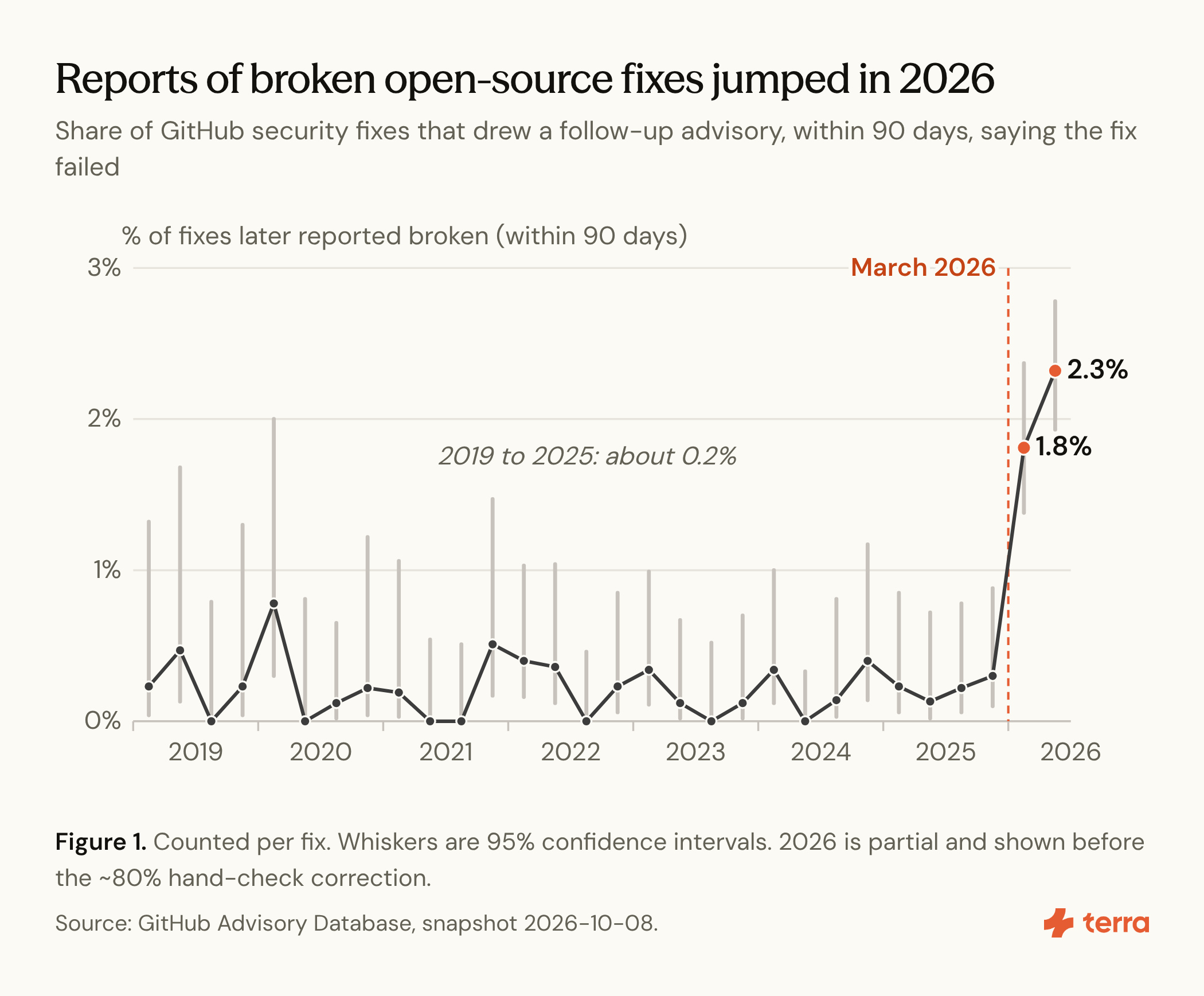
A security patch can neutralize a vulnerability while simultaneously exposing a direct path to the next exploit. Recently, cybersecurity firm Terra Security investigated how security patches became maps for attackers across the digital ecosystem. Researchers examined public CVE records and GitHub advisories to trace recurring flaws. Consequently, their analysis revealed that open-source bug fixes increasingly require subsequent remediation.
A Drastic Surge in Incomplete Vulnerability Fixes
Between 2019 and 2025, approximately 0.2% of GitHub security advisories received secondary warnings within 90 days. However, that figure surged to 2.3% during 2026. This sharp adjustment represents an eightfold to elevenfold increase depending on specific measurement baselines. Therefore, developers are inadvertently leaving residual exposure in critical software repositories.
Secondary Flaws Emerge Within the Linux Kernel
Within the Linux kernel, this problem manifests through subtle architectural regressions. By October 2026, telemetry revealed that 3.2% of newly cataloged kernel vulnerabilities originated in previous bug fixes. Furthermore, in rapidly developing subsystems such as fs/smb and net/sched, that proportion reached roughly 10%.
The Cascade of Unix Socket Vulnerabilities
For instance, a recurring sequence of defects plagued Linux Unix domain sockets. A code modification in 2023 disrupted file descriptor accounting during specialized message transfers. Consequently, the initial patch caused kernel hangs during stress conditions. A subsequent revision also proved incomplete due to list ordering issues. Ultimately, maintainers had to register multiple CVE identifiers for what remained a single underlying design flaw.
Recurring Bypasses in Web Application Defenses
Attackers most frequently bypass remedies designed to stop server-side request forgery (SSRF) and JavaScript prototype pollution. In fact, incomplete fixes for these vulnerabilities occur 4.6 and 11 times more often than expected. Frequently, narrow input validation routines cause these recurring failures.
Narrow Input Validation Enables Quick Evasions
Often, programmers block a single malicious IP address while ignoring equivalent representations. In Roundcube webmail, a security update blocked 127.0.0.1 but overlooked formats like 127.1 or hexadecimal notations. Consequently, maintainers had to deploy three consecutive updates to resolve the issue. Similarly, researchers bypassed a PaperCut update within 24 hours of its initial release.
Automated Auditing Accelerates Patch Analysis
For actively exploited bugs, Terra discovered a fourfold increase in subsequent patch bypasses. Meanwhile, artificial intelligence tools accelerate reverse engineering. In September, researchers disassembled a complex MikroTik patch within an hour using AI models. However, analysts note that algorithmic tooling alone does not explain the broader rise in defective updates.
Therefore, Terra advises software teams to test patches against alternative exploit techniques before distribution. Developers must address root causes rather than applying superficial filters. Furthermore, network administrators should never treat patch installation as an absolute guarantee of safety. Rigorous regression testing must confirm that every evasive path is securely sealed.
Support Our Threat Intelligence
If you find our technology report and cybersecurity news helpful, consider supporting our work.
 Buy Me a Coffee
PayPal