Brotli CVE-2026-111497 Vulnerability Triggers Remote Code Execution
A critical flaw within Google’s Brotli compression algorithm has sent shockwaves through the software industry. Specifically, the Brotli CVE-2026-111497 vulnerability permits unauthenticated attackers to corrupt server memory remotely. Security researchers have already demonstrated practical remote code execution against modern cloud stacks. Furthermore, the defect affects multiple prominent application runtimes and cloud proxies. Because maintainers embedded the vulnerable library across diverse languages, fixing one platform does not safeguard the others.
Anatomy of the Decoder Buffer Overflow
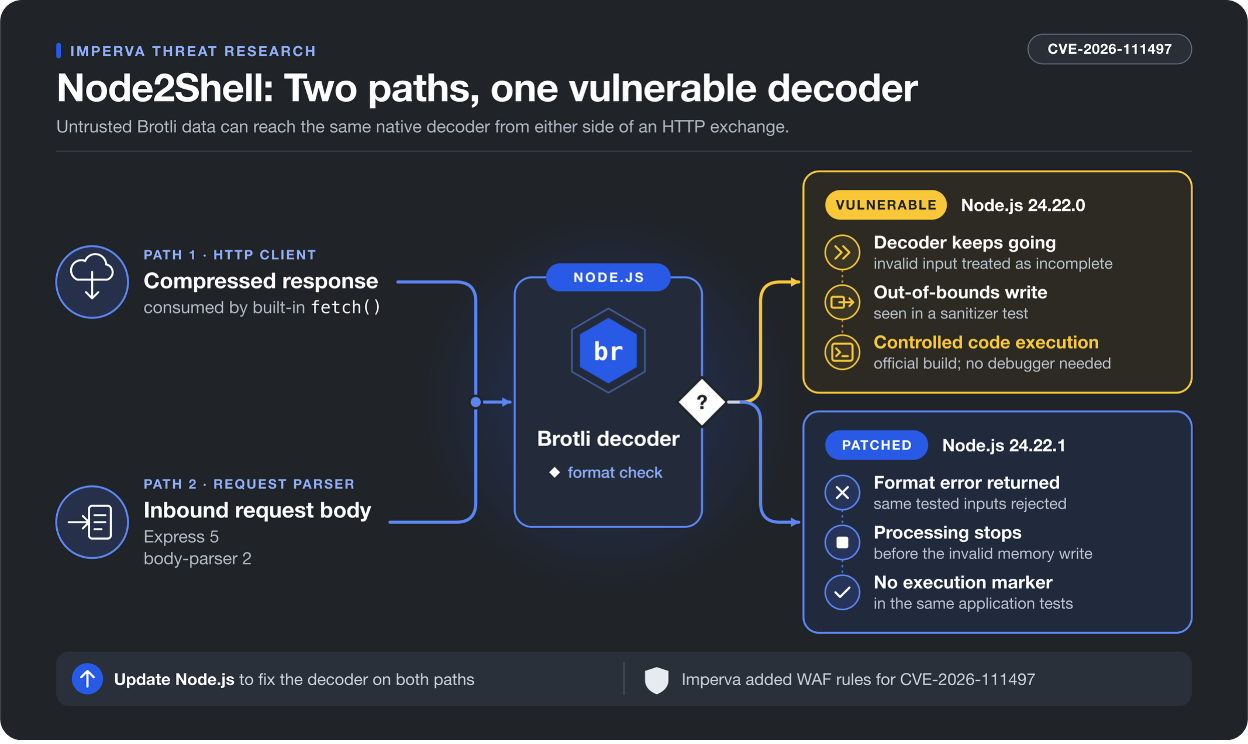
Engineers widely deploy Brotli compression to accelerate web applications and API pipelines. When an application accepts compressed data, a specialized decoder reconstructs the original payload. However, an insidious buffer overflow disrupts this decompression sequence. Specifically, when parsing an invalid stream block, the decoder erroneously requests additional input. Instead of halting execution, the algorithm writes incoming bytes past an internal eight-byte buffer. Consequently, malicious payloads can induce system crashes, expose memory secrets, or execute arbitrary commands.
Demonstrating Remote Code Execution in Laboratory Environments
Exploitation risk depends strictly on whether a service decodes untrusted user input. Merely hosting the Brotli library on a server does not introduce immediate danger. Instead, the application must actively pass malicious streams to the vulnerable decoder. In an extensive technical analysis of Node2Shell from Brotli data to remote code execution, Imperva analysts verified reliable exploitation. Researchers executed arbitrary commands inside standard Node.js 24.22.0 environments running on ARM64 Linux systems.
The exploit succeeded against inbound HTTP requests parsed by Express body-parsers. Similarly, the attack functioned when applications processed outbound fetch responses. Although the exploit required several sequential attempts, it reliably achieved code execution without custom debugging builds. Fortunately, tests on patched releases confirmed that repaired runtimes reject malicious streams cleanly.
Runtime Patches Across Node.js, Bun, and Python
Upstream maintainers rushed to publish security fixes across active software frameworks. As outlined in the Node.js October security releases, the project patched versions 22.23.4, 24.22.1, and 26.12.1. Meanwhile, Google resolved the core issue in upstream Brotli releases 1.0.10, 1.1.1, and 1.2.1. According to the official GitHub advisory for Brotli CVE-2026-111497, vulnerable versions start at 1.0.3 and carry a critical CVSS 4.0 score of 9.2.
The vulnerability also jeopardizes the broader JavaScript and Python ecosystems. As documented in a dedicated Bun runtime security advisory, maintainers remediated the flaw in version 1.4.4. Similarly, Python administrators must update the native Brotli library to version 1.2.1. Alternatively, teams utilizing CFFI bindings should upgrade brotlicffi to version 1.2.1.0 immediately.
Cloud Infrastructure Exposure in Envoy and Istio
Modern service mesh architectures also face significant operational exposure from this vulnerability. According to the Envoy proxy security advisory, developers deployed patches across versions 1.40.0, 1.39.3, 1.38.6, 1.37.8, and 1.36.12. However, Envoy systems remain vulnerable only when administrators explicitly enable Brotli decompression filters.
Similarly, cloud service mesh deployments require prompt administrative attention. In the official Istio security bulletin, maintainers released fixed builds for versions 1.31.2, 1.30.6, and 1.29.9. Administrators deploying EnvoyFilter resources should verify that active clusters run patched software baselines.
Automated Detection and Ecosystem Discovery
To assist defenders, security firm Trail of Bits released an open-source scanner named Brotli Checker. This utility inspects source repositories, application dependencies, and container images for embedded decoders. Notably, researchers credited security analysts at OpenAI Codex Security for discovering the flaw using automated artificial intelligence tooling. Dubbed Node2Shell and Brotlipocalypse, this incident underscores the profound supply chain risk residing in ubiquitous decompression utilities.
Support Our Threat Intelligence
If you find our technology report and cybersecurity news helpful, consider supporting our work.
 Buy Me a Coffee
PayPal