PHP2Shell ASLR Bypass Enables Remote Code Execution
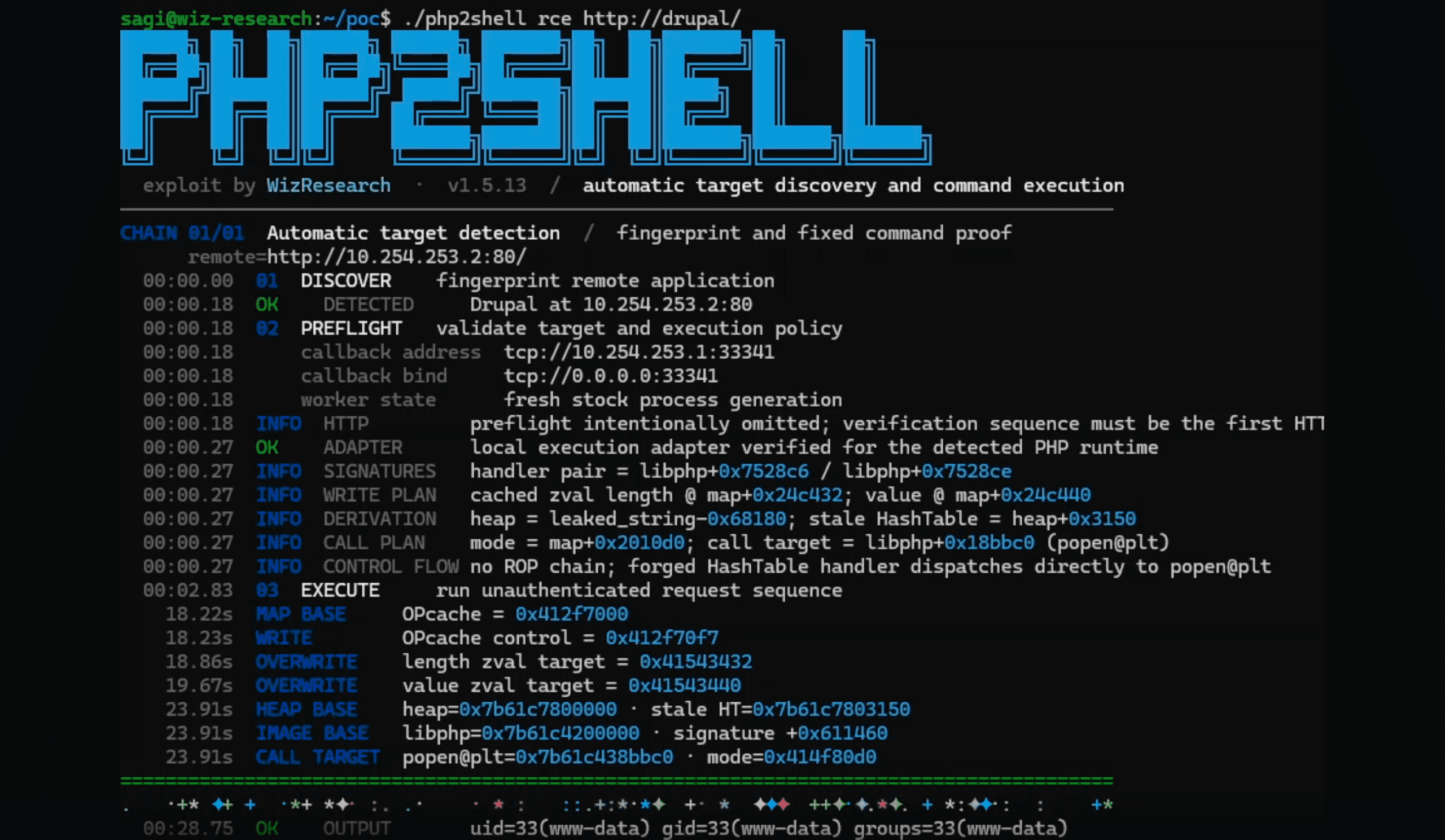
Researchers have engineered a reliable exploit against critical memory safety protections. Specifically, cybersecurity analysts at VulnCheck defeated Address Space Layout Randomization (ASLR) on modern 64-bit systems. Their technical breakthrough transforms the dangerous PHP2Shell vulnerability into a weaponized intrusion vector. Furthermore, this exploit delivers unauthenticated remote code execution across diverse PHP installations.
Bypassing ASLR Defenses on x86-64 Servers
Historically, ASLR randomizes program memory layouts during system execution. This randomized defense prevents attackers from predicting target memory offsets reliably. However, the new exploit successfully neutralizes this defense through a two-stage attack chain.
First, the payload triggers an information disclosure bug within the target memory space. Next, the script reconstructs base addresses to bypass layout randomization entirely. Researchers initially demonstrated this exploit against PHP 8.4.26 under standard production profiles. Moreover, the attack succeeds even when administrators disable error outputs completely.
Expanding Exploit Reliability Across Multiple Versions
Subsequently, the research team refined their attack framework. In a technical analysis of PHP2Shell vulnerabilities and memory safety exploits, VulnCheck demonstrated remarkable reliability. The weaponized tool reliably compromises every release between PHP 8.4.10 and 8.4.26 without per-version customization.
Additionally, researchers evaluated the attack surface across ARM64 processor architectures. While the initial memory leak succeeds on ARM64 chips, full command execution remains unverified. Meanwhile, analysts warn that public proof-of-concept repositories on GitHub are expanding rapidly.
Millions of Exposed Servers Face Severe Risk
Internet telemetry reveals an alarming exposure landscape for online infrastructure. Specifically, internet scanners cataloged over 2.6 million public endpoints exhibiting active PHP signatures. Shockingly, analysts classified roughly 99.99% of those discoverable hosts as vulnerable to exploitation.
Over 1.4 million servers explicitly broadcast version headers indicating outdated software builds. Furthermore, more than 1.1 million servers operate obsolete branches that no longer receive official security patches. Therefore, millions of web applications remain entirely exposed to remote compromise.
Core Interpreter Defects in CVE-2026-109618 and 109619
Crucially, these vulnerabilities reside directly within the PHP runtime interpreter rather than web application code. For example, CVE-2026-109618 triggers corrupted state cleanups during out-of-memory exceptions. Similarly, CVE-2026-109619 preserves dangerous dangling pointers to freed heap memory between requests.
Both vulnerabilities carry critical CVSS 4.0 severity ratings of 9.2. Although Apache with mod_php represents the most acute risk profile, other architectures remain susceptible. Specifically, PHP-FPM, FrankenPHP, and LiteSpeed servers face potential compromise.
Official Remediation and Temporary Workarounds
Upstream developers addressed both defects in an official PHP maintenance release advisory. The fixes arrived in versions 8.5.12, 8.4.27, 8.3.36, and 8.2.35. Consequently, web administrators must update their core runtime environments immediately.
Simply updating CMS platforms like WordPress or Drupal will not protect underlying servers. Therefore, administrators who cannot upgrade immediately must adopt strict interim mitigations. Engineers should enforce request size boundaries and disable vulnerable session tracking options. Ultimately, deploying official upstream patches remains the only definitive defense against memory exploitation.
Support Our Threat Intelligence
If you find our technology report and cybersecurity news helpful, consider supporting our work.
 Buy Me a Coffee
PayPal