Parasitic Bandwidth: How Free Applications Convert Domestic Smart TVs into Residential Proxies
Free mobile or Smart TV software often serves secondary, hidden purposes. Specifically, games, streaming utilities, or screensavers may secretly harbor the Bright Data SDK. This silent component integrates a domestic internet connection into a vast residential proxy network. Consequently, external web requests route directly through an ordinary home IP address. This occurs instead of utilizing the client’s own corporate infrastructure.
Unveiling the Mobile Proxy Architecture
Analysts from Include Security and an independent researcher named Buchodi recently dismantled this mechanism. They scrutinized the iOS implementation of the Bright Data SDK. Furthermore, their investigation demonstrated how the application ingests remote web scraping assignments. The device then executes these queries through the domestic internet pipeline. Ultimately, this process allows platform clients to harvest digital intelligence seamlessly.
The primary operational risk diverges significantly from traditional device exploitation. Software threat actors do not plunder local files. Moreover, they refrain from hijacking personal accounts. However, the user’s localized bandwidth, data quotas, and IP reputation systematically enrich an external commercial service.
The Mechanics of Residential Proxy Dominance
Bright Data explicitly markets itself as the operator of the world’s preeminent residential proxy matrix. The corporation boasts a pool exceeding 400 million domestic IP addresses. Through this network, buyers route complex web queries. Additionally, developers assemble part of this infrastructure by embedding the SDK into complimentary applications. They display a brief consent architecture and secure alternative monetization pathways. Therefore, Bright Data classifies this asset as an authorized pool of 150 million cooperative nodes.
Domestic IP addresses remain highly coveted by artificial intelligence enterprises scraping web data. Legitimate websites easily detect aggressive data harvesting from centralized cloud data centers. Consequently, anti-bot perimeters like Cloudflare, DataDome, and HUMAN heavily restrict this cloud-based traffic. Conversely, a residential proxy bypasses these digital filters elegantly. The target web server perceives an inquiry from a standard Comcast or T-Mobile subscriber.
Smart TVs as Ideal Exploitation Anchors
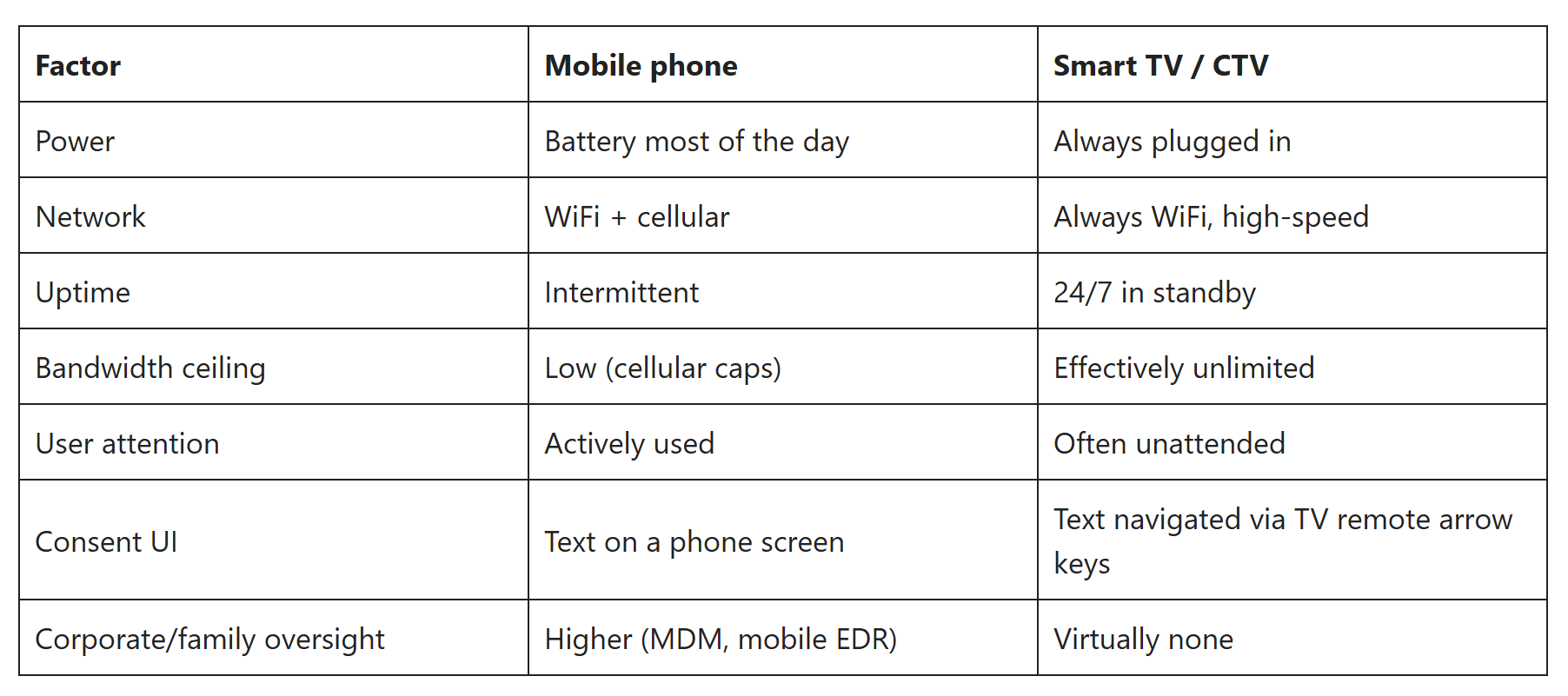
Amusingly, contemporary Smart TVs fulfill the proxy role far more effectively than cellular handsets. A television remains permanently connected to power grids. Furthermore, it operates on high-speed Wi-Fi networks. The device rarely migrates offline and typically evades user scrutiny. In contrast, smartphones expose performance anomalies rapidly. Mobile batteries drain quickly, cellular data limits expire, and corporate security profiles trigger immediate alarms. Meanwhile, televisions lack rigorous oversight, allowing viewers to dismiss consent screens carelessly via remote controls.
Telemetry Harvesting and Handshake Technicalities
Investigators extracted their most comprehensive technical intelligence directly from the iOS binary. Public corporate disclosures and historic television case studies confirm this smart TV integration. Researcher Buchodi explicitly clarifies that an entry on Bright Data’s partner registry does not imply immediate, universal deployment. Nevertheless, the documentation proves that connected TV engineers collaborated with the proxy provider. This roster includes prominent entities such as PlayWorks Digital, CloudTV, and Longvision.
The SDK initiates its operational cycle immediately upon application launch. The module queries the centralized Bright Data infrastructure to fetch configuration parameters. During this sequence, it transmits the unique bundle identifier, SDK version, and a generated UUID. Interestingly, the ingestion server executes minimal validation regarding the request origin. An attacker merely supplies a legitimate App Store bundle ID to receive real device configurations.
These configurations contain feature flags, idle schedules, and hardware utilization thresholds. Specifically, they enforce battery, processor, and memory limits alongside Wi-Fi boundaries and geographical manifests. After parsing this data, the SDK establishes a persistent WebSocket connection to proxyjs.brdtnet.com via port 443. The accompanying TLS certificate points to luminatinet.com. This domain represents the historic identity of Bright Data prior to rebranding.
Subsequently, the server initializes an active session and returns a public IP address. The SDK then transmits continuous device telemetry. This reporting captures Wi-Fi availability, battery levels, screen stasis, active calls, and processing loads. If the endpoint satisfies the target criteria, the server dispatches a cmd_tun command. Consequently, the device executes an HTTP request to an external target using its own residential IP.
Network Layer Subversion and VPN Evasion
Channel protections remain fundamentally fragile within this architecture. WebSocket payloads travel via standard JSON frames containing command parameters. However, the researcher discovered no cryptographic message signatures, HMAC verifications, or client certificate validations. Instead, system control relies strictly on standard TLS encryption and reputation filters. These algorithms determine which nodes receive active harvesting assignments.
The public consent screens describe these operations far more gently than the internal SDK settings. For example, the Petflix utility on Roku informed users that their connection would download public web data occasionally. Yet, investigators discovered configurations enforcing massive monthly Wi-Fi quotas up to 200 gigabytes. The iOS analysis also uncovered strict geographical limitations. Most regions restrict traffic to 500 megabytes monthly. Conversely, limits in Uzbekistan and Oman escalate to 30 gigabytes, draining batteries completely.
Within the iOS environment, researchers exposed an additional vulnerability regarding VPN evasion. The SDK weaponizes a specific use_netifs flag to bind network connections directly to physical hardware interfaces. It isolates en0 for Wi-Fi or pdp_ip0 for cellular traffic. Crucially, this traffic bypasses the secure tun0 interface where local VPNs typically operate. Thus, while standard application traffic remains visible to defensive inspection, the Bright Data tunnel routes through an alternative pathway.
The deliberate choice of network primitives further complicates forensic evaluation. Instead of utilizing traditional iOS URLSession or NSURLConnection classes, the component relies on CFNetwork and CFHTTPMessage. Consequently, defensive monitoring tools struggle to visualize the application’s network behavior accurately. Some utilities log the initial configuration requests but miss the actual proxy tunnel entirely. Other platforms capture only fractional elements of the active session.
Historical Evolution and Corporate Countermeasures
The lineage of Bright Data traces directly back to Luminati and Hola VPN. In 2015, Hola triggered widespread controversy by commercializing the bandwidth of its free VPN users through Luminati. At that time, external traffic routed covertly through consumer systems. Today, this underlying concept operates with greater regulatory care. The application displays a consent screen, the developer secures revenue, and Bright Data sells residential access to AI companies.
Consequently, the distinction between legitimate proxy networks and criminal botnets grows increasingly obscure. Malicious networks like Aisuru or IPIDEA hijack consumer devices without any authorization. Bright Data asserts that its nodes join voluntarily and forfeit no personal identifiers beyond their IP addresses. However, a generic consent button rarely ensures that a consumer comprehends the arrangement. Users seldom realize their home internet will relay foreign web scraping requests continuously.
Network Mitigation and Forensic Auditing
Fortunately, network administrators can suppress this parasitic traffic at the local gateway level. Researchers published explicit domain lists required to sustain the peer-to-peer tunnel infrastructure. Defensive teams can block domains like proxyjs.brdtnet.com and clientsdk.bright-sdk.com effortlessly. For execution, tools like Pi-hole, NextDNS, or local router DNS filters prove highly effective.
However, basic network blocking is insufficient for enterprise environments. If a compromised iPhone migrates to cellular data, its traffic entirely evades corporate Wi-Fi filters. Therefore, managed device fleets require rigorous auditing for embedded Bright SDK components. Engineers should scan binary files for specific strings like BrdWebSocketFacade and BrdNetwork.DNSResolver. Furthermore, standard blocklists offer no permanent immunity against architecture updates. Bright Data can shift domains, alter transport protocols, or deploy latent HTTP/3 flags seamlessly.
Ultimately, domestic hardware has been thoroughly integrated into the data-harvesting supply chain for artificial intelligence. The consumer observes a complimentary utility and a brief consent prompt. The developer establishes a fresh revenue stream. Concurrently, the Bright Data client enjoys requests originating from pristine home IP addresses. Between these parties remains the living room television or the mobile device, silently routing foreign traffic without explicit transparency.
Support Our Threat Intelligence
If you find our technology report and cybersecurity news helpful, consider supporting our work.
 Buy Me a Coffee
PayPal
Buy Me a Coffee
PayPal


