Sovereign Compromise: Zero-Day “MiniPlasma” Flaw Grants SYSTEM Privileges in Windows
The Emergence of the MiniPlasma Threat
A perilous zero-day vulnerability designated as MiniPlasma is currently enduring active exploitation within the Windows ecosystem. Consequently, this severe architectural defect allows local adversaries to instantly inherit absolute SYSTEM-level administrative privileges. Therefore, malicious actors can effectively secure total sovereignty over a compromised host computer. To mitigate this critical exposure, Microsoft intends to distribute an official security patch on June 9, 2026.
Unwarned Disclosures and Zero-Day Proliferation
Kaspersky Lab initially exposed the ongoing malicious campaign. Remarkably, a pseudonymous security researcher known as Nightmare Eclipse recently published six unpatched Windows vulnerabilities. Furthermore, this actor, also recognized as Chaotic Eclipse, immediately disseminated functional proof-of-concept exploit binaries online. Because Microsoft received no prior warning regarding these exposures, engineers lacked the time to devise remediations before public disclosure.
The Resurrection of a Legacy Defect
Among these dropped exploits, MiniPlasma poses the most significant operational danger to enterprise networks. Specifically, the flaw directly mirrors CVE-2020-17103, a vulnerability that engineers theoretically neutralized back in 2020. Regrettably, fully updated deployments of Windows 11 remain highly vulnerable to this resurrected exploitation methodology. Similarly, Windows Server 2022 and Windows Server 2025 infrastructures share this identical exposure.
Mechanics of the Cloud Filter Exploitation
Much like its predecessor, this novel flaw subverts the native Cloud Filter driver. In particular, it targets a structural anomaly within the HsmOsBlockPlaceholderAccess procedure. The vector functions strictly as a local privilege escalation mechanism. Thus, an attacker must establish an initial foothold within the system before launching the exploit.
Nevertheless, telemetry indicates live weaponization of this flaw since April 10, 2026. Additionally, the public release of the exploit code significantly lowers the barrier to entry for unsophisticated threat actors.
Key Indicators of Compromise
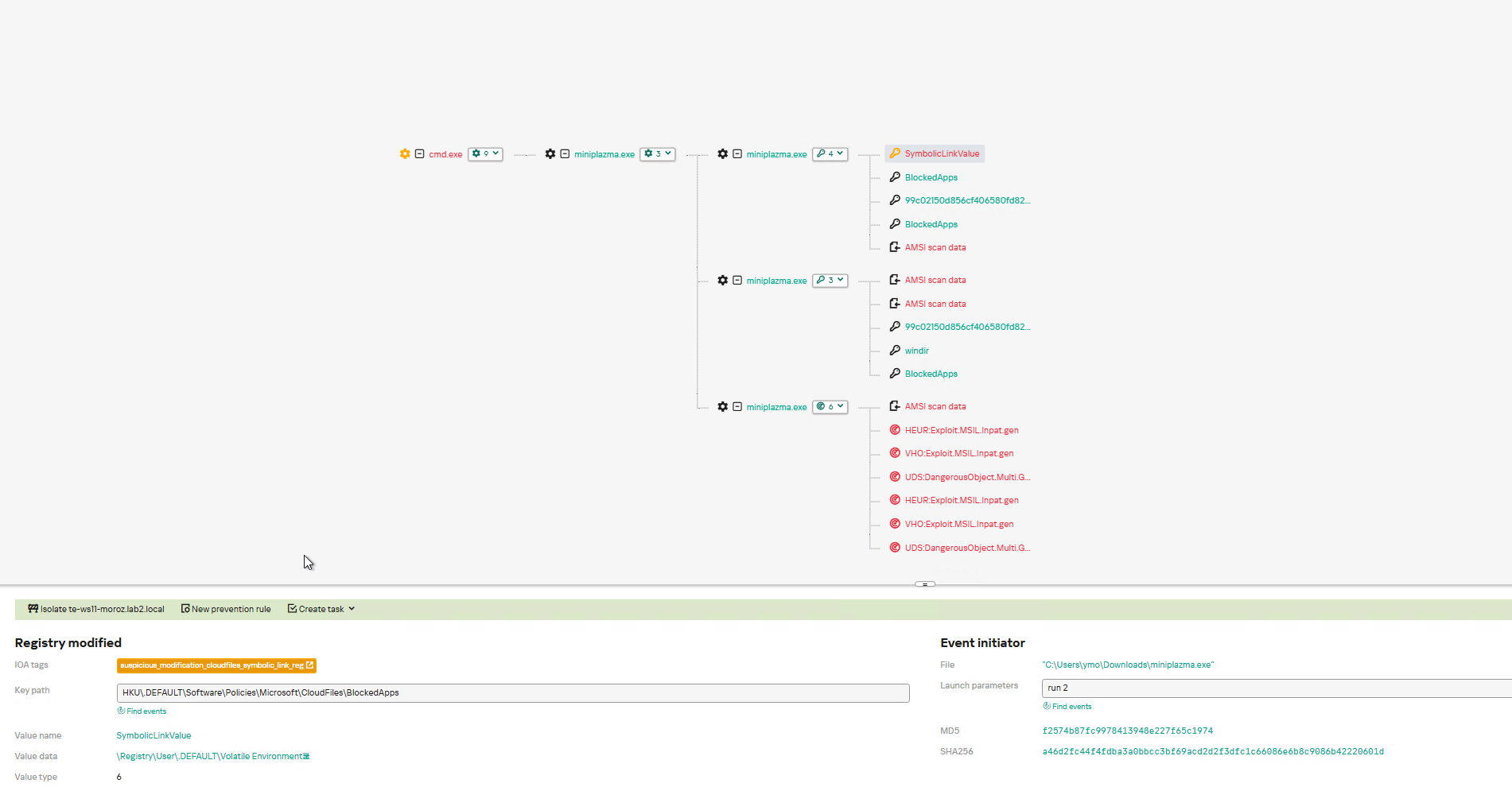
Fortunately, Kaspersky Lab meticulously detailed specific behavioral telemetry to identify live exploitation attempts. First, defenders should audit the registry path HKU\.DEFAULT\Software\Policies\Microsoft\CloudFiles\BlockedApps for anomalous symbolic links. Second, the native wermgr.exe binary may materialize outside its standard system directories during an active breach. Concurrently, administrators must flag core system files executing from non-standard folders. Moreover, the public exploit relies on the NtApiDotNet library to perform low-level manipulations of the Windows registry.
Monitoring Error Reporting and Process Spawns
Security teams must pay explicit attention to modifications within the CloudFiles\BlockedApps registry keys. Furthermore, the exploit triggers the \Microsoft\Windows\Windows Error Reporting\QueueReporting task to hide its behavior. Therefore, any instantiation of wermgr.exe outside of C:\Windows\System32 or C:\Windows\SysWOW64 warrants immediate isolation. Finally, security operations centers should scrutinize all child processes spawned by the error reporting utility.
Temporary Mitigations Prior to Patch Tuesday
While awaiting the official Microsoft hotfix, network administrators must aggressively monitor their environments for suspicious registry activity. Additionally, teams should implement strict detection rules for non-standard system binary execution paths. Ultimately, organizations must continuously track anomalous behavior within the Windows Error Reporting framework to detect active incursions.
Support Our Threat Intelligence
If you find our technology report and cybersecurity news helpful, consider supporting our work.
 Buy Me a Coffee
PayPal
Buy Me a Coffee
PayPal


