Architectural Deception: Voice-Driven Extortion Campaigns Target American Legal Institutions
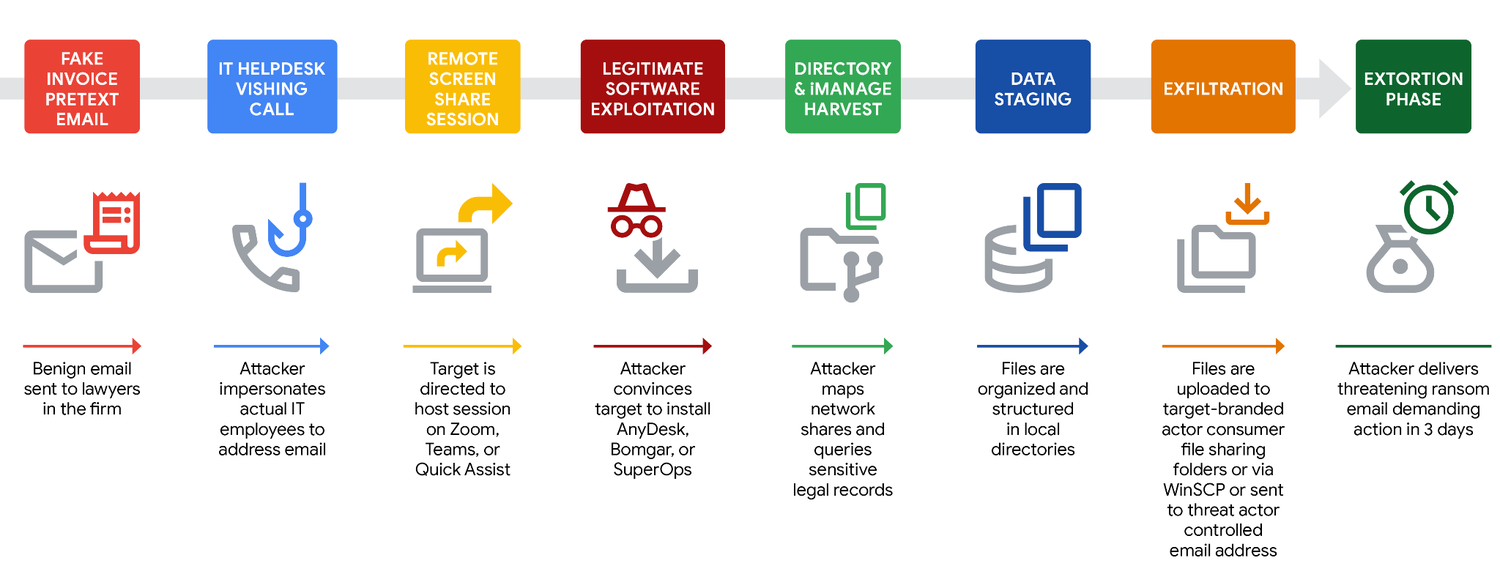
American legal institutions face an unprecedented wave of adversarial incursions. Importantly, these threat actors completely forgo malicious software. Instead, they secure initial system access via conventional telephone communications. According to intelligence from Mandiant, an espionage syndicate designated as UNC3753 targeted dozens of domestic organizations. This aggressive campaign spanned the legal, financial, and professional service sectors within the United States. Remarkably, the perpetrators executed these malicious maneuvers between January and May 2026.
The Strategic Objectives of UNC3753
Data Exfiltration Over System Encryption
The primary objective of UNC3753 diverges sharply from traditional ransomware strategies. Specifically, the group avoids encrypting host architectures. Instead, the adversaries systematically plunder confidential telemetry to execute corporate extortion schemes. The stolen data inventory encompasses sensitive legal dossiers, proprietary financial ledgers, private client identifiers, and corporate covenants. Consequently, these breaches inflict severe reputational and operational liabilities upon the targeted enterprises.
The Anatomy of Social Infiltration
Establishing Phony Trust Paradigms
The initial phase typically commences with a seemingly benign electronic missive. Crucially, the text mimics a routine inquiry regarding invoices or billing logs. The message conspicuously lacks malicious hyperlinks or weaponized attachments. Shortly thereafter, the target receives a voice call from individuals masquerading as internal IT support personnel. Under the pretext of resolving an urgent security vulnerability, the handlers smoothly persuade the employee to initialize a screen-sharing session.
Once they establish a baseline of trust, the intruders request the execution of common collaboration tools. These applications include Zoom, Microsoft Teams, and Quick Assist. Regrettably, multiple employees manually installed remote administration utilities during these interactions. Software like AnyDesk, Bomgar, or Zoho Assist was frequently deployed. Consequently, these actions granted the adversaries immediate, unhindered access to internal corporate networks.
High-Velocity Exfiltration and Corporate Monetization
Rapid Reconnaissance Frameworks
Investigators emphasize the extraordinary velocity of the UNC3753 syndicate. Indeed, the timeline spanning initial contact to complete data extraction often takes mere hours. In fact, operators routinely isolate high-value dossiers within sixty minutes of securing an endpoint. Once inside, the adversaries aggressively comb through internal network repositories and cloud storage nodes. They prioritize corporate tax documents, client agreements, audit reports, and Social Security numbers.
Evading Boundary Defenses
The collected assets are compiled into compressed staging directories. Subsequently, the actors transfer these packages to attacker-controlled cloud storage or external email repositories. To bypass security filters, the group combines browser-based uploads with specialized utilities like WinSCP and Rclone. For instance, investigators documented an incursion where attackers exfiltrated over sixteen gigabytes of data. They achieved this by exploiting a combination of public cloud nodes and legacy remote desktop connections.
Immediately following the exfiltration phase, the extortion sequence begins. An explicit ransom demand usually arrives within thirty minutes of the operational conclusion. Furthermore, the syndicate imposes a strict three-day deadline to initiate negotiations. If executive leadership refuses to comply, the criminals threaten to contact clients and partners directly. Ultimately, they vow to publish the plundered datasets on the public LEAKEDDATA repository.
Transcending the Digital Domain: Kinetic Incursions
Physical Social Engineering Tactics
Most alarmingly, multiple intrusions escaped the boundaries of pure cyberspace. According to joint advisories from Mandiant and the FBI, fraudulent technicians staged physical breaches at corporate headquarters. Under the guise of validating hardware assets or performing emergency local backups, they connected external storage peripherals directly to terminal workstations. This audacious tactic allowed them to harvest data without traversing external firewalls.
Lineage of the Threat Actor
Security researchers link this cohesive campaign to UNC3753. This collective operates under several monikers, including Luna Moth, Chatty Spider, and Silent Ransom Group. Analysts have tracked their illicit footprint since at least 2022. Historically, the syndicate relied on fraudulent software renewal notifications. However, around March 2025, they pivoted definitively toward masquerading as internal corporate IT departments.
Tactical Conclusions and Institutional Risks
Legal institutions remain highly lucrative targets due to the vast repositories of sensitive litigation materials they harbor. Therefore, the fusion of vocal deception and physical intrusion marks a mature phase in modern extortion. The primary vulnerability is no longer flawed software architecture. Instead, the threat vector relies entirely on exploiting the natural trust of employees.
We notice that the FBI distributed an explicit warning regarding the Silent Ransom Group in May 2026. The bureau confirmed that the syndicate systematically leverages highly tailored social engineering matrices. By combining fake support dispatches with physical infrastructure tampering, they continue to harvest corporate contracts, identity records, and tax documentation efficiently.
Support Our Threat Intelligence
If you find our technology report and cybersecurity news helpful, consider supporting our work.
 Buy Me a Coffee
PayPal
Buy Me a Coffee
PayPal


