Architectural Blueprints: The Security Risks of Exposed Swagger Specifications
An Application Programming Interface description file might seem like an ordinary technical detail. However, for malicious actors, this file often serves as an elegant map of an external service.
The Mechanics of API Exposure
The SANS Internet Storm Center recently reported that adversaries are executing mass scans for swagger.json files. Developers utilize this file within the Swagger or OpenAPI framework to describe interface operations. Furthermore, it catalogs available functions and endpoints. Consequently, while it accelerates developer onboarding, negligent publication yields excessive intelligence to unauthorized entities.
In terms of web application security, swagger.json functions as an open directory. Undeniably, the document itself does not introduce immediate vulnerabilities. Indeed, development teams frequently rely on it. Nonetheless, a critical problem manifests when this architectural blueprint becomes accessible from the public internet without proper access controls.
Tracking Automated Scanning Patterns
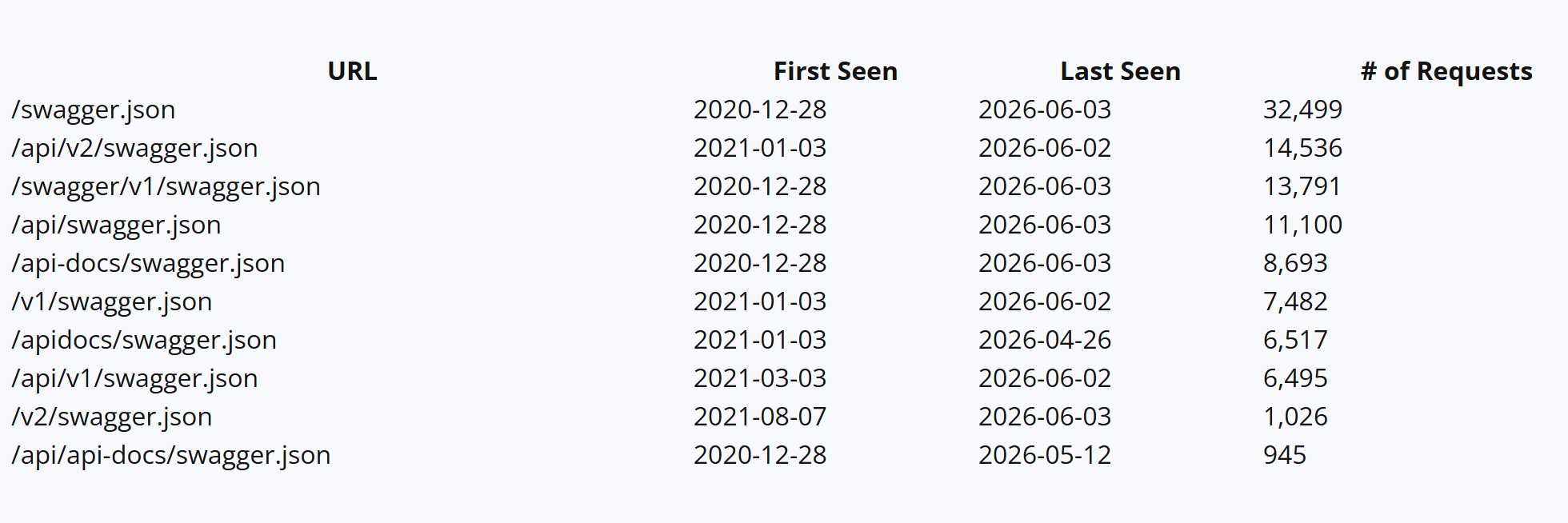
According to SANS telemetry, threat actors have targeted standardized paths for several years. Specifically, the /swagger.json directory path remains the primary target. Analysts recorded 32,499 queries to this endpoint since late 2020.
In addition, scanners frequently probe /api/v2/swagger.json and /swagger/v1/swagger.json. Analysts observed the latest probes to these endpoints on June 2 and June 3, 2026.
The Value of API Reconnaissance
The profound interest in swagger.json remains entirely logical. An API specification effortlessly exposes functional boundaries, request structures, and internal naming conventions. As a result, attackers quickly discern the underlying product architecture. Subsequently, they efficiently hunt for documented vulnerabilities or structural flaws in the business logic.
Moreover, SANS highlighted emergent URL variations surfacing throughout 2026. These paths include URL-encoded segments like /%2Fswagger.json. Similarly, automated tools check longer strings containing api-docs or swagger attributes. Although query volumes remain modest, this activity proves that scanning engines continually expand their targeted routes.
Strategic Remediation and Perimeter Defense
SANS.edu does not advocate abandoning the OpenAPI framework entirely. Instead, the fundamental conclusion emphasizes proactive internal discovery. Organizations must systematically scan their infrastructure for exposed specification files.
Therefore, enterprise groups managing vast web portfolios must prioritize this audit. Expanding API integrations inherently increases the risk of leaving structural blueprints exposed to adversarial reconnaissance.
Support Our Threat Intelligence
If you find our technology report and cybersecurity news helpful, consider supporting our work.
 Buy Me a Coffee
PayPal
Buy Me a Coffee
PayPal


