Persistent Exposure: How OP-512 Exploits Legacy IIS Infrastructure

Legacy web servers frequently appear as ordinary infrastructure components for months. Meanwhile, hidden adversaries quietly establish initial access pathways into internal networks. ReliaQuest recently documented a sophisticated compromise of this nature. Specifically, they attributed the intrusion to an unclassified Chinese cyber-espionage collective designated as OP-512.
Anatomy of the Infiltration
ReliaQuest associates the OP-512 syndicate with China with moderate-to-high confidence. Primarily, the group targeted an Internet Information Services (IIS) server. This host ran Windows Server 2016 and an archaic .NET Framework 4.0 platform. Lifecycle support for this specific framework version concluded in 2016. Consequently, the server remained an exceptionally soft target for external adversaries.
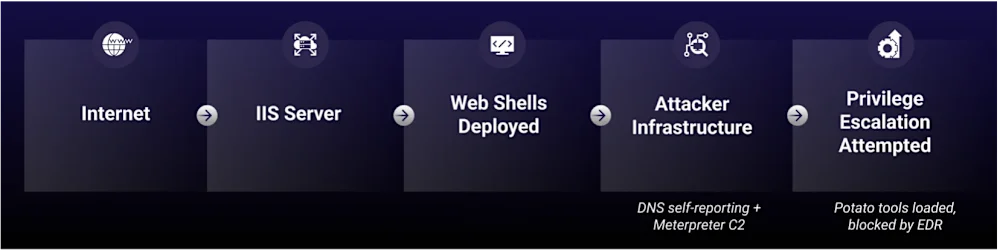
High-level attack chain
Cryptographic Uniqueness in Web Shell Deployment
The defining characteristic of this operation involved a bespoke suite of web shells. Typically, these malicious files empower attackers to administer a host via standard browsers. OP-512 deployed three distinct web shells simultaneously to secure access. Crucially, each installation remained entirely unique from a cryptographic standpoint. Therefore, signature-based defensive mechanisms struggle to identify these files. Every single iteration exhibits a completely distinct digital footprint.
The primary web shell functioned as a localized file manager. Furthermore, it autonomously exfiltrated its own location telemetry to the handlers. Upon page initialization, the script encoded its URL structure. It then transmitted this data via a query to an attacker-controlled domain. However, if this primary method encountered failure, the module utilized a redundant fallback channel. Specifically, it dispatched an HTTP request to an isolated command server.
Remote Command Execution and Privilege Escalation
The remaining two web shells managed remote command execution workflows. Prior to executing any directive, they decrypted the inbound payload. They also verified its digital signature carefully. Crucially, they functioned only upon receiving a valid cryptographic key. This rigid schema compartmentalized operational control within the intrusion framework. Consequently, a single compromised key could not yield mastery over all installed components.
High-Velocity Infiltration Tactics
Investigative logs revealed preliminary footprints 75 days prior to the primary deployment phase. Later, the adversaries returned to deploy the web shells within mere hours. They established multiple command pathways and attempted rapid privilege escalation. To achieve this, they deployed BadPotato, SweetPotato, and EfsPotato. These specialized tools exploit native Windows architecture flaws to harvest elevated system rights.
Evading Remediation and Forensic Alterations
Endpoint defense mechanisms successfully terminated the malicious processes. Nevertheless, the incursion persisted. The IIS architecture automatically recycles worker processes following a sudden termination. Consequently, the malicious utilities continually reloaded into system memory. ReliaQuest highlights that terminating the process without isolating the host created an endless loop. Thus, the defense triggered repeatedly while the underlying activity endured.
Managing Transient Compilation Artifacts
Transient ASP.NET artifacts introduced a separate forensic complication for defenders. Upon initial execution, the platform compiled the malicious scripts into local DLL files. These libraries can persist long after the deletion of the original web shells. Therefore, forensic investigators must meticulously audit and purge transient ASP.NET compilation directories.
Furthermore, OP-512 attempted to obscure the chronological markers of the files. The web shells scanned adjacent documents and spoofed their own creation dates. This technique allowed them to blend seamlessly with legacy server content. Ultimately, this practice complicates basic forensic searches relying on chronological parameters.
Strategic Defensive Realignments
ReliaQuest classifies OP-512 as at least the fourth Chinese threat cluster targeting legacy IIS infrastructure recently. However, OP-512 diverges from known operations such as CL-STA-0048, GhostRedirector, and DragonRank. While they share isolated techniques, their toolsets and infrastructures differ significantly.
Consequently, the enterprise warns that organizations harboring outdated .NET Framework deployments must accelerate migrations. Alternatively, they should immediately isolate these public-facing assets. Security teams must carefully monitor file upload directories and transient ASP.NET folders. They must also audit anomalous DNS queries originating from IIS processes. Finally, they should examine any command-line commands spawned by the web server.
ReliaQuest projects that incursions targeting legacy IIS infrastructure will likely persist throughout 2026 and 2027. This threat remains active as long as these servers remain exposed to the public internet. Therefore, standardized detection rules tailored to known groups are no longer sufficient. OP-512 demonstrates that modern threat actors adapt their toolsets rapidly to evade traditional security baselines.
Support Our Threat Intelligence
If you find our technology report and cybersecurity news helpful, consider supporting our work.
 Buy Me a Coffee
PayPal
Buy Me a Coffee
PayPal


