The Sophistication of Kimsuky: Deceptive Social Engineering and Tiered Infection
Evolution of Tactical Delivery
The North Korean cyber-adversary Kimsuky has abandoned rudimentary malware distribution strategies. Instead, their modern campaigns target South Korean military and corporate structures with immense precision. These operations deploy impeccably forged corporate portals and authentic conference itineraries. Furthermore, the threat actors utilize real-time browser validations to verify successful endpoint compromise.
Exploiting Familiar Environments
Strategic Corporate Spoofing
According to a recent disclosure by ENKI Whitehat, the group orchestrated multiple campaigns through late April 2026. Initially, one operation mimicked a security software installation page for a popular enterprise B2B messenger. Concurrently, an alternative campaign duplicated a legitimate Webex landing interface. Consequently, both intrusion vectors heavily leveraged user trust in ubiquitous corporate utilities.
The B2B Security Lure
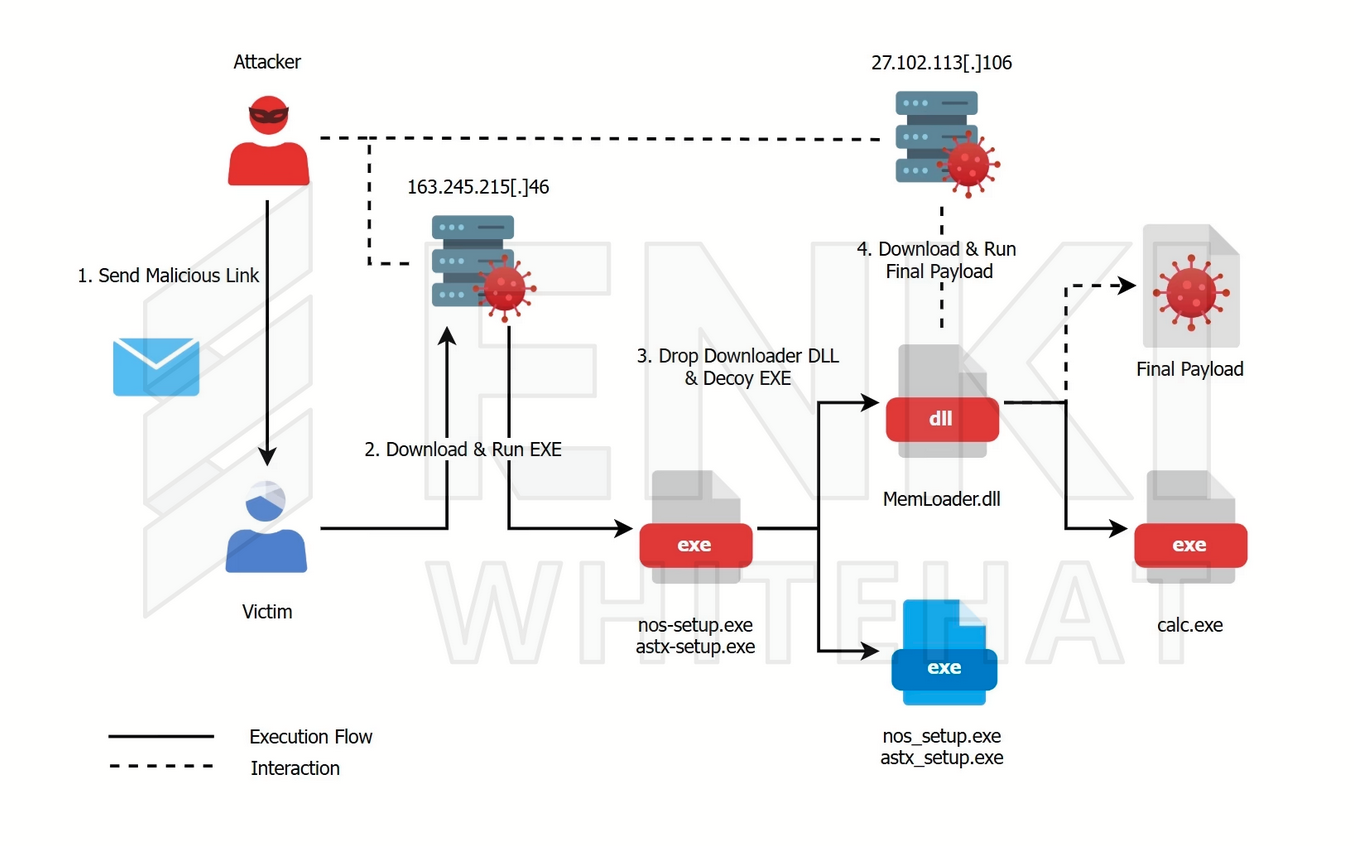
In the messenger campaign, victims encountered an interface resembling a standard security software portal. Crucially, the “download” and “complete installation” buttons delivered malicious droppers. These files deceptively masqueraded as authentic nProtect Online Security and AhnLab Safe Transaction setups. Upon execution, the payload displayed a benign installer decoy. Meanwhile, a background process silently decrypted the subsequent infection stage.
Rapid Visual Reconstruction
Security researchers observed a remarkable detail regarding the architectural construction of the fraudulent portal. The threat actors simply copied the underlying HTML source code from Woori Bank. Subsequently, they modified the layout and integrated a counterfeit logo. This tactical maneuver allowed the group to construct an exceptionally convincing replica without developing the site from scratch.
Weaponizing Authentic Concurrency
Infiltrating Webex Ecosystems
A parallel campaign presented a significantly greater perimeter hazard because Kimsuky weaponized authentic Webex scheduling data. The fraudulent interface displayed a blurred conference login environment. Within seconds, a prompt requested a mandatory “camera driver update.” Clicking this button delivered an archive containing a malicious JSE script. This file silently executed a loader while redirecting the user to the genuine Webex room.
Pre-Reconnaissance and Trust Amplification
Analysts assess that the adversaries likely compromised a participant’s account prior to the event. This initial breach granted them access to the corporate calendar. Using this real-world intelligence, they constructed a highly targeted phishing portal for the remaining attendees. Unquestionably, this technique drastically amplifies the psychological credibility of the assault. The victim recognizes the explicit context, effectively neutralizing any suspicion regarding the software update.
Advanced Architectural Heuristics
The JSONPing Validation Method
The technical report highlights a unique validation methodology designated as JSONPing. The phishing architecture leveraged JSONP requests to communicate with a local server executed by the malware. Consequently, the browser executed the remote response as a script. This loop allowed the webpage to instantly determine whether the endpoint infection succeeded. If the initial exploitation failed, the portal repeatedly displayed the software prompt.
Deconstructing HttpSpy
Investigators identified the ultimate payload as a highly refined variant of the HttpSpy remote access trojan. Historically, previous iterations operated as a solitary executable binary. However, this contemporary version splits the execution chain into discrete components. The new framework introduces separate installers, loaders, and primary modules. This structural segregation complicates forensic analysis while granting the actors exceptional delivery flexibility.
Operational Capabilities of the RAT
HttpSpy functions as a comprehensive administrative trojan. The malware establishes a persistent connection with its command server via HTTP POST requests. Furthermore, it encrypts outbound data using RC4 and encodes the traffic in Base64. Its expansive command matrix enables arbitrary shell execution and file manipulation. Additionally, the asset captures screenshots, injects DLLs into legitimate processes, and meticulously purges local event logs.
Evasion Tactics and Definitive Attribution
Environmental Auditing
To maintain persistence, the infection chain utilizes the Windows Task Scheduler or modifications to the registry. Moreover, the loader executes rigorous anti-analysis checks upon initialization. If the binary detects VMware, VirtualBox, or common security research utilities, it terminates immediately. This defensive filtering prevents the malware from revealing its behavioral signatures within sandboxes or automated laboratories.
Forensic Attribution
ENKI Whitehat firmly attributes these campaigns to Kimsuky based on several distinct technical intersections. Multiple samples shared identical RC4 cryptographic keys and code templates. They also utilized consistent exported function monikers and executed DLLs via regsvr32. Furthermore, investigators identified infrastructure overlaps. These markers included the persistent reuse of default XAMPP HTTPS certificates on actor-controlled servers.
Metadata Cross-Referencing
Finally, specific phishing documents masqueraded as internal administrative resources of prominent South Korean enterprises. Two extracted JSE scripts delivered the exact HttpSpy variant discovered in the Webex campaign. Remarkably, the metadata of one decoy document contained a specific “jira” username. This artifact matched the internal PDB compilation path embedded within one of the loaders.
Strategic Conclusion
Evolution of the Threat Landscape
Ultimately, the report illustrates that Kimsuky has significantly evolved its delivery tactics. The group now validates infection success in real time. They also synthesize phishing frameworks based on genuine corporate milestones. For the target, this intrusion bypasses standard email security entirely. It materializes as an unexceptional corporate procedure directly preceding an official meeting.
Support Our Threat Intelligence
If you find our technology report and cybersecurity news helpful, consider supporting our work.
 Buy Me a Coffee
PayPal
Buy Me a Coffee
PayPal


