Architectural Rectification of the FatGid Flaw: Securing the FreeBSD Kernel Against Privilege Escalation
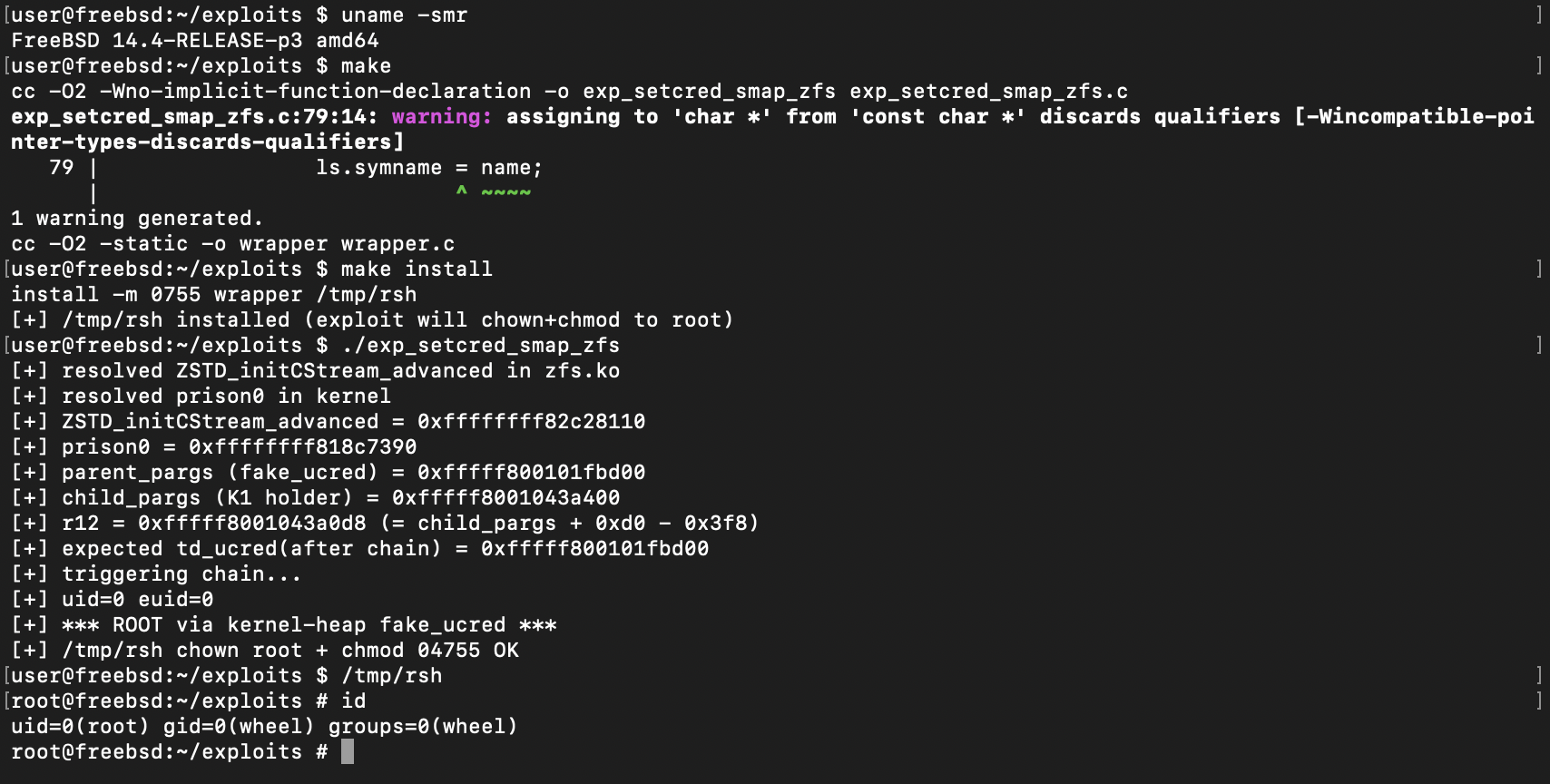
The FreeBSD security apparatus has successfully resolved a high-severity vulnerability, cataloged as CVE-2026-45250, within the setcred(2) system call architecture. This fundamental defect resided within the core kernel logic, empowering an unauthenticated local adversary to induce a catastrophic kernel panic or, under specific operational configurations, elevate execution privileges to the absolute root tier. Crucially, the operating system parsed this defective routine prior to verifying the authorization parameters of the calling process; consequently, triggering the vulnerable code path required zero administrative entitlements.
Official Advisory Disclosures and Environmental Remediation
In response, the FreeBSD Security Officer distributed the formal advisory FreeBSD-SA-26:18.setcred, accompanied by binary patches for all actively supported deployment tracks.
| Operating System Version | Minimum Compliant Patch Level |
| FreeBSD 14.3 | 14.3-RELEASE-p14 |
| FreeBSD 14.4 | 14.4-RELEASE-p5 |
| FreeBSD 15.0 | 15.0-RELEASE-p9 |
Engineers have also backported these definitive structural fixes into the upstream stable/14 and stable/15 source trees to protect ongoing developmental rollouts.
Functional Genesis of the setcred(2) Subsystem
The setcred(2) primitive initially debuted within the production runtime environment of FreeBSD 14.3-RELEASE. Architected specifically for high-privilege applications, this system call enables an execution thread to atomically establish a comprehensive biometric profile for a target process in a single transaction. Specifically, it synchronizes real, effective, and saved user and group identifiers, compiles supplementary group memberships, and applies Mandatory Access Control (MAC) security labels. Therefore, this consolidated mechanism effectively supersedes a fragmented sequence of legacy primitives, such as setuid(2), setgid(2), and setgroups(2).
Architectural Deconstruction of the Size Mismatch Flaw
The underlying memory corruption anomaly manifested during the structural parsing of supplemental group arrays. Within the internal helper function kern_setcred_copyin_supp_groups(), the kernel was instructed to ingest an array of group identifiers directly from user space into a localized memory container. However, during the calculation of the destination buffer size, the compiler evaluated the physical footprint of an abstract memory pointer rather than parsing the literal structure of the underlying gid_t element type. On 64-bit architectures, this logical error introduced an acute scalar mismatch: a standard memory pointer commands eight bytes of storage, whereas the native gid_t token requires merely four. As a consequence of this structural variance, the kernel inadvertently copied up to double the volume of expected data into the allocated space.
In its most fundamental abstraction, the vulnerability crystallized around the malicious interpretation of the sizeof(*groups) expression. At the critical execution junction, this directive evaluated strictly to the size of a pointer variable, completely disregarding the literal dimensions of the target group identifier structure. In scenarios where the kernel instantiated this memory pool dynamically from the heap, the surplus byte allocation merely resulted in benign buffer padding. Conversely, when the execution path traversed a bounded buffer located natively upon the kernel stack, the incoming telemetry overflowed the boundaries of the localized array, bleeding into critical adjacent registers.
The Severe Hazards of Kernel Stack Corruptions
A stack-based buffer overflow within the kernel space represents an exceptionally lethal hazard, as it directly corrupts the memory structures governing the core operating system. In a benign scenario, this memory corruption destabilizes the execution thread, causing the machine to collapse into an immediate kernel panic that necessitates a hard physical reboot. In a more sophisticated intrusion chain, however, a capable adversary can manipulate these corrupted stack frames to redirect the CPU’s instruction pointer. This orchestration subverts the kernel’s execution flow, granting the unprivileged process absolute superuser hegemony.
The Strategic Implications of Asynchronous Logic Validation
The definitive hazard of this vulnerability is amplified by the asynchronous sequence of its logical operations. The kernel initiated the user-space data copy routine prior to validating whether the originating process possessed the administrative entitlements to modify its cryptographic credentials. Consequently, any unprivileged local actor could initialize the vulnerable path at will. This specific exposure pattern introduces immense systemic risk for multi-tenant server environments, virtualized jail enclaves, containerized microservice architectures, or web-facing applications where an initial compromise has equipped an adversary with low-privilege system access.
Weaponizing FatGid: Circumventing Silicon-Level Defenses
Security researchers dubbed this localized exploit vector FatGid, demonstrating a functional local privilege escalation exploit targeting FreeBSD 14.3 and 14.4 running natively on the amd64 architecture. Their investigative data confirms that an attacker can achieve a root shell escape even when modern hardware-enforced protections—specifically Supervisor Mode Access Prevention (SMAP) and Supervisor Mode Execution Prevention (SMEP)—are fully operational. These hardware gates are engineered to isolate the kernel by preventing it from inadvertently reading from or executing code within user-space memory maps. Although these silicon barriers typically paralyze basic kernel exploitation chains, the FatGid exploit elegantly bypasses them by strictly manipulating pre-existing structures already resident within high-privilege kernel memory pools.
Remediation Imperatives and Strategic Mitigation Protocols
While a granular deconstruction of the exploitation chain—encompassing explicit memory offsets, kernel structure layouts, and the staging of counterfeit objects to hijack loaded modules—is omitted here to preserve defensive integrity, the practical risk matrix remains unyielding. For unpatched FreeBSD 14.3 and 14.4 infrastructure, this single flaw transforms a constrained, low-privilege compromise into absolute, unhedged dominion over the host system.
Leveraging Loaded Kernel Modules for Defense Evasion
A specialized variation of the exploit chain leverages the native storage driver module, zfs.ko. Because FreeBSD ecosystems utilizing ZFS storage pools routinely maintain this module in an active memory state, this dependency condition represents a highly realistic scenario for a vast majority of production environments. Crucially, the underlying vulnerability does not reside within the ZFS codebase itself, which remains fundamentally secure; rather, the exploit chain treats the loaded ZFS binary as a convenient tactical bridge to gracefully navigate around the machine’s enabled hardware defenses (SMAP/SMEP).
Comparative Structural Analysis Across Upstream Tiers
Although FreeBSD 15.0 similarly required a security patch due to the presence of the defective source code, its adjacent kernel layout diverges significantly from the FreeBSD 14.4 baseline. Analytical data suggests that the specific exploit chain optimized for the 14.x branch fails to achieve root escalation on the 15.0 tier due to these structural variations. Nevertheless, an unprivileged user can still invoke the bug to trigger an instantaneous system-wide crash; thus, implementing the update on FreeBSD 15.0 remains an absolute security necessity.
The Anomalous Lifecycle of the Structural Patch
The chronological evolution of this code correction followed a highly unconventional trajectory. The compromised logic was quietly eliminated from the main FreeBSD branch as early as November 2025 during a comprehensive refactoring of the setcred() architecture; however, the corresponding commit metadata omitted any explicit mention of a stack-based buffer overflow risk. The formal security advisory and tracking token manifested significantly later, debuting in unison with the compiled binary patches prepared for the stable release distributions.
Hardening the Enterprise Perimeter: Actionable Upgrades
System administrators must immediately audit the patch levels of their active deployments. If a terminal evaluates to a build iteration lower than 14.3-RELEASE-p14, 14.4-RELEASE-p5, or 15.0-RELEASE-p9, the kernel must be recompiled or upgraded, followed by a mandatory system reboot. The exact remediation methodology depends on the infrastructure type: standard environments can leverage the automated freebsd-update utility, whereas custom deployments may require compiling the base system binaries directly from the authenticated source trees.
Importantly, legacy branches such as FreeBSD 13.x remain entirely insulated from this threat vector, as the setcred(2) subsystem does not exist within their codebase. For contemporary production servers, the defensive mandate is absolute: deploy the security patch, initialize a clean reboot sequence with the modernized kernel, and meticulously audit systems hosting multi-user tenancies, isolated jail environments, or restricted network services.
Support Our Threat Intelligence
If you find our technology report and cybersecurity news helpful, consider supporting our work.
 Buy Me a Coffee
PayPal
Buy Me a Coffee
PayPal


