Algorithmic Infiltration: Microsoft Unmasks Generative AI Poisoning in Cryptojacking Campaign
Exploitation of High-Performance Hardware Boundaries
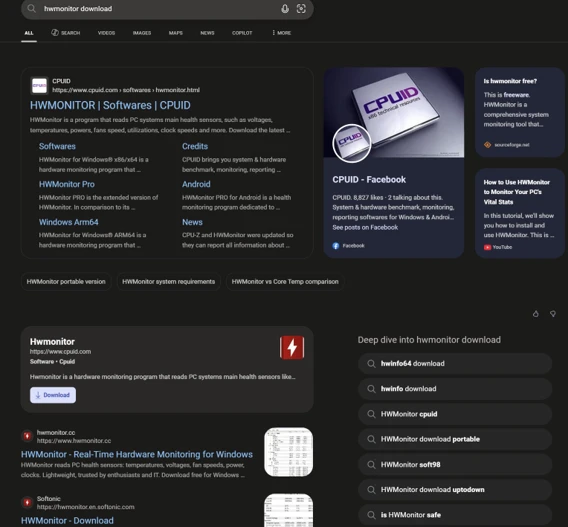
Microsoft recently discovered an advanced cryptojacking campaign. Specifically, this malware masquerades as popular hardware monitoring utilities and PC overclocking software. Consequently, the threat actors do not focus on mass infection. Instead, they deliberately target users with high-performance graphics architecture. Furthermore, the distribution strategy leverages both fraudulent search results and poisoned generative AI chatbot recommendations.
The Mechanics of the Compromise
Analysts from the Microsoft Defender cell investigated the malicious infrastructure. Notably, the operators cloned legitimate domains for tools like CrystalDiskInfo, HWMonitor, and FurMark. Additionally, they mimicked utilities like Display Driver Uninstaller, K-Lite Codec Pack, and PDFgear.
Initially, unsuspecting users downloaded a compromised ZIP archive containing a legitimate binary. However, the package secretly bundled a malicious library named autorun.dll. Subsequently, initializing the executable triggers the hidden installation of auxiliary components.
Infrastructure Scale and Generative Poisoning
The offensive operation leverages an expansive network exceeding 150 distinct domains. Specifically, the actors provisioned part of this infrastructure using the Dynu dynamic DNS registry. Furthermore, telemetry analysts observed substantial malicious referral traffic originating directly from conversational AI platforms. According to VirusTotal documentation, multiple poisoned links routinely manifested within automated chatbot answers for software inquiries.
Establishing Remote Administration Capabilities
Following successful endpoint compromise, the payload installs the ScreenConnect remote administration utility. Through this tool, the remote operators command persistent system access. Consequently, they can easily introduce novel malicious payloads into the host. Therefore, Microsoft security specialists warn that this vector facilitates far more than cryptocurrency harvesting. Specifically, it empowers threat actors to execute data theft, move laterally, or deploy devastating ransomware.
Architectural Evasion and Dynamic Throttling
The secondary phase involves executing a component called SimpleRunPE.exe. Subsequently, this utility injects the mining payload directly into legitimate Microsoft .NET execution spaces. To obscure its presence, the malware subverts native Windows components. These tools include InstallUtil.exe, MSBuild.exe, and RegAsm.exe.
Furthermore, the script automatically appends registry exclusions to Microsoft Defender. Then, it actively audits the environment for virtual machines and reverse-engineering utilities. If the module detects tools like Wireshark, IDA, or Ghidra, it terminates instantly.
Smart Resource Management
To harvest digital assets, the operators deploy standard mining tools like gminer, lolMiner, and SRBMiner-MULTI. Concurrently, the payload monitors user keyboard activity and real-time GPU workloads. If the operator launches an intensive game, the miner pauses automatically. As a result, the system completely avoids triggering consumer suspicion.
Recommended Defensive Controls
Readily, Microsoft asserts that the integrated Defender suite successfully mitigates this adversarial activity. Accordingly, the enterprise urges organizations to enable cloud-delivered protection modules and network filtering configurations. Ultimately, deploying strict attack surface reduction rules will insulate corporate networks from these emerging threats.
Support Our Threat Intelligence
If you find our technology report and cybersecurity news helpful, consider supporting our work.
 Buy Me a Coffee
PayPal
Buy Me a Coffee
PayPal


