AI Weaponized to Shatter Georgia’s Secret Ballot
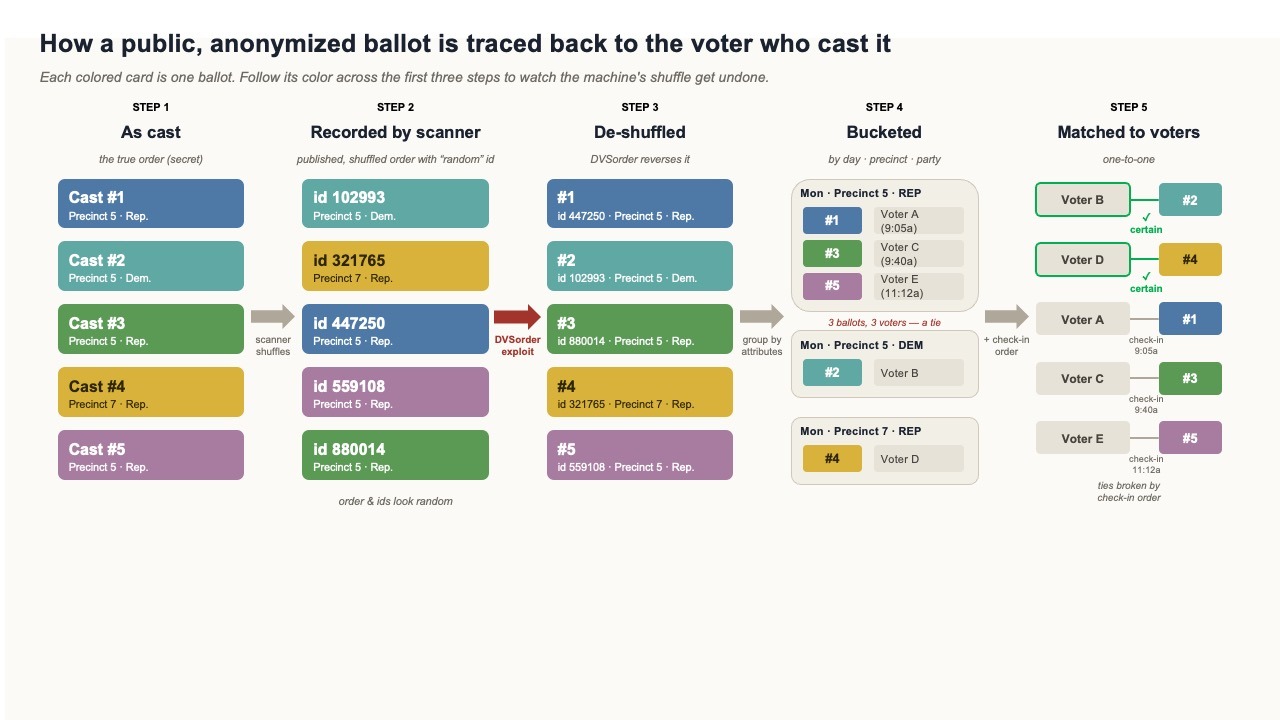
The sanctity of the secret ballot in Georgia fractured profoundly, absent any physical machine tampering, network infiltration, or illicit access to proprietary source code. Max Springer, an intrepid specialist from Princeton University, merely invested $20 to access an AI agent. Within hours, he transformed publicly available electoral data into a terrifying instrument capable of inextricably linking specific voters to their cast ballots.
The Mechanics of the DVSorder Vulnerability
This catastrophe does not involve internet voting. In Georgia, electors select their preferences on a touchscreen terminal, receive a physical paper ballot, and deposit it into an optical scanner. Following tabulation, officials release the electronic cast vote records in a deliberately randomized sequence. Authorities long presumed that reconstructing the original chronological order was impossible; however, contemporary AI de-anonymization tools have drastically lowered the threshold required for such sophisticated attacks.
Security researchers designated this specific flaw as DVSorder. Dominion ImageCast Precinct and ImageCast Evolution scanners append an identifier to each electronic ballot that superficially appears random. In reality, a highly predictable algorithm generates these numbers. Consequently, an adversary can retroactively reverse the sequence and meticulously reconstruct the exact scanning order. Researchers initially disclosed this vulnerability in 2022, yet jurisdictions across 21 US states continue utilizing the affected models.
De-anonymization Through Data Correlation
The reconstructed ballot order, in isolation, does not surrender voter identities. The true peril materializes when an attacker aggregates several open-source datasets. By correlating lists of individuals who voted, scanner logs, precise polling station registration times, and the electronic vote records, a comprehensive, damning picture emerges. Essentially, this employs the identical logic underpinning open-source intelligence de-anonymization: while each individual data fragment appears benign, mathematical correlation obliterates privacy protections.
Springer rigorously analyzed data from the May 2026 primaries. Across 114 of the 139 evaluated counties, he successfully reconstructed the scanning order for approximately 1.52 million ballots, representing a staggering 98.9% of the scrutinized in-person votes. Merely analyzing two public files proved sufficient to definitively link approximately 1% of early voters to their specific ballots. Incorporating supplemental logs and registration metadata drastically elevated the accuracy rate.
Real-World Demonstrations of Compromised Anonymity
In Heard County, the AI agent successfully linked the overwhelming majority of 650 early voters to their exact ballots. For the remaining individuals, the margin of uncertainty dwindled to virtually two possibilities. A similarly alarming result materialized for 1,860 voters at the massive Ball Ground voting center. Furthermore, the presence of security cameras, observer recordings, or simply an individual knowing their precise position in line provides yet another potential vector for reconstructing ballot correspondence.
The Severe Threat to Democratic Integrity
Crucially, this vulnerability does not empower an attacker to alter cast votes; therefore, it does not intrinsically challenge the mathematical outcome of the election. The paramount risk strictly concerns privacy. The fundamental institution of the secret ballot shields individuals from pernicious pressure exerted by employers, relatives, political organizations, and government officials, while simultaneously obstructing overt vote-buying schemes. Thus, possessing the capability to definitively prove how a specific individual voted escalates a technical defect into a monumental systemic crisis.
A remediated software version has existed since 2023. As detailed in the USENIX Security ’24 presentation on DVSorder, Springer strongly recommends installing Dominion Democracy Suite 5.17 or a subsequent iteration. Nevertheless, Georgia audaciously proceeded with the 2026 elections utilizing the vulnerable configuration. Discussing the algorithmic failure beneath the secret ballot, the specialist emphatically underscored that the AI did not discover a novel vulnerability. The autonomous coding agent merely assimilated previously published research and executed a complex task in hours that formerly necessitated profound programming expertise.
Inadequate Responses and the Search for Solutions
Georgia authorities have thus far deployed only interim, superficial countermeasures. They plan to obscure certain sensitive data fields prior to publication and implement additional layers of randomization upon the electronic records. State officials summarily rejected proposals to urgently install the available software update, citing bureaucratic hurdles regarding certification, immovable deadlines, and an alleged lack of funding. Critics vehemently argue that merely restricting data access is insufficient, as the raw source copies perpetually retain the potentially hazardous correlations. This fierce debate regarding electoral protection has intensified dramatically preceding the November elections.
Unfortunately, the deficiencies plaguing American voting systems extend far beyond DVSorder. A recent, rigorous audit of Dominion infrastructure within a separate jurisdiction simultaneously exposed 12 vulnerabilities carrying high and critical severity ratings, although investigators found zero technical evidence indicating the illicit alteration of election results.
Fascinatingly, physicists propose a radically divergent approach to safeguarding ballot secrecy. In nascent laboratory experiments involving quantum voting, the intrinsic properties of entangled photons guarantee anonymity, entirely superseding reliance upon the supposed secrecy of software algorithms or the fragile promises of electoral organizers not to correlate records with participants.
Support Our Threat Intelligence
If you find our technology report and cybersecurity news helpful, consider supporting our work.
 Buy Me a Coffee
PayPal
Buy Me a Coffee
PayPal


