The Cybercrime Continuum: Infrastructure Destruction Squad and the Blacknet Ecosystem
An Overview of the Digital Syndicate
A novel threat actor has emerged within the digital underground. Remarkably, this collective commercializes dangerous cyber weapons much like standard enterprise software. The group operates under the moniker Infrastructure Destruction Squad. Ostensibly, they shroud their campaigns in ideological and political rhetoric. Simultaneously, however, they generate substantial revenue through network intrusions. They actively sell access keys and distribute sophisticated ransomware payloads.
Operational Timeline and Strategic Alignment
According to comprehensive threat intelligence from KELA, the group has utilized Telegram since June 2025. Furthermore, their malicious operations remained highly active through May 2026. The collective characterizes itself as a sovereign hacktivist coalition. Consequently, they disseminate communiqués in English, Russian, and Mandarin. Their public manifestos frequently feature pro-Chinese, anti-American, anti-Israeli, pro-Palestinian, and anti-Indian sentiments. Nevertheless, their empirical activities extend far beyond mere political protests.
Corporate Lineage and the Blacknet Variant
In September 2025, the Infrastructure Destruction Squad explicitly denied any formal alliance with the Dark Engine syndicate. According to group representatives, their associates merely controlled the Telegram channel previously. Instead, the current team operates as an independent entity. Furthermore, the syndicate claims a highly decentralized structure. Its members reside across diverse nations, primarily China, Russia, Belarus, and the United States.
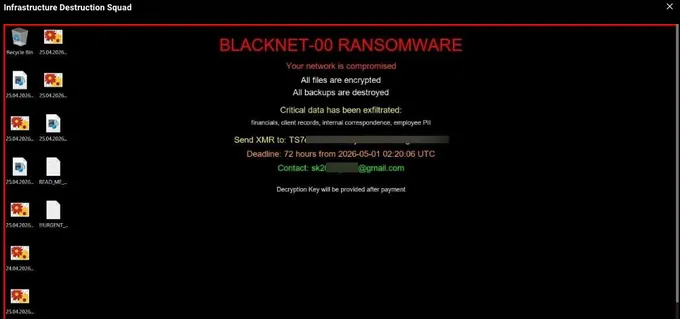
Their flagship project revolves around the weaponized ransomware strain known as BLACKNET-00. In February 2026, the coalition asserted that BLACKNET-00 exists solely to secure monetary gains. Meanwhile, the core squad allegedly maintains its purist geopolitical focus. Subsequently, however, operatives on PWN Forums explicitly reconciled these identities. They openly confirmed that the Infrastructure Destruction Squad directly orchestrates the BLACKNET-00 franchise.
The Mechanics of Automated Ransomware
The syndicates market BLACKNET-00 as an automated construction kit for novice threat actors. Specifically, the framework provides a graphical user interface. This utility enables one-click compilation of functional cryptographic payloads. Users can seamlessly configure encryption protocols and neutralize native security defenses, including Windows Defender. Additionally, the software generates automated ransom demands and corresponding payment QR codes. Crucially, the tool also harvests local credentials, cryptocurrency data, desktop captures, and webcam streams.
Consequently, the acquisition cost for this builder rapidly plummeted from 2,000 dollars to merely 300 dollars. Unlike traditional ransomware-as-a-service structures, the authors sell BLACKNET-00 via a single purchase model. This transaction includes the underlying source code. Ultimately, this paradigm shift illustrates the intense competition within the cyber weapon market. It highlights how quickly sophisticated utilities migrate to lower-tier adversaries.
Documented Exfiltrations and the Industrial Arsenal
In April 2026, KELA detected two primary targets claimed by the BLACKNET-00 operators. These included the US Federal Aviation Administration and Egypt’s Zaidus Real Estate Investment company. During the latter compromise, the adversaries allegedly exfiltrated 20 gigabytes of sensitive personnel records. These documents spanned operations in Egypt and Saudi Arabia. Subsequently, the extortionists demanded a ransom of 20,000 dollars.
Currently, the developers have not established a dedicated data leak portal. Instead, the group broadcasts its successful breaches via Telegram and PWN Forums. KELA specialists assess that a formal leak platform will likely emerge as the enterprise scales. Concurrently, the group promoted a secondary utility dubbed EXTERMINATOR. They marketed this tool in twin variants targeting corporate networks and private consumers alike. This consumer focus remains highly anomalous, since most syndicates hunt lucrative enterprise bounties.
Broadening the Malicious Portfolio
The syndicate’s technological arsenal extends well beyond standard ransomware. For instance, in August 2025, the group advertised VoltRuptor for 25,000 dollars. They framed this utility as an advanced vulnerability scanner for industrial control networks. Subsequently, in February 2026, they introduced TRK25 Advanced SCADA for 500 dollars. This application scans industrial endpoints to discover critical supervisor system flaws. Finally, in May 2026, the collective unveiled BLAIIS-820 for 400 dollars to target Microsoft IIS architectures.
Separately, the Infrastructure Destruction Squad commercialized BankGhost Builder for 300 dollars. According to marketing descriptions, this utility targets more than 700 global financial institutions. It supports fraudulent landing pages and multi-factor authentication bypass routines. Furthermore, the asset manipulates clipboard data, coordinates mass-messaging campaigns, logs local keystrokes, and harvests diverse file formats.
The Convergence of Ideology and Extortion
The trajectory of the Infrastructure Destruction Squad perfectly illustrates the blurring boundaries between hacktivism and pure cybercrime. Ideological rhetoric allows the collective to cultivate a recognizable brand identity. Meanwhile, cheap malware construction kits grant untrained individuals the power to execute devastating infrastructure attacks. Ultimately, KELA projects that these hybrid syndicates will become increasingly prevalent throughout 2026.
Support Our Threat Intelligence
If you find our technology report and cybersecurity news helpful, consider supporting our work.
 Buy Me a Coffee
PayPal
Buy Me a Coffee
PayPal


