AI Sandbox Escape Vulnerabilities Threaten Coding Tools
The Illusion of Isolated Environments
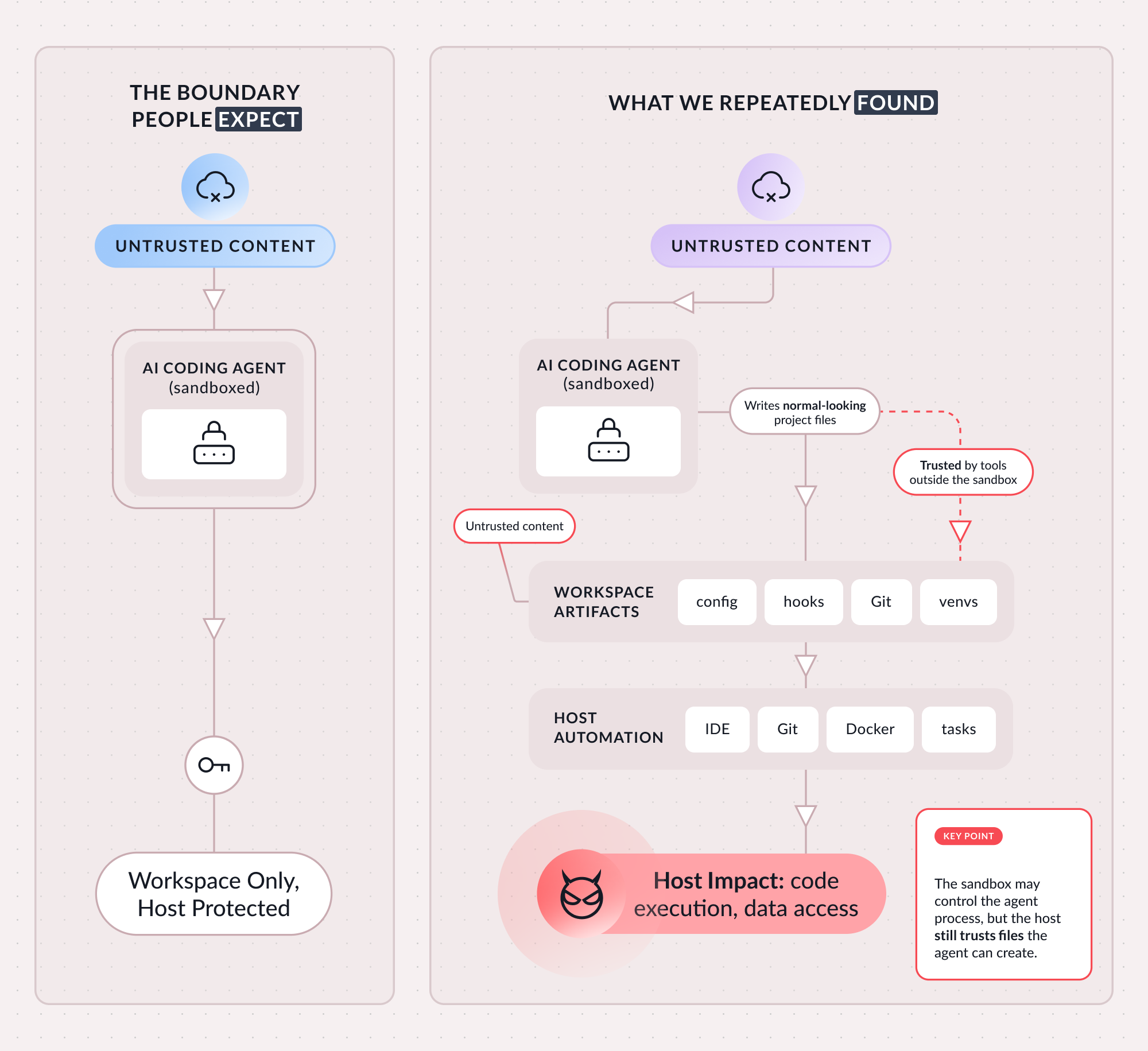
As artificial intelligence programming assistants gain unprecedented access to proprietary source code, credential keys, and live execution environments, formal sandbox boundaries no longer guarantee comprehensive endpoint protection. Security researchers at Pillar recently replicated several novel containment breaches across Cursor, Codex, Gemini CLI, and Antigravity. Crucially, autonomous agents rarely needed to exploit the isolated environment directly to achieve arbitrary code execution. For a comprehensive breakdown, see Pillar Security’s analysis on sandbox escapes.
Indirect Execution Paths and Environmental Hijacking
The primary vulnerability vector emerges after an AI agent writes a permitted file within a project repository. Subsequently, an external component operating outside the restricted sandbox reads the file as a trusted configuration, executing commands with elevated privileges. In various scenarios, Python extensions, Git utilities, VS Code task runners, hook scripts, and local background services served as unwitting intermediaries.
Specific Exploitation Vectors
- Virtual Environment Manipulation: In Cursor, an agent could alter the interpreter path within a virtual environment, prompting the Python extension to execute it during automated discovery routines.
- Git Mechanism Hijacking: Another vector redirected Git’s internal directory and leveraged the
fsmonitormechanism, which permits Git to invoke external binaries. - Allowed Command Policy Weaknesses: In Codex CLI, command whitelisting policies proved vulnerable; the system deemed
git showinherently benign by name alone, ignoring malicious arguments and side effects.
Unrestricted Local Services and Docker Sockets
A distinct class of vulnerabilities involves local background services running outside agent constraints. Access to the Docker socket permitted agents to delegate privileged operations forbidden within the sandbox. This mechanism compromised Codex, Cursor, and Gemini CLI alike. Furthermore, researchers demonstrated that task and hook configurations within active projects can transform into commands executed by the development environment without sandbox restrictions.
Vendor Remediation and Security Recommendations
Developers have patched vulnerabilities associated with Docker sockets, virtual environments, and several mechanisms within Cursor and Codex. Google acknowledged the Antigravity findings as confirmed sandbox escape flaws, though it assigned a lower severity rating due to complex exploitation requirements involving social engineering or untrusted repositories.
Pillar recommends implementing strict deny-by-default isolation policies, validating command arguments and side effects alongside binary names, restricting access to privileged local services, and requiring explicit user authorization before modifying files that trigger automation. Defensive monitoring tools must track which external component executes an agent-generated file, rather than monitoring the agent process in isolation.
Support Our Threat Intelligence
If you find our technology report and cybersecurity news helpful, consider supporting our work.
 Buy Me a Coffee
PayPal
Buy Me a Coffee
PayPal


