Acoustic Keystroke Attack Decodes Typing Using Language Models
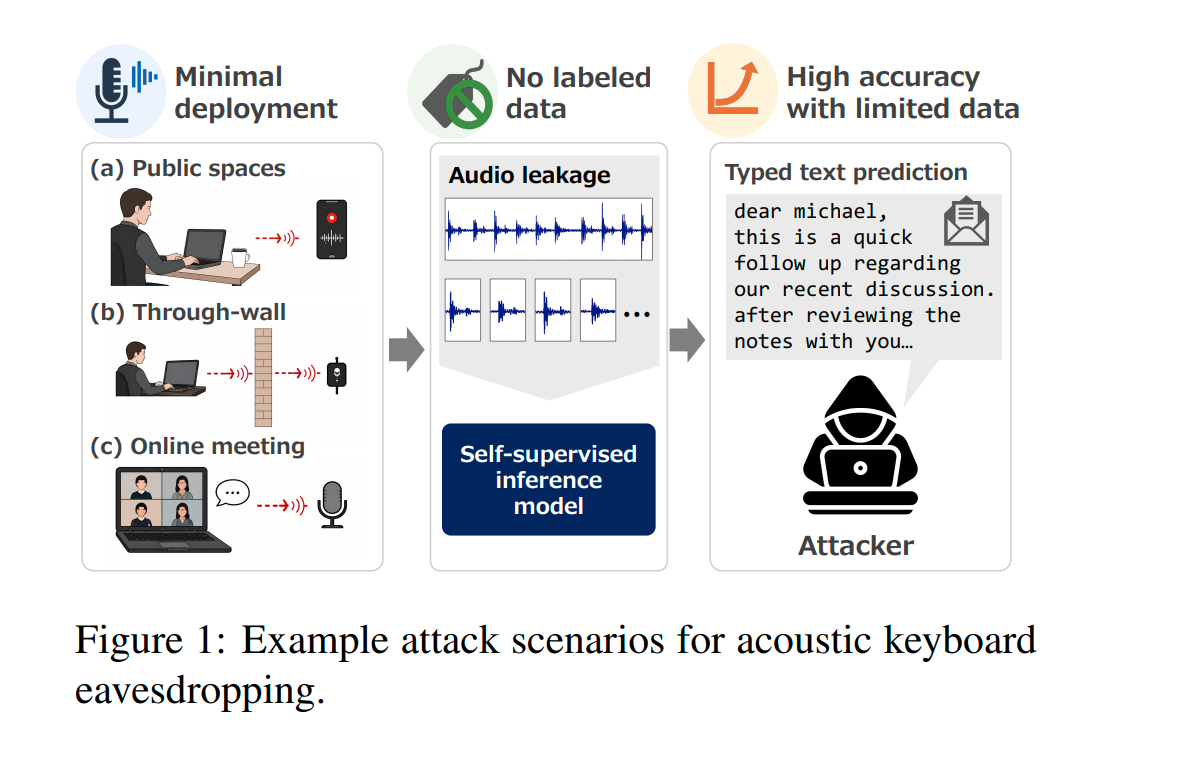
The acoustic reverberations of keyboard strokes can betray far more information than previously imagined. Recently, a novel side-channel attack demonstrated that a brief audio recording suffices to reconstruct typed text without requiring direct compromise of the target machine. Scientists hailing from Tohoku University, Kyoto University, and the Nara Institute of Science and Technology engineered this sophisticated mechanism, which deciphers keystrokes through advanced acoustic analysis coupled with language models.
Overcoming Legacy Acoustic Attack Limitations
Traditional acoustic attacks historically necessitated prior calibration, requiring researchers to record specific keystroke signatures for every individual key on a target keyboard. Conversely, this pioneering paradigm operates without preliminary training. The system autonomously isolates discrete keystrokes from raw audio streams, clusters acoustically similar sound profiles, and subsequently predicts the most probable character sequence based on contextual probability.
To achieve high translation fidelity, researchers deployed a Transformer-based language model complemented by a large language model framework. As detailed in research published on acoustic keyboard eavesdropping, the mechanism iteratively refines the inferred text, correcting errors by evaluating individual acoustic signals against surrounding lexical context. Consequently, the attack does not rely solely on subtle physical variances between individual keys.
Experimental Benchmarks and Real-World Eavesdropping
In controlled laboratory environments, a smartphone positioned adjacent to a 2019 MacBook Pro recorded ambient typing sounds. Upon capturing merely 100 to 150 keystrokes, the system reconstructed typed text with an astonishing accuracy exceeding 99%. Furthermore, the methodology proved effective across various laptop architectures, including models from Dell, HP, Lenovo, and Apple, though certain designs required slightly larger audio samples.
More intricate experimental scenarios demonstrated accuracy exceeding 90% after recording 150 to 250 keystrokes. Researchers successfully captured mechanical vibrations using a contact microphone positioned approximately three meters away across a desk surface and even through adjacent walls. However, the authors emphasize that these trials represent controlled academic demonstrations rather than active in-the-wild exploitation against consumers.
Vulnerability Over Video Conferencing and Mitigation Strategies
Additionally, researchers evaluated the attack vector during active video conference calls on Google Meet, Microsoft Teams, and Zoom. When participants disabled native noise suppression, residual keystroke acoustics persisted within the audio stream, enabling text reconstruction after several hundred keystrokes. The overall success rate varied depending on specific laptop hardware and communication platform algorithms.
To minimize exposure to acoustic eavesdropping, security specialists recommend refraining from entering passwords or sensitive credentials while active microphones are enabled. Furthermore, users should consistently enable AI-driven noise suppression features and remain vigilant regarding nearby smartphones, external microphones, and ambient recording equipment.
Support Our Threat Intelligence
If you find our technology report and cybersecurity news helpful, consider supporting our work.
 Buy Me a Coffee
PayPal
Buy Me a Coffee
PayPal


