Cascading Subversion: Exploit Chain Grants Zero-Click Root Access to UniFi OS Servers
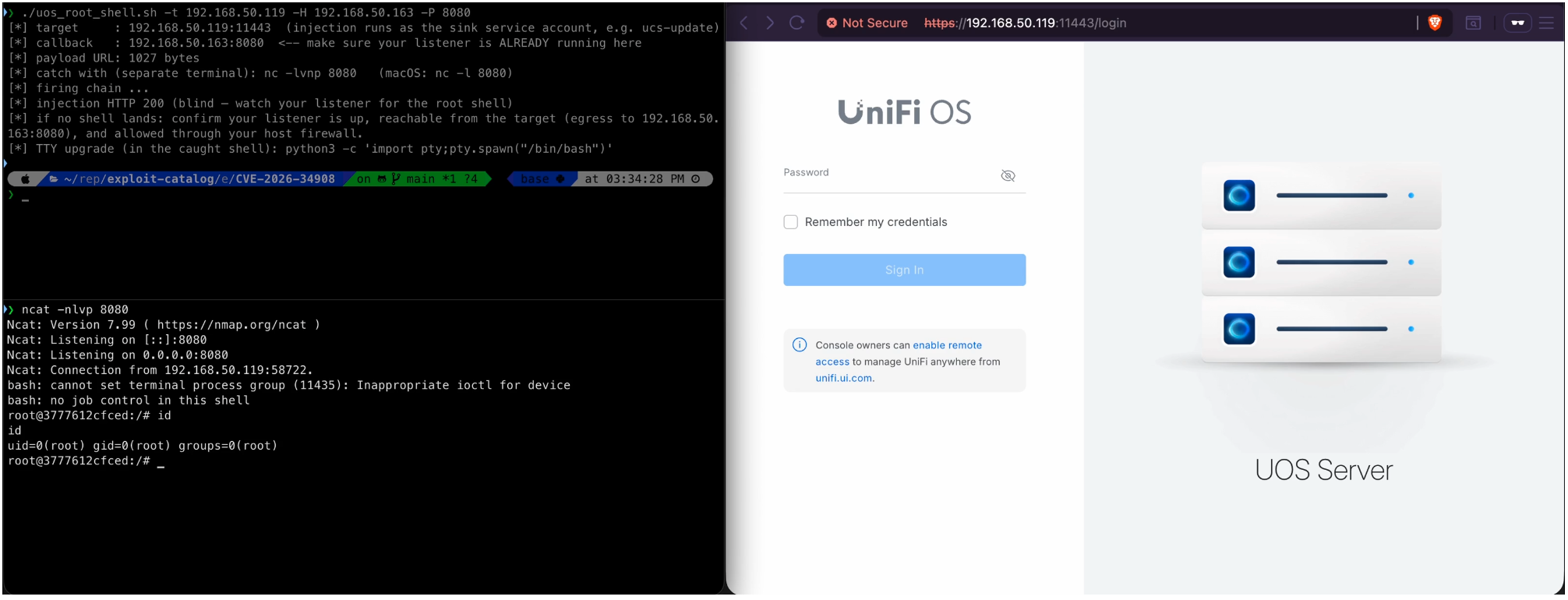
A solitary network management server can transform into a catastrophic entry point. Consequently, deferring vital software deployments multiplies enterprise security risks exponentially. Security researchers at Bishop Fox recently exposed a severe architectural threat. Specifically, they chained three patched vulnerabilities within the Ubiquiti UniFi OS Server environment. As a result, unauthenticated remote adversaries can achieve arbitrary code execution with root privileges. This dangerous mechanism requires absolutely no credentials or user interaction.
Analyzing the Critical Threat Vector
The exploit chain leverages three distinct flaws cataloged under separate identifiers:
- CVE-2026-34908 (CVSS 10.0 Critical)
- CVE-2026-34909 (CVSS 10.0 Critical)
- CVE-2026-34910 (CVSS 10.0 Critical)
Ubiquiti successfully remediated these software anomalies in May 2026. Furthermore, the vendor designated UniFi OS Server versions 5.0.6 and prior as vulnerable. Although exploitation requires local network access, all three defects received maximum severity ratings. Crucially, the manufacturer’s original advisories failed to disclose that these flaws could form a chain.
Deconstructing the Vulnerability Cascade
Mechanically, the first defect features improper access controls, enabling unauthorized system modifications. The secondary flaw permits arbitrary file disclosure via path traversal maneuvers. Concurrently, the third vulnerability facilitates remote command injection.
According to Bishop Fox, the primary two flaws allow attackers to bypass authentication gates. Subsequently, the actors exploit this access to interact with protected internal functionalities. Ultimately, the final vulnerability executes arbitrary commands directly on the hosting server.
Architectural Parsing Discrepancies
This authentication bypass stems from an architectural parsing conflict between internal components. Specifically, the access validation module evaluates the raw, unparsed request path. In contrast, Nginx routes the data payload only after full path normalization.
Therefore, a meticulously structured request deceptively mirrors an authorized endpoint route. Consequently, the malicious traffic penetrates deep into the hardened system core.
Once inside, an attacker invokes the native package update subroutine. Subsequently, they pass unvalidated data strings directly into the system shell. Initially, these commands execute under a restricted system service account context.
However, this specific service profile possesses passwordless sudo permissions for system utilities. Thus, escalating privileges to the supreme root tier remains entirely trivial.
Operational Repercussions and Forensics
Bishop Fox successfully verified this exploit chain against a live instance of version 5.0.6. Environmental markers indicate that the underlying danger extends far beyond the local console infrastructure. Indeed, UniFi OS Server frequently governs entire enterprise network footprints. The console simultaneously manages physical access barriers, surveillance arrays, and credential repositories. Therefore, securing root access grants absolute sovereignty over the managed perimeter.
Additionally, Bishop Fox distributed a complimentary, non-destructive diagnostic utility. This tool safely probes the target code path without executing harmful payloads. Following the execution, the asset receives a definitive vulnerability status classification.
However, the utility cannot detect historical breaches or hidden persistence mechanisms. Undeniably, identifying past compromises remains an exceptionally arduous forensic challenge. Because the exploit circumvents authorization checks, standard security logs lack typical failure entries.
For manual forensic inspections, analysts recommend scanning for /api/auth/validate-sso/ string patterns. Concurrently, defenders must audit system records for unexpected ucs/update/latest_package queries. Teams should also monitor anomalous child processes generated by the ucs-update service.
Bishop Fox confirmed that this exploit chain fails against version 5.0.8. Therefore, administrators must transition to the updated framework immediately. Finally, teams should execute a thorough compromise assessment prior to patching.
Support Our Threat Intelligence
If you find our technology report and cybersecurity news helpful, consider supporting our work.
 Buy Me a Coffee
PayPal
Buy Me a Coffee
PayPal


