Forgotten UEFI Shims Undermine Secure Boot Defenses
The Illusion of Early-Stage Security
The Secure Boot mechanism must block malicious code before Windows or Linux even launches. However, ESET researchers recently made a startling discovery. Specifically, attackers could bypass this protection almost continuously since its inception. They achieved this by exploiting ancient boot files. Surprisingly, Microsoft persistently recognized these old files as trusted entities. Consequently, some of these files remained fully valid for over a decade following the initial disclosure of known vulnerabilities. Readers can explore the technical details in the original ESET research report.
Understanding the Shim Component
This critical problem involved special software components known as shims. Developers originally created shims to extend Secure Boot capabilities to Linux systems and early-stage utility programs. Initially, Microsoft signed these specific files using its official digital certificate. Subsequently, the computer firmware permitted these signed files to execute during the crucial startup phase. During their investigation, the researchers identified 11 distinctly vulnerable shim images. The earliest known file in this compromised group originated in 2013, merely one year after the official launch of Secure Boot.
The Risk of Lingering Trust
Security experts understood the vulnerabilities within these specific components for many years. Nevertheless, Microsoft failed to append them to the official revocation lists. As a result, computers implicitly continued to trust these obsolete versions. Meanwhile, malicious actors could easily exploit them to execute unsigned or deeply harmful code. Furthermore, orchestrating this attack did not require discovering a novel zero-day vulnerability. It also did not demand highly sophisticated technical maneuvers. An attacker simply needed a copy of an outdated, yet still active, shim file.
Executing the Bypass
Naturally, the intruder also needed a basic understanding of the general UEFI boot sequence. Upon launching this compromised component, the attacker could intentionally disrupt the digital signature verification chain. Ultimately, this allowed them to install dangerous malware during the very earliest stages of the computer powering on. Importantly, this severe danger threatened both Linux and Windows environments equally. Although developers initially intended the shim primarily for Linux, the UEFI firmware does not bind a trusted boot file to any specific operating system.
The Threat of Persistent Bootkits
Therefore, if a component possesses a valid Microsoft signature, an attacker can readily launch it on a Windows machine. After successfully bypassing Secure Boot, the intruder gains the terrifying ability to install a bootkit. A bootkit is a specialized malware strain that executes before the main operating system loads. Consequently, it aggressively interferes with the entire computer startup sequence. Traditional antivirus software struggles to detect such software. This difficulty arises because the bootkit activates long before most standard security tools initialize.
Maintaining Deep System Access
Furthermore, a bootkit can stubbornly persist even after a complete reinstallation of Windows or Linux. It can sometimes survive a total replacement of the primary hard drive. This occurs if the malware embeds itself directly into the motherboard firmware or a hidden system partition. Consequently, the attacker secures highly persistent, long-term access to the infected device. They can freely alter core system components or entirely disable vital security features. Moreover, they can continuously download and deploy additional malicious payloads.
The Original Promise of Secure Boot
Microsoft originally introduced Secure Boot in 2012 specifically to defend against these exact types of deep-level attacks. The mechanism strictly verifies the digital signature of every single component that executes when the computer turns on. If a file lacks a trusted certificate, the firmware must halt the boot process immediately. Similarly, it must stop if the system previously revoked the certificate. Over the past decade, security professionals have discovered several dangerous real-world bootkits.
Real-World Bootkit Examples
These notable threats include LoJax, MosaicRegressor, CosmicStrand, and BlackLotus. Researchers linked some of these sophisticated tools directly to state-sponsored hacking groups. Meanwhile, cybercriminals sold other variants openly on underground hacking forums. The majority of these attacks absolutely require physical access to the target device. However, certain complex infection chains do permit remote bootkit installation after an attacker secures high-level system privileges. Defending against brief, opportunistic physical access remains a primary objective of Secure Boot.
The Scope of the Vulnerable Files
For instance, an attacker might briefly acquire a powered-off laptop. They could quickly load a vulnerable component from an external USB drive. Thus, they install the malicious code long before returning the device to its rightful owner. A comprehensive list prepared by CERT details the compromised shim files. This list includes components associated with Red Hat, openSUSE, Oracle, and various third-party applications. Alarmingly, it even included a component from the Finnish company PC-Doctor. Officials previously used this specific software within a national examination system.
Flaws and Second-Stage Exploits
Developers released some of these flawed files long before the invention of modern revocation mechanisms. Conversely, other files contained severe logical errors within their own source code. Furthermore, some versions dangerously permitted the execution of highly vulnerable second-stage boot components. In the Windows ecosystem, the primary source of trust remains the official Microsoft bootloader. The company signs this critical file directly with its primary root certificate. Consequently, every subsequent component must pass a rigorous security check before execution.
The Complexities of Linux Booting
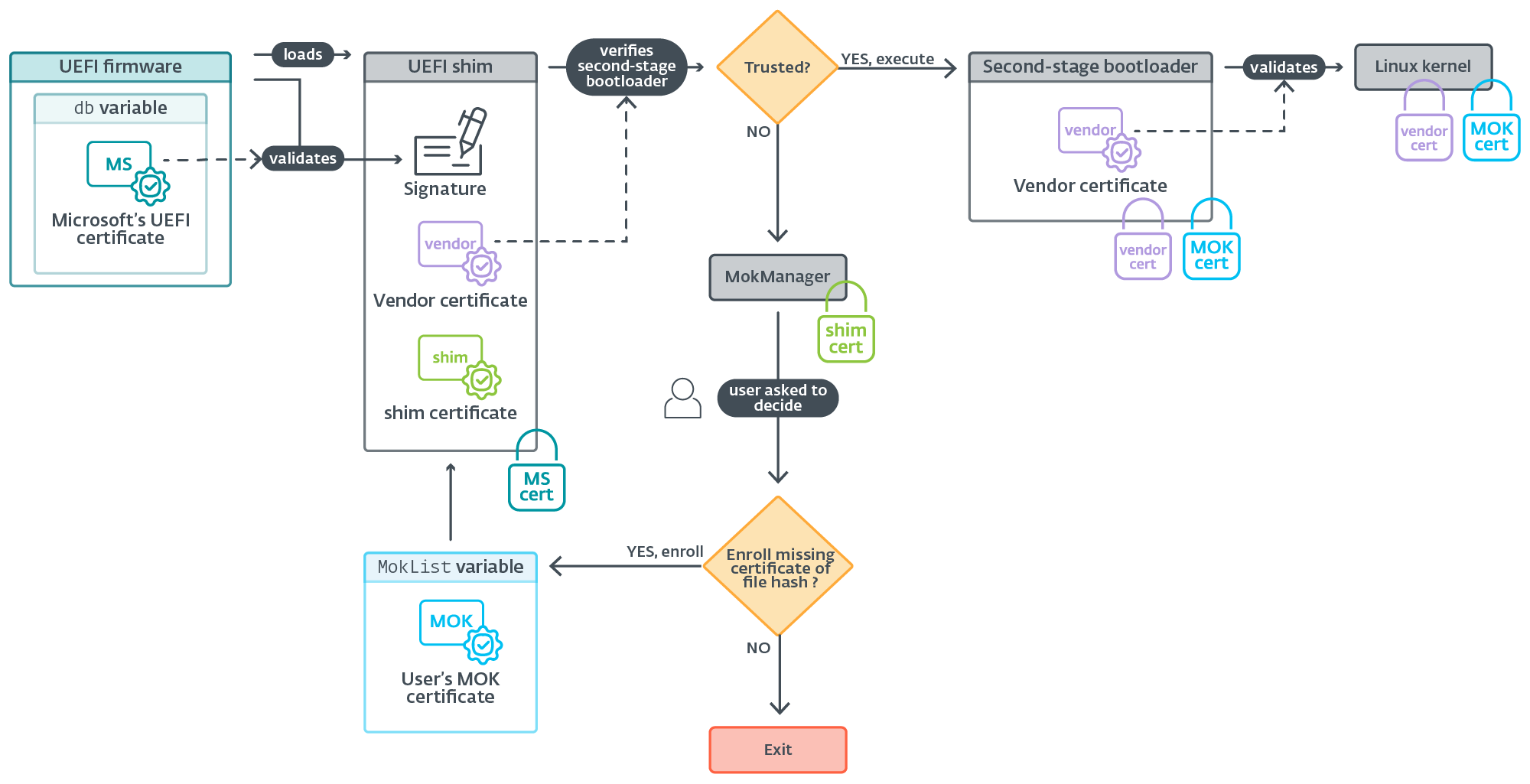
Linux utilizes a significantly different structural approach. Obviously, Microsoft cannot individually sign every single bootloader, kernel, and utility program for every existing Linux distribution. Therefore, the shim ingeniously solves this logistical problem by introducing an intermediate layer of trust. Microsoft securely signs a small, universally compatible bootloader. Then, the specific Linux developer or software manufacturer embeds their own unique certificate inside it. After its initial launch, the shim independently verifies the remaining system components.
The Double-Edged Sword of Shims
This elegant architectural design empowers developers to update Linux distributions seamlessly. They avoid the tedious necessity of constantly requesting a new signature from Microsoft for every minor file modification. Simultaneously, however, it creates a significant secondary point of risk. If a vulnerable shim improperly retains its trusted status, its embedded certificate might inadvertently authorize the execution of other highly insecure components. Microsoft holds the ultimate responsibility for revoking any compromised shim files.
The Architecture of Revocation
Upon discovering a vulnerability, the company must promptly add the digital fingerprint of the component to a special blocklist. Alternatively, they can add its associated certificate. Shockingly, in the case of these 11 discovered images, this crucial revocation never occurred. Some versions remained dangerously valid for over ten years. The company finally revoked them only within the June update package. They acted only after ESET directly shared their detailed findings with Microsoft and CERT specialists. The exact reasons for this massive, decade-long delay currently remain undisclosed.
Managing the Databases
Managing trusted Secure Boot components is an incredibly complex logistical undertaking. The system firmware relies heavily on two primary databases. The “db” database securely stores the explicitly permitted certificates and digital file fingerprints. Conversely, the “dbx” database contains detailed information regarding components that the system must no longer trust. Before executing any file, the system rigorously checks both of these essential lists. A file must possess a valid signature from the permitted database.
The Challenge of Storage Limits
Simultaneously, the file must remain entirely absent from the revoked components list. If a vulnerable bootloader stays in the “db” list and avoids the “dbx” list, the computer will consistently consider it perfectly safe. Directly adding every single insecure Linux component into the “dbx” database proved highly impractical. Engineers allocated only 32 kilobytes of total storage space for this critical database. Meanwhile, the sheer number of available bootloaders, kernels, and utility files grows continuously.
Advanced Revocation Strategies
Consequently, developers ingeniously created supplementary, version-based revocation mechanisms. One prominent solution is the Secure Boot Advanced Targeting system, commonly known as SBAT. Instead of storing the massive digital fingerprint of an individual file, the system simply stores the component name and its generation number. After a developer patches a vulnerability, they incrementally raise the version number. Subsequently, the updated Secure Boot policy automatically forbids the execution of all previous, vulnerable generations.
Version Checks and Lingering Flaws
A similar protective principle utilizes the Security Version Number metric, often abbreviated as SVN. Both of these advanced mechanisms allow administrators to revoke an entire group of vulnerable builds simultaneously. This efficiently avoids filling the highly limited database with a massive list of complex hashes. Every compatible component contains securely signed metadata detailing its specific name and generation number. During the startup sequence, the shim meticulously compares this information against the minimum acceptable version threshold.
The Dangers of Outdated Code
If the file number falls below the established security threshold, the system absolutely refuses to launch it. Crucially, this rigorous check also applies directly to the shim itself. Theoretically, an updated security policy can actually force an obsolete bootloader to reject its own execution. Subsequently, the system applies the exact same strict procedure to every single subsequent file in the boot chain. The core problem stemmed from the fact that some discovered components predated SBAT and other modern defensive mechanisms entirely.
The Path Forward for Security
Furthermore, some specific shim files completely failed to check the Machine Owner Key denial lists. Experts generally know these as the MOK deny list. Other flawed versions explicitly permitted the launch of older programs containing long-known vulnerabilities. For example, a specific Oracle shim implicitly trusted a secondary component that remained highly vulnerable to the CVE-2015-5381 attack. According to ESET’s rigorous assessment, even a relatively inexperienced specialist could exploit this specific error successfully.
Securing the Future
Certain isolated files contained their own unique internal defects. These specific flaws allowed attackers to bypass the boot chain verification entirely. Furthermore, the natural expiration of a Microsoft certificate did not resolve the problem automatically. The UEFI firmware stubbornly continues to trust previously signed files until an administrator officially adds them to the revocation list. Therefore, the mere expiration of the certificate that signed the old shim components did not block their dangerous execution. Following the installation of the comprehensive June updates, Microsoft finally neutralized these vulnerable files on affected Windows devices. Secured-core Windows 11 computers likely remained safe against this attack under default settings due to advanced built-in protections. However, Linux users must urgently review the specific recommendations provided by their chosen distribution. They should also consult the Linux Vendor Firmware Service for vital updates. Users can actively check the current status of their revocation database using the uefi-dbx-audit script. A simple operating system update might not suffice if the manufacturer has not yet distributed the new Secure Boot policy for the specific device hardware. This alarming history with vulnerable shim files starkly highlights a profound weakness within the entire security model. Ultimately, the true reliability of Secure Boot depends on much more than just strong cryptography. It fundamentally requires the flawless, continuous management of thousands of individually signed components. Just one forgotten bootloader can dangerously retain system trust for years. This catastrophic oversight can easily open a devastating pathway for malicious code that the system was explicitly designed to stop.
Support Our Threat Intelligence
If you find our technology report and cybersecurity news helpful, consider supporting our work.
 Buy Me a Coffee
PayPal
Buy Me a Coffee
PayPal


