Within a specimen of malicious software, initially misidentified as the infamous Vidar infostealer, an entirely disparate narrative has been unearthed. Lurking beneath this misattribution was a nascent instrument for data exfiltration, subsequently christened the Torg Grabber. Over a tripartite temporal span of three months, forensic sentinels harvested 334 specimens, meticulously chronicling how a rudimentary prototype rapidly metamorphosed into a consummate criminal service, boasting its own sovereign infrastructure, an administrative nexus, and scores of operators.
The primordial anomaly that awakened the analysts’ profound skepticism was a stark deviation from foundational hallmarks. The binary artifact, weighing a mere 747 kilobytes, was compiled as a 64-bit executable module via MinGW/GCC and marshaled an entirely alien command protocol. Vidar’s architectural structure and instrumental arsenal are fundamentally different. Nestled within the code lay a debugging sentinel—”grabber v1.0″—whilst network communion was orchestrated via a REST API, fortified by ChaCha20 cryptography and HMAC-SHA256 authentication. A comparative analysis against kindred stealers, such as StealC, similarly yielded no congruence. Ultimately, it became unequivocally manifest: this was a profoundly nascent creation.
The evolutionary trajectory of the Torg Grabber has been chronicled with near-cinematic precision. In its embryonic epoch, the venomous program operated with absolute simplicity. Telemetry was harvested, compressed into ZIP archives, and dispatched unto clandestine Telegram conduits via the Bot API. It possessed no cryptographic armor beyond orthodox TLS, and should a transmission falter, the program would brazenly dispatch the intelligence as unvarnished text. Such a paradigm demanded minimal expenditure, yet it was effortlessly unmasked and swiftly interdicted.
Mere days later, the architects pivoted to a divergent stratagem: a bespoke binary protocol layered atop TCP. The program would forge a tether to a remote sovereign server, transmitting the plundered telemetry under the cryptographic shroud of ChaCha20-Poly1305. The data packets were elegantly fractured into 64-kilobyte blocks, augmented by SHA-256 integrity validation. Whilst technically meticulous, this architecture proved agonizingly complex to scale. The endeavor was unceremoniously abandoned after a mere four iterations.
Subsequently, the cardinal phase of its evolution ignited. The venomous program ascended to a REST API layered atop HTTPS, acquiring a consummate server-side architecture. Upon awakening, the Torg Grabber registers itself with the command sovereign via an entreaty to /api/auth, surrendering a systemic fingerprint—encompassing the graphical processing unit, hardware identifiers, and a registry of extant anti-virus sentinels—before receiving its operational directives. Thereafter commences the piecemeal exfiltration of the purloined telemetry, with every solitary request cloaked in encryption and authenticated. The traffic frequently meanders through the labyrinth of Cloudflare, profoundly complicating interdiction efforts.
Its functional prowess burgeoned rapidly. The binary artifact nearly doubled in mass, absorbing supplementary modules. A paramount component is a dynamic-link library (DLL) engineered to circumvent the Application Bound Encryption mechanism, a fortress Google erected within Chrome commencing with iteration 127. This mechanism inextricably tethers cryptographic keys to the browser’s sovereign process in order to safeguard credential telemetry. The Torg Grabber vanquishes this obstacle by injecting code directly into memory and entreating the COM interfaces of the Elevation Service, thereby usurping the master key and unsealing the sanctuaries holding passwords, cookies, and kindred data.
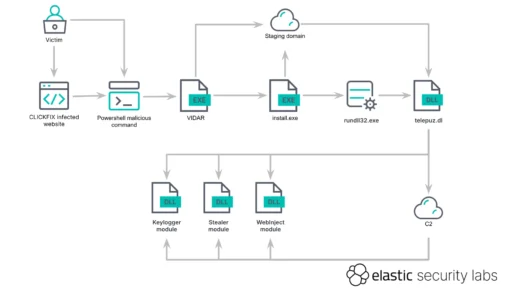
The very choreography of infection is constructed as a multi-tiered labyrinth. Initially, the patron encounters a lure: counterfeit gaming cheats, compromised software, or a portal displaying a fabricated admonition. A ubiquitous stratagem involves an assault via the clipboard. The venomous portal duplicates a PowerShell edict and implores the victim to manually execute it. Upon ignition, the edict summons the subsequent phase via the Background Intelligent Transfer Service—a native Windows mechanism that seldom arouses suspicion.
Following this, a bootloader awakens, exquisitely masquerading as an orthodox installer or update. It unseals supplementary components, layers multiple echelons of cryptography and obfuscation, and gradually unfurls the paramount module within the systemic memory. The venomous code studiously avoids etching the ultimate executable artifact onto the physical disk, electing instead to manifest directly within the volatile Random Access Memory (RAM). Such a paradigm profoundly confounds detection by classical sentinels.
Upon activation, the Torg Grabber ravenously harvests telemetry from a sprawling compendium of sources. The registry encompasses 25 Chromium-based navigators, 8 iterations of Firefox, approximately 850 extensions, alongside Discord, Steam, Telegram, VPN clients, FTP portals, postal emissaries, and cryptocurrency sanctuaries. The program commands the sovereignty to capture optical screengrabs, pillage archives from the desktop and document repositories, and, should the necessity arise, summon and execute supplementary code from the command sovereign.
The architectural paradigm governing its proliferation commands profound intrigue. The identical binary artifact is wielded by a multitude of disparate operators. Operational parameters are transmitted via environmental variables, which are rigidly defined during the epoch of infection. Such a methodology obliterates the necessity of recompiling the venomous program for each individual patron. In essence, this manifests as a consummately realized “Malware-as-a-Service” paradigm, wherein the architect provisions the instrument, whilst operators wield it to fulfill their bespoke imperatives.
The forensic dissection of the binary artifacts illuminated upwards of forty distinct operator identifiers. Amongst these are pseudonyms, compilation epochs, and numerical designations that seamlessly mirror Telegram accounts. Through these identifiers, the administrative nexus routes notifications regarding the harvested bounty. A fraction of these accounts have been inextricably tethered to the Russophone cybercriminal underworld.
The campaign’s overarching infrastructure is similarly compartmentalized by function. Certain domains are tasked exclusively with the delivery of bootloaders, whilst others govern the operations of the command sovereign. Such an architecture profoundly elevates resilience: the decapitation of a solitary segment does not paralyze the entirety of the operation. Servers are provisioned for fleeting epochs, relying upon complimentary certificates, and are subjected to incessant rotation.
Ultimately, the Torg Grabber epitomizes the prevailing trajectory of recent epochs. Malignant software no longer evolves as a solitary instrument, but rather as a holistic service, boasting a blistering cycle of rejuvenation, a profoundly modular architecture, and a sprawling, distributed infrastructure. Within the span of a mere few months, this endeavor traversed the arduous path from a rudimentary Telegram-based prototype to a labyrinthine architecture that seamlessly amalgamates advanced cryptography, the circumvention of browser fortresses, and a profoundly scalable paradigm of proliferation.